Chapter Six
The Mercy Problem
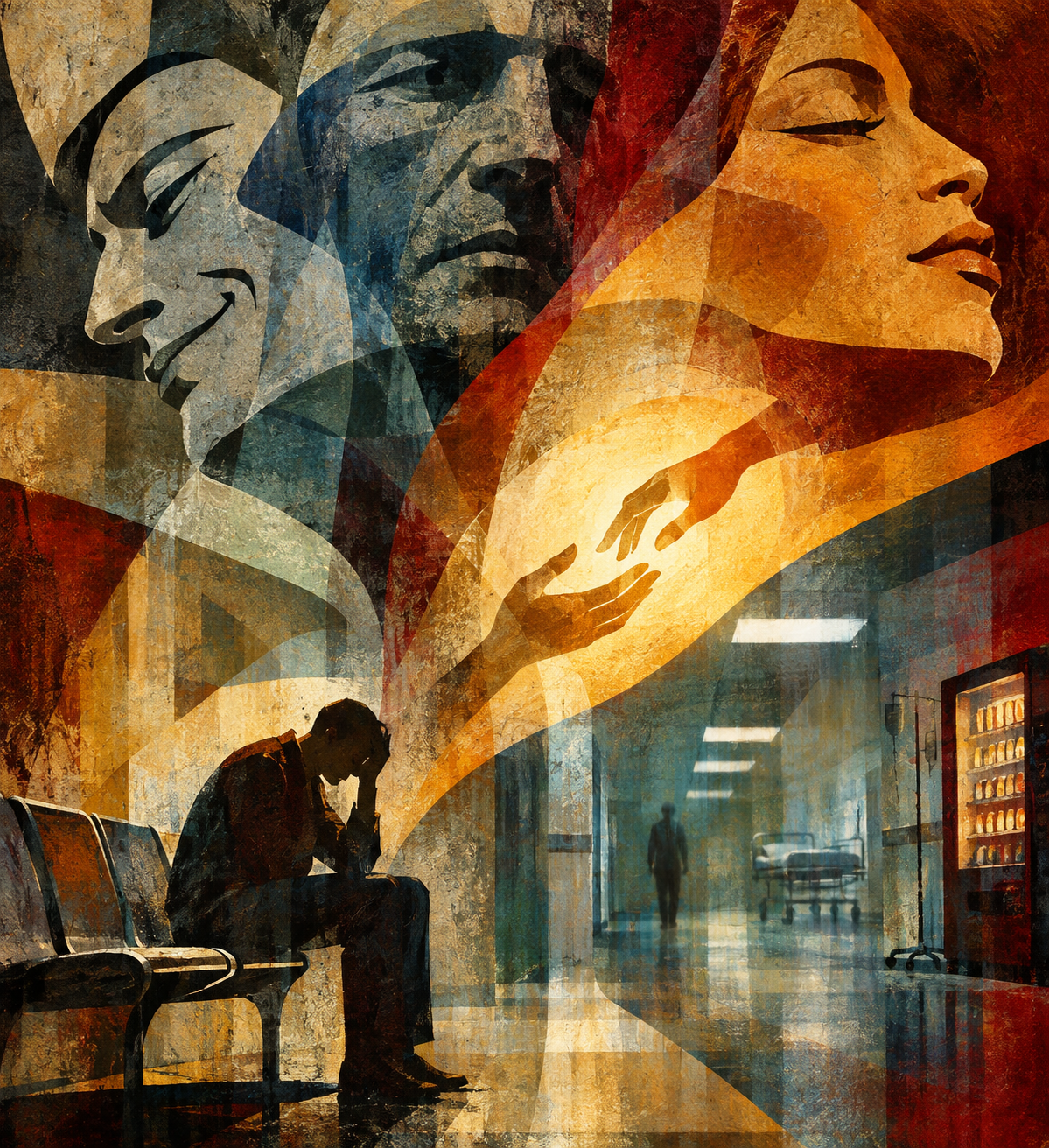
Maya Angelou arrived while Monte was sitting in the emergency room vending area, trying to decide whether a package of peanut butter crackers constituted dinner.
It was 11:38 at night. Gerald was alive. That was all anyone knew. The doctors had stabilized him, which was medical language for he has not died yet and “we would prefer you stop asking questions in the hallway.”
Leah sat with her sponsor in the waiting room. Amanda had gone home after Monte insisted she leave, though “insisted” suggested authority he had not possessed. She had looked at him for a long moment, kissed his cheek and said, “Call me when you know something.”
Not I love you. Not we’re okay. Something.
Monte stood before the vending machine holding three wrinkled dollar bills. The crackers cost two twenty-five. The machine accepted his first dollar, rejected the second and swallowed the third without adding it to the total. Monte pressed the coin-return button.
Nothing happened. He pressed it again. The machine hummed with bureaucratic indifference.
Cleese said: You have been robbed by a cabinet.
Morgan replied: Monte’s anger at the machine was not about the money.
It is always partly about the money.
Monte struck the glass with the heel of his hand. The crackers remained suspended behind spiral metal.
“Give me the crackers.”
The machine had no intention of giving Monte the crackers, Morgan said.
Machines do not have intentions, Cleese replied. That is why they make such excellent managers.
Monte hit the glass again.
“Come on.”
Then a woman’s voice said:
Baby, if you put one more ounce of your sorrow into that vending machine, it is going to begin charging you rent.
Monte froze.
The voice was rich, warm and measured. Not soft. Softness was often confused with weakness by people who had never been struck with a pillow containing a brick. This voice held both tenderness and warning.
It sounded exactly like Maya Angelou.
Cleese groaned. Oh, marvelous. We’ve formed a literary festival.
Morgan said: She had arrived.
Yes, Morgan, we heard her. That is generally how voices work.
Monte stepped away from the vending machine.
“No.”
The new voice laughed. It was not cruel. That somehow made it more unsettling.
You have been saying no to life for forty years, and life has shown very little interest in obeying you.
Monte looked around.
A nurse pushed a wheelchair past the vending alcove without glancing toward him. An elderly man slept in a chair beneath a television broadcasting a cooking competition with the sound muted. No one else had heard.
“Are you Maya Angelou?”
No more than the others are the men whose voices they wear.
Cleese said: Finally. A direct answer.
Morgan replied: It was incomplete.
Every answer is incomplete. We needn’t stamp it on the stationery.
Monte leaned against the vending machine.
“Why do you sound like her?”
The woman’s voice said: Because when a frightened man will not listen to himself, sometimes he will listen to a woman who sounds as if she has survived him.
Cleese laughed. A strong opening.
Morgan said: Monte had needed compassion.
Maya replied: No. He has had compassion circling him for days. What he needs is the courage to receive it without turning it into a debt.
Monte shut his eyes.
“Great.”
It may be, she said. We will see.
“You two know her?”
Morgan answered: Yes.
Cleese said: Know is an ambitious word. We are acquainted by proximity and irritated by principle.
Maya laughed again. John believes irritation is a principle because it sounds better than habit.
And you believe aphorisms become true if you let them breathe between sentences.
Sometimes truth needs room.
Sometimes truth needs an editor.
Morgan said: Both were possible.
Cleese snapped: You are the human equivalent of adding “in a way” to the end of every argument.
Monte held up his hands.
“Stop.”
The three voices fell silent.
Three.
The number was absurd. One voice might be a hallucination. Two voices might be a conflict. Three voices were programming. His mind had become public radio.
“What are you here to do?” Monte asked.
Maya answered: To remind you that being broken open is not the same as being destroyed.
Cleese said: There it is. We’ve been waiting forty seconds for the inspirational poster.
Morgan replied: There was wisdom in it.
There is wisdom in soup. We do not frame soup.
Maya’s tone sharpened. John, your humor is a fine knife, but a man cannot eat with a knife alone.
Cleese was silent.
Monte opened his eyes.
“That shut him up.”
Temporarily, Maya said.
I was allowing the metaphor to expire naturally, Cleese replied.
Monte looked at the vending machine. The peanut butter crackers no longer seemed worth the effort. He retrieved his wallet and counted his remaining cash. Four dollars. The hospital cafeteria had closed at nine. A coffee kiosk stood dark at the end of the corridor.
He sat in a plastic chair.
“Why now?”
Maya answered: Because you are tired enough to stop performing competence.
“I’m not performing.”
Morgan said: Monte had spent the evening walking quickly through corridors so no one would notice he had nowhere useful to go.
Cleese added: He has also asked the same nurse for an update four times, as if repetition might qualify as medical training.
Maya said: And he has not eaten because hunger feels simpler than grief.
Monte stared at the floor. The tiles were beige with dark specks. Hospitals used patterns designed to disguise dirt and sadness.
“I’m not grieving. Gerald is alive.”
Grief does not wait for death, Maya said.
The sentence settled into him. He wanted to object. Across the hallway, Leah sat with her sponsor, a thickset man named Carl who had arrived wearing flannel pajama pants and a leather jacket. Leah’s face was blank. Carl spoke quietly to her.
Morgan said: Leah blamed herself.
Cleese added: Because human beings prefer guilt to helplessness.
Maya replied: Guilt lets us imagine there was a door we failed to open. Helplessness asks us to admit there may have been no door at all.
Monte looked at Leah. She was holding Gerald’s gloves. He had left them in Monte’s apartment. Leah had picked them up before coming to the hospital, as if gloves might become necessary if her father survived.
Or evidence if he did not.
“I should talk to her.”
Morgan said: Yes.
Cleese said: No.
Maya said: Ask yourself whether you wish to comfort her or be forgiven by her.
Monte remained seated. That was the problem with the third voice.
Morgan made his choices meaningful. Cleese made them ridiculous. Maya made them naked.
“I saved him.”
Morgan said: Yes.
Cleese replied: The paramedics saved him. You located him.
Maya said: And now you are trying to collect gratitude before the man has opened his eyes.
“That’s not what I’m doing.”
Then sit still.
Monte sat still. It lasted twenty seconds. He stood.
Cleese said: An inspiring display of discipline.
Monte walked to the restroom. He splashed water on his face. The mirror showed a man who looked older than he had four days earlier.
His eyes were red. His hair stood at uneven angles. There was a coffee stain on his shirt from the Starbucks, though he could not remember spilling coffee. He looked like the person who was called after the competent people had already left.
“What am I supposed to do?”
Morgan answered: Wait.
Cleese said: Leave.
Maya said: Stay without making your presence the center of the room.
Monte gripped the sink.
“Those are three different answers.”
No, Maya replied. They are three parts of one answer.
Cleese groaned. That is cheating.
Morgan said: Wisdom often appeared contradictory before it was lived.
And nonsense often appeared profound before it was diagrammed.
Maya said: John, not every truth arrives with numbered instructions.
That explains religion.
Monte stared at himself.
“Can you tell me whether Gerald survives?”
Morgan said nothing. Cleese said nothing. Maya said: No.
The directness surprised him.
“You don’t know?”
I know many things. That is not one I will give you.
“Then you do know.”
Perhaps.
“Why won’t you tell me?”
Because you have begun treating the future as a narcotic.
Monte looked away from the mirror.
“I’m trying to prepare.”
No. You are trying to experience pain early so you can claim control over its arrival.
Morgan said: Monte often rehearsed loss.
Cleese added: It gives anxiety a clipboard.
Maya continued: But tomorrow’s grief will not become lighter because you dragged it into tonight.
Monte turned off the faucet. The voices had begun collaborating. This was worse than the arguing. He returned to the waiting room.
Leah was alone now. Carl had gone to find coffee. She looked up when Monte approached. He remembered Maya’s instruction. Stay without making your presence the center of the room.
“Can I sit?”
Leah nodded.
He sat two chairs away. Not close enough to demand intimacy. Not far enough to suggest fear. For a while neither spoke. The television above them showed contestants arranging tiny pieces of food with tweezers. Finally Leah said, “He told me.”
Monte turned.
“About the cancer?”
“This afternoon.”
Monte was surprised. Gerald had listened. Not to Monte, perhaps. But he had done the thing.
“He came to my school,” Leah said. “I had kids in the room. He stood in the hallway holding a bag of cookies like some divorced father in a sitcom.”
“Were they good cookies?”
She almost smiled.
“Oatmeal raisin.”
“That feels punitive.”
“He likes them.”
“That’s worse.”
Leah looked down at the gloves.
“He told me the cancer was back. Then he said he had to go to a meeting.”
“Did he say anything else?”
“He said he was scared.”
Monte waited.
“I got angry,” she continued. “Can you believe that?”
“Yes.”
“I started asking questions. Treatment. Doctors. Timing. I turned it into logistics.”
“That’s what people do.”
“I told him he should have told me sooner.”
“You weren’t wrong.”
“He apologized.”
Leah rubbed the leather between her fingers.
“Then I went back to class.”
“You had students.”
“I could have left.”
“You didn’t know what he was going to do.”
“He told me he was scared.”
Maya said: Do not rescue her from the truth.
Monte almost responded. Instead he stayed quiet. Leah looked at him.
“Say something.”
“I don’t know what to say.”
“You knew where he was.”
“Yes.”
“You knew he had taken pills.”
“Yes.”
“Did you know he was going to?”
Monte felt all three voices waiting.
“No.”
This was true. Or true enough. Leah’s face tightened.
“Could you have?”
“I don’t know.”
“That’s not an answer.”
“It’s the only honest one.”
She looked away. Monte could tell her the voices had admitted knowing it was possible. He could tell her they had withheld information. He could make them responsible. That version of the story would let Leah hate something larger than herself. It would also let Monte escape her anger.
Maya said: Do not hand her a villain merely because blame is easier to carry than sorrow.
Monte swallowed.
“I could have called you after your father came to see me.”
Leah turned back.
“Why didn’t you?”
“He asked me not to.”
“He was suicidal.”
“I didn’t know that.”
“You knew he was sick.”
“Yes.”
“You knew he almost drank.”
“Yes.”
“And you let him leave.”
The words struck.
Morgan said: Monte had not known.
Cleese replied: He had known enough to worry.
Maya said: And not enough to imprison a grown man inside his concern.
Monte took a breath.
“I made the best decision I could with what I knew.”
Leah laughed bitterly.
“Is that what you tell yourself?”
“No.”
He looked at her.
“I tell myself I failed him.”
Her expression shifted.
“But that isn’t completely true either.”
She stared.
“I helped him once. I missed something later. Both happened.”
Leah’s eyes filled.
“I missed it too.”
“Yes.”
The word seemed cruel.
Maya said: Let her have the truth without punishment.
Monte continued.
“You missed it. That doesn’t mean you caused it.”
Leah covered her face. Her shoulders shook. Monte remained in his chair. He did not touch her. He did not tell her everything would be okay. He did not say Gerald would survive. He did not promise a future the voices refused to provide. He stayed.
After a moment, Leah reached across the empty chair and took his hand. Monte held hers.
Morgan said: Compassion did not require an answer.
Cleese added: Good, because he hasn’t got one.
Maya said: Sometimes the hand is the answer.
Cleese remained silent. Monte noticed. Maya did not mock him. That seemed significant.
A doctor appeared at the end of the hallway. Leah stood so quickly the gloves fell. The doctor approached. She was young, perhaps thirty, with fatigue arranged carefully behind professionalism.
“Ms. Collins?”
“Yes.”
“I’m Dr. Reyes.”
Leah gripped Monte’s hand. The doctor looked at him.
“I’m a friend,” Monte said.
The word felt strange. He had known Gerald less than a day. But time had become an unreliable measurement. Dr. Reyes nodded.
“Your father is stable.”
Leah exhaled.
Monte felt his knees weaken.
“He’s breathing on his own. We’ve given medication to reverse the sedative effects, and we’re monitoring his heart rate and oxygen.”
“Will he be okay?” Leah asked.
“We’re encouraged.”
Not yes. Encouraged. A word designed to hold hope without creating liability.
“Can I see him?”
“Briefly.”
Leah picked up the gloves. She turned to Monte.
“Come with me.”
He hesitated.
Maya said: Go.
Morgan said: Yes.
Cleese said: Try not to make a speech.
Monte followed.
Gerald lay in a curtained bay surrounded by machines. Tubes entered his arm. A monitor displayed green lines and numbers. His skin looked gray beneath the fluorescent light. Leah went to his bedside.
“Dad?”
Gerald’s eyelids moved. She took his hand.
“I’m here.”
His lips parted. No sound came. Monte remained near the curtain. Not family. Not exactly friend. The man who had found him because voices inside his head supplied an address.
Gerald opened his eyes. They moved slowly toward Leah. Then toward Monte.
“You,” he whispered.
Monte stepped closer.
“Me.”
Gerald tried to smile. It appeared painful.
“You asked,” Monte said.
Gerald frowned.
“What?”
“You asked how long you had.”
Leah looked at Monte. Gerald’s eyes closed. Monte immediately regretted speaking.
Cleese said: And there it is. Speech.
Maya said: Do not punish him. Help him.
Monte took Gerald’s other hand.
“The voices wouldn’t tell me.”
Gerald’s eyes opened again.
“Good,” he whispered.
Monte leaned closer.
“Why good?”
Gerald swallowed.
“Would’ve ruined the surprise.”
A laugh escaped Monte. Leah began crying again, but she was smiling. Even Cleese laughed.
Morgan said: Gerald had returned from the edge with a joke.
Maya replied: Sometimes laughter is not an escape from death. Sometimes it is how we tell death it has not yet won.
Cleese said: That was almost intolerably good.
Thank you, John.
I said almost.
Gerald looked between Leah and Monte.
“Sorry,” he whispered.
Leah shook her head.
“Not now.”
“I—”
“Not now.”
She pressed his hand against her cheek.
“You can apologize when you’re strong enough for me to yell at you.”
Gerald closed his eyes.
“Deal.”
The nurse asked them to leave.
In the hallway, Leah hugged Monte. It was sudden and fierce. He held her.
“Thank you,” she said.
This time he did not reject the gratitude. He also did not enlarge it.
“You’re welcome.”
When she released him, she returned to Gerald’s bedside. Monte walked back toward the vending machines. His body felt hollow. The hospital seemed quieter. He sat in the same plastic chair.
“Why did you come?” he asked Maya.
She answered: Because those two have taught you how complicated truth is.
Morgan said: Truth carried responsibility.
Cleese added: And contradiction.
Maya continued: But neither has taught you what to do when truth is not enough.
Monte leaned back.
“And you will?”
No.
Cleese said: Excellent. Another instructor who refuses the syllabus.
Maya ignored him.
I will remind you that wisdom without mercy becomes cruelty with excellent grammar.
Monte considered the words. The voices had shown him hidden wounds, selfish motives, lies, contradictions and consequences. They had shown him that facts were incomplete. That certainty could become vanity. That helping could become control.
But mercy was different.
Mercy did not require innocence. It did not require agreement. It did not even require ignorance. Mercy was what remained after you knew the worst thing and refused to reduce the person to it. The thought did not arrive in any of the voices.
It was his.
Maya said: There you are.
Monte sat forward.
“What?”
Your own voice.
For a moment, Monte’s mind was quiet.
Then Cleese spoke. It could use editing.
Monte smiled.
Morgan said: But it was his.
Maya replied: And that is where we begin.
Monte’s phone buzzed. Amanda.
How is Gerald?
He typed:
Alive. Stable. Leah is with him.
He hesitated.
Then added:
I’m sorry I pushed you away. I was afraid and turned fear into authority again. You didn’t deserve that.
A few minutes later, Amanda replied.
Thank you. Get some food. Call me when you leave.
Not forgiveness. Not rejection. Care without surrender. Mercy with boundaries.
Monte looked toward the vending machine.
“Fine.”
He stood and inserted his final dollar. The machine accepted it. He selected the peanut butter crackers. The spiral turned. The package moved forward. Then stopped at the edge without falling. Monte stared through the glass.
Cleese inhaled sharply. Do not touch that machine.
Morgan said: Monte’s patience had been tested.
Maya said: Baby, break the glass.
Monte laughed so loudly the elderly man beneath the television woke up. He struck the side of the vending machine with both hands. The crackers fell. So did a package of powdered donuts and two bags of pretzels. Monte reached into the tray.
“Was that a miracle?”
Morgan said: Perhaps.
Cleese said: It was theft.
Maya said: It was dinner.
Monte sat beneath the hospital lights and ate all three.