Chapter Two
The Scientific Method
Monte did not sleep. This was not unusual. He had reached the age when sleep was no longer an automatic biological function but a negotiation conducted nightly between caffeine, regret, lower-back discomfort, and the bladder.
What was unusual was the presence of Morgan Freeman.
The voice did not speak constantly. That would have been easier. A constant voice could be classified as noise. Noise could be drowned out with music, alcohol, or a box fan purchased at Walgreens.
Instead, the voice practiced restraint.
It waited.
It allowed silence to grow comfortable, then stepped into it with the precise timing of a man who knew the pause was doing half the work.
At 12:14, Monte lay in bed staring at the ceiling. Amanda had left twenty-seven minutes earlier. The conversation they had been supposed to have had not occurred.
They had eaten Thai Spoon at his kitchen counter. She had asked about his day. He had said it was weird. She had said hers was weird, too. Neither had elaborated because adulthood was largely the art of recognizing an open door and walking into the wall beside it.
They drank Two Buck Chuck (which was no longer two bucks), discussed her job. They discussed his store. They discussed a mutual friend’s engagement with the cautious enthusiasm of two people who suspected marriage was a franchise opportunity with catastrophic overhead.
Then they had sex.
Afterward, Amanda lay with her head on his chest while Monte stared at the ceiling and attempted to identify the correct moment to say something permanent. The moment did not identify itself.
Eventually Amanda said, “I should go.”
Monte said, “You can stay.”
She said, “I have an early morning.”
He said, “Right.”
At the door, she kissed him and said, “We still need to talk.”
Monte said, “Yeah.”
She said, “Soon.”
He said, “Definitely.”
Now Monte was alone.
Monte had spent the evening preparing to be abandoned and was disappointed when Amanda failed to do it properly.
He closed his eyes.
“Not tonight.”
Silence.
“I mean it.”
Nothing.
Monte pulled the comforter over his head.
As a child, Monte believed blankets protected him from monsters.
“Jesus Christ.”
As an adult, he simply purchased more expensive blankets.
Monte threw the covers off and sat up.
“All right.”
The room was dark except for the amber glow of a streetlamp coming through the blinds. His clothes lay in a pile beside the bed. Amanda’s wineglass (which was actually a mason jar) remained on the nightstand.
“Let’s settle this.”
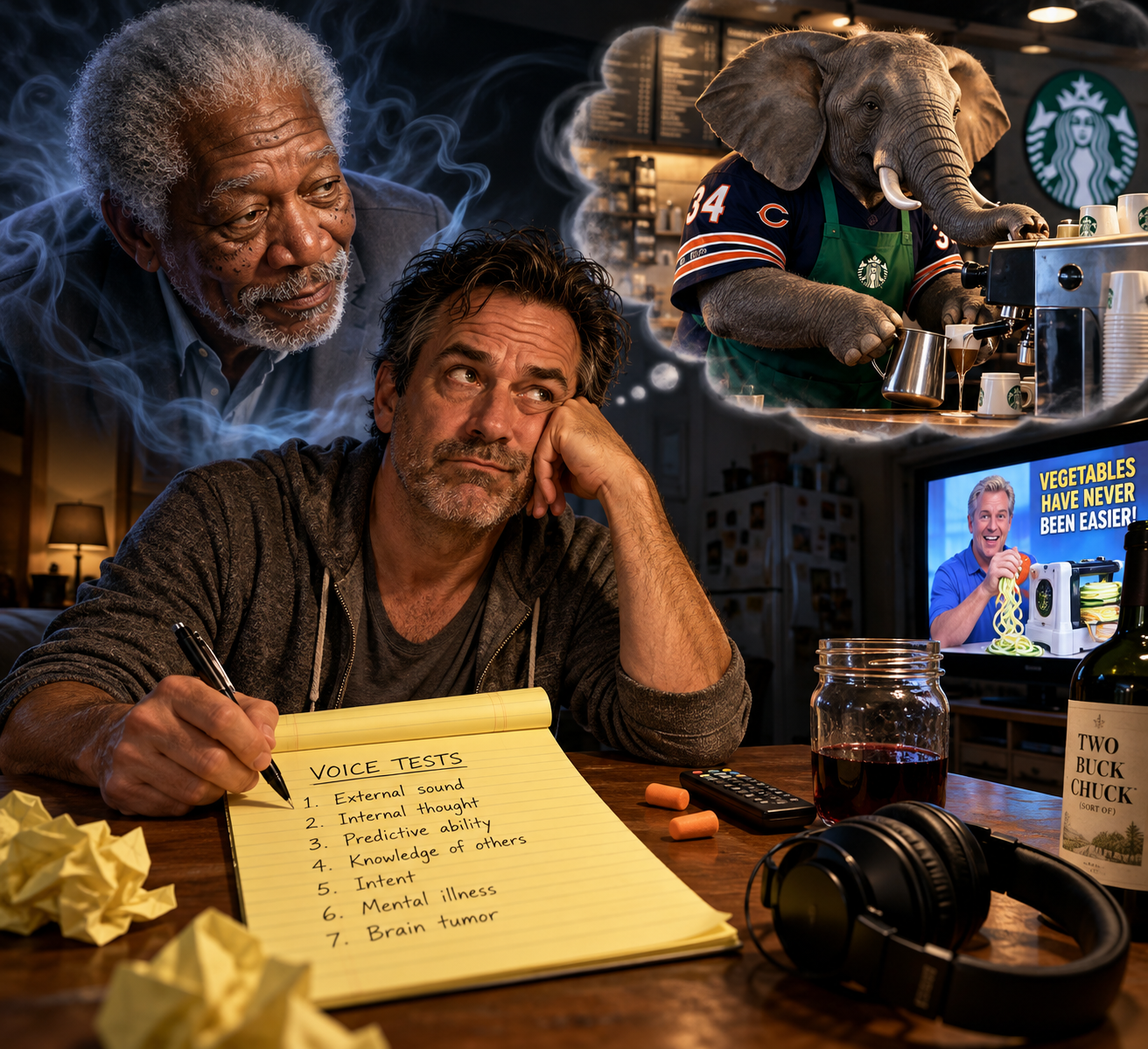
He put on sweatpants and walked into the kitchen, where he turned on every light as if illumination carried legal authority. He opened a drawer and took out a yellow legal pad. Monte had always trusted legal pads. They belonged to lawyers, journalists, and detectives in movies—the sort of people who possessed theories and wore jackets with useful inside pockets.
He wrote:
VOICE TESTS
Then beneath it:
External sound
Internal thought
Predictive ability
Knowledge of others
Intent
Mental illness
He stared at number six.
Then added:
Brain tumor
He looked toward the ceiling.
“You want to say something?”
Nothing.
“Fine.”
Monte drew a line beneath the list. He began with external sound. He turned on the television. A late-night infomercial featured an intense blonde man demonstrating a kitchen device capable of transforming a zucchini into a ribbon. Monte increased the volume. The blonde man shouted that vegetables had never been easier.
“You still there?”
Yes.
Monte muted the television.
He wrote:
Audible regardless of ambient sound.
Then he reconsidered. He had not technically tested ambient sound. He had tested a blonde man slicing zucchini. Monte went into the bathroom and turned on the shower, the sink faucet and the exhaust fan. He flushed the toilet for additional rigor.
“You still there?”
Yes.
He wrote:
Unaffected by water pressure or bathroom fan.
He found an old pair of foam earplugs in the medicine cabinet, rolled them between his fingers and inserted them. The world softened. He clapped his hands. Barely audible.
“You still there?”
Monte believed blocking his ears might prevent him from hearing a voice located inside his own consciousness.
He removed the earplugs.
“That’s not an answer.”
Yes.
Monte wrote:
Earplugs ineffective. Voice smug.
Next came music. He placed headphones over the earplugs and played Led Zeppelin at a volume that would have alarmed both an audiologist and Jimmy Page.
“Still there?”
Yes.
He increased the volume. Robert Plant screamed about communication breakdowns.
“Still?”
Yes.
Monte pulled the headphones off.
He wrote:
Headphones ineffective. Possible permanent damage.
The next test was more complicated.
“If you’re inside my head, can you hear my thoughts?”
Silence.
Monte thought the word elephant.
Nothing.
He thought it again, louder, which was a meaningless concept but felt necessary.
ELEPHANT.
Still nothing.
He imagined an elephant wearing a Bears jersey, standing behind the counter at Starbucks and attempting to operate the espresso machine.
Nothing. Monte smiled. “Can’t read thoughts.”
Monte was thinking about an elephant.
His smile disappeared.
“What kind?”
No response.
“What was it wearing?”
Silence.
“Was it behind a counter?”
Monte wrote:
Can read broad thoughts, possibly not detail. May be withholding.
He paused.
“Why would you withhold information?”
Because information and understanding are not the same thing.
Monte wrote:
Pretentious.
He needed stronger tests. At 1:03 in the morning, Monte assembled five objects on the kitchen counter: a spoon, a paperback copy of Slaughterhouse-Five, a bottle cap, a chess piece, and one of Amanda’s earrings. He closed his eyes and moved the objects around. Then he placed one beneath an overturned cereal bowl.
“Which object is under the bowl?”
No answer.
“Come on.”
Silence.
“You know intimate details about my relationships but not what’s under a bowl?”
Monte lifted the bowl. The chess piece sat beneath it. A black knight.
Monte had selected the knight because he preferred the illusion of unpredictability.
Monte stared at it.
“You knew.”
Yes.
“Why didn’t you answer?”
Because Monte already knew.
“That is not how a test works.”
Monte placed the objects inside a paper grocery bag, shook them and reached in without looking. His fingers closed around something.
“What am I holding?”
Nothing. He removed the object. Amanda’s earring.
Monte had kept the earring for three months without telling Amanda he had found it.
“It was in the bathroom.”
It had been on the floor beside his bed.
“I meant to give it back.”
Monte had enjoyed possessing evidence that Amanda belonged there.
Monte dropped the earring.
“That is incredibly creepy.”
Yes.
“I meant you.”
So did I.
He wrote:
Voice can identify concealed objects but refuses to cooperate. Also morally judgmental about jewelry.
The predictive test presented greater possibilities. Monte tore a clean page from the legal pad.
“Tell me something I’m going to do.”
In twelve seconds, Monte will touch his face.
Monte placed both hands flat on the counter.
“No, I won’t.”
He began counting. At five seconds, his nose itched. He ignored it. At eight seconds, the itch intensified. At ten, his entire face seemed to erupt with microscopic insects. At twelve, Monte kept his hands on the counter.
“There.”
He waited. The itch remained.
“I didn’t touch my face.”
No.
“You were wrong.”
Yes.
Monte felt a surge of relief so powerful it bordered on joy. The voice could be wrong. Whatever it was—hallucination, demon, neurological event—it was not omniscient. He had found a limit. He picked up the pen.
Monte would now touch his face because he believed the experiment had ended.
Monte scratched his nose. Then froze. The voice chuckled. Not a loud laugh. Not even an actual laugh. A small, warm exhalation of amusement.
Morgan Freeman had laughed at him.
“You cheated.”
No.
“You said twelve seconds.”
And Monte did not touch his face in twelve seconds.
“So you were wrong.”
Yes.
“But you knew I’d do it afterward.”
Yes.
“That’s cheating.”
Monte had spent most of his life changing the rules whenever reality threatened his preferred conclusion.
Monte pointed the pen at the empty kitchen.
“You’re an asshole.”
That possibility had not been eliminated.
Monte wrote:
Prediction may influence behavior. Observer effect. Voice enjoys technicalities.
He conducted seventeen more tests.
He asked what he would eat for breakfast. The voice said nothing. Monte decided he would eat eggs. Then deliberately ate cereal. The voice observed that Monte had eaten cereal because he believed contradiction constituted freedom.
Monte asked which employee would arrive late. The voice said Leon. Leon arrived seven minutes early and spent nine minutes in the bathroom before clocking in. Monte considered this both a victory and a draw.
He asked how many customers would order pumpkin spice lattes before noon. The voice said fourteen. Monte counted thirteen.
At 11:58, an elderly man ordered one for his wife, who was waiting in the car.
Monte asked whether the Cubs would win the World Series. The voice remained silent.
“Everybody has limits,” Monte said.
By the end of the morning, his legal pad contained four pages of data, most of it useless.
Can predict some immediate actions.
Will not predict major events.
Knows private history of strangers.
Cannot or will not explain source.
Responds selectively.
May be Morgan Freeman. Unclear whether actual Morgan Freeman is involved.
That final possibility required investigation.
During his lunch break, Monte went into the back room and searched for Morgan Freeman’s agent. The internet produced several names, none of which appeared likely to answer questions from a Starbucks manager concerning telepathic narration.
He searched:
Morgan Freeman voice hallucination
The results included fan forums, dream interpretations, and a video titled “Morgan Freeman Reads the Lyrics to WAP,” which Monte avoided on spiritual grounds.
He tried:
Hearing famous actor narrate life mental illness
This produced links about auditory hallucinations, schizophrenia, bipolar disorder, neurological conditions, medication side effects, and tumors.
Monte sat very still. The store noises drifted through the door: grinders, milk steamers, voices, laughter.
Brain tumor.
He had written the words casually because fear often disguised itself as clerical work. He clicked a medical website. Auditory hallucinations could be caused by sleep deprivation, extreme stress, substance use, epilepsy, brain lesions, and psychosis.
Monte read the word psychosis three times.
He had no history of mental illness, at least none requiring a diagnosis. He had periods of depression, but he considered depression less an illness than an accurate response to winter. He drank, but not impressively. He smoked marijuana perhaps twice a month, usually with Amanda, and had not used enough to hear a single voice, let alone one with an Academy Award.
His mother had become forgetful in recent years, though she was in her seventies and believed passwords were a government conspiracy. His father had spent the last decade of his life watching cable news and shouting at the television, which was not technically schizophrenia.
Monte closed the browser.
Monte wanted reassurance.
He stared at the wall.
“You know whether I have a tumor.”
Silence.
“Don’t do that.”
Nothing.
“Tell me.”
No answer.
Monte stood.
“If this is medical, I need to know.”
Yes.
“Then tell me.”
No.
“Why?”
Because Monte would believe the answer only if it frightened him.
“That doesn’t make sense.”
Reassurance had rarely survived contact with Monte’s imagination.
Monte picked up the legal pad and threw it against the wall. It struck a shelf and knocked over a box of filters. Sadie opened the door immediately.
“What happened?”
“Nothing.”
She looked at the filters scattered across the floor.
“Did nothing throw the notebook?”
“I dropped it.”
“You dropped it horizontally?”
Monte knelt and began picking up filters. Sadie closed the door behind her.
“You’re acting strange.”
“I told you, I didn’t sleep.”
“You talked to the ceiling yesterday.”
“There could have been a leak.”
“There wasn’t.”
“I know that now.”
“You yelled at lids.”
“I was frustrated.”
“You just threw office supplies.”
“They’re coffee filters.”
“That is not the reassuring distinction you think it is.”
Monte stood. Sadie watched him with the concerned impatience of someone deciding whether a person needed kindness or restraint.
“Are you using something?” she asked.
“No.”
“Are you sick?”
“I don’t know.”
Her expression softened.
“What does that mean?”
Monte looked at her. He could tell her. The thought arrived with almost physical force. Sadie was smart. She was stable. She had known him for three years. If he told her the truth and she believed him, he would no longer be alone. If she did not believe him, she might call the district manager. Or an ambulance. Or both, in whichever order protected corporate liability.
“I’m just tired,” he said.
Sadie folded her arms.
“Take the rest of the day.”
“I’m fine.”
“That wasn’t a suggestion.”
“I’m the manager.”
“And I’m the person standing closest to you while you have what looks like a nervous breakdown.”
“I am not having a nervous breakdown.”
Monte associated nervous breakdowns with screaming, weeping and dramatic collapse.
Monte shut his eyes. Sadie tilted her head.
“What?”
“Nothing.”
He did not understand that some breakdowns looked exactly like a man insisting he was fine while surrounded by scattered coffee filters.
“Okay,” he said. “I’ll go.”
“Good.”
“I’ll be back tomorrow.”
“We’ll see.”
“What does that mean?”
“It means go home.”
Monte collected his coat and legal pad. On his way out, Leon handed him a drink.
“What’s this?”
“Tea.”
“I didn’t order tea.”
“It’s chamomile.”
“Why?”
Leon shrugged.
“You seem like you need to calm the fuck down.”
Monte took the cup.
“Thank you.”
“You’re welcome.”
Leon had paid for the tea himself.
Leon was already restocking cups. Something tightened in Monte’s throat.
“Why’d you tell me that?”
The afternoon was bright and cold. Sunlight reflected off dirty snow and glass buildings with the sterile beauty of a knife. Monte walked south on Clark with no destination. He passed the Swedish bakery, the pawn shop, the Middle Eastern grocery, and a bar that would open in three hours for men who considered daylight a technicality.
The city felt louder than usual. Without narration, every sound became suspicious.
A car horn. A siren. A woman laughing into her phone. The click of a traffic signal.
Monte stopped outside a Walgreens. He needed a doctor. That was the adult response.
Not tests. Not legal pads. Not internet searches conducted in the back room of a coffee shop.
A doctor.
He entered the store and wandered to the pharmacy, where a line of customers stood beneath fluorescent lights, each holding some form of private catastrophe. An old man clutched a paper prescription. A mother held a coughing child. A young woman stared at the floor while hugging a brown paper bag to her chest.
Monte imagined approaching the counter.
“Hello, I hear Morgan Freeman narrating my life.”
He imagined the pharmacist’s expression, the forms, a hospital room, Amanda receiving a call, and his mother hearing that her son had become mentally ill in Chicago because this was exactly the kind of thing mothers believed happened in Chicago.
Monte left without speaking to anyone.
Monte had gone to the pharmacy seeking medical help.
“I know.”
He had purchased gum.
Monte looked at the package in his hand. He did not remember picking it up.
“You don’t have to narrate everything.”
I don’t.
That stopped him.
“What aren’t you narrating?”
Silence.
Monte stood on the sidewalk while pedestrians moved around him.
“What aren’t you telling me?”
Nothing.
The question followed him home. By five o’clock, he had developed a new test. Not a test of knowledge but one of intent. If, in fact, the voice knew everything—or enough to be dangerous—then it might be possible to manipulate it by creating stakes.
Monte placed a kitchen knife on the table.
“This is stupid,” he said.
No response.
“I’m not going to hurt myself.”
Nothing.
“I want to know whether you’ll stop me.”
The voice remained silent. Monte reached for the knife.
Monte did not want to die.
He withdrew his hand.
“That’s not the point.”
He wanted proof that something cared whether he lived.
The room seemed suddenly very small.
“That’s not true.”
No answer.
“I’m testing you.”
Yes.
“I’m not suicidal.”
No.
“Then stop making it sound dramatic.”
Silence.
Monte pushed back from the table. The experiment had turned on him. That was becoming a pattern.
He put the knife away. Then he took the Maker’s Mark from the counter and poured three fingers into a glass.
Monte believed alcohol made difficult truths more manageable.
He drank.
In reality, it simply made him less qualified to manage them.
He poured another.
By seven, Monte was drunk enough to become philosophical and sober enough to believe the philosophy was original. He sat on the floor with his back against the couch. A Bruce Springsteen record played softly from speakers he had purchased during a brief period when he believed vinyl would restore ceremony to his life.
“Maybe you’re my subconscious.”
No response.
“Maybe you’re the part of my brain that knows things before I know them.”
Nothing.
“Like intuition.”
Silence.
“Except you know things about other people.”
He drank.
“Unless I already knew them.”
The record crackled.
“Maybe I saw Stella’s tattoo. Maybe I heard something years ago and forgot it. Maybe Cynthia’s ring and her face and the foam thing all added up.”
The voice said nothing.
Monte smiled.
“There. That’s possible.”
Yes.
He sat forward.
“You agree?”
It is possible.
Relief moved through him. A psychological explanation. Strange, yes. Frightening, certainly. But human.
He had observed details unconsciously. His mind had assembled them and presented the conclusions using Morgan Freeman’s voice because Morgan Freeman represented wisdom, calm and moral authority. There were worse things to discover about yourself.
“Why Morgan Freeman?”
Monte did not trust his own voice.
The relief disappeared. Monte looked at the glass.
“That was unnecessary.”
Yes.
His phone buzzed.
Amanda.
Can I come by?
Monte stared at the message.
It was 7:16.
He typed:
Sure.
Then deleted it.
He looked around the apartment.
The legal pad lay open on the table. The knife was visible through the transparent block on the counter. Two glasses sat beside the bourbon though only one person had been drinking. The room looked like a crime scene arranged by an unimaginative production designer.
He typed:
Tonight’s not great. Tomorrow?
Before sending it, he stopped.
Monte wanted Amanda to come.
He deleted the message.
Typed:
Come over.
Sent.
Amanda arrived twenty-two minutes later.
She wore jeans, boots and the green wool coat Monte liked. Her hair was pulled back. She carried a grocery bag.
“I brought soup.”
“Why?”
“You said your day was weird.”
“That means soup?”
“It means you didn’t ask me to bring wine.”
She stepped inside and kissed him. Then she smelled the air.
“You’ve been drinking.”
“A little.”
She looked at the bottle.
“That bottle was half-full yesterday.”
“It’s still technically half-full.”
“No, it isn’t.”
She took off her coat.
Amanda was beautiful in ways that annoyed conventional language. Not breathtaking. Not radiant. Not any of the other adjectives used by men who had never watched a beautiful woman search beneath couch cushions for a missing sock. She was sharp and warm and alive. Her face contained every thought slightly before she chose to reveal it.
At that moment, her face contained concern.
“What’s going on?”
Monte looked toward the ceiling.
Monte considered telling Amanda the truth.
He flinched.
Amanda noticed.
“What?”
“Nothing.”
“You keep saying that.”
“Apparently.”
She set the grocery bag on the counter.
Inside were containers of chicken soup, a loaf of bread and two oranges.
“Sit down,” she said.
“I’m not sick.”
“Humor me.”
They sat at the table. Amanda reached across and took his hand. Monte looked at their hands. Her fingernails were painted dark red. His were bitten and uneven. There was a small burn on his thumb from the espresso machine.
“Talk to me,” she said.
The voice remained silent.
This was worse. Monte wanted it to interrupt. He wanted a criticism, an observation, some ruthless sentence that would tell him what he was avoiding. Instead, the decision belonged entirely to him.
“I’ve been hearing something,” he said.
Amanda’s fingers tightened.
“What?”
“A voice.”
She did not pull away.
That frightened him more than if she had.
“What kind of voice?”
“A person talking.”
“To you?”
“About me.”
Amanda studied his face.
“How long?”
“Since yesterday.”
“Is it happening now?”
Monte waited.
Nothing.
“No.”
“What does it say?”
He laughed.
“It narrates.”
“Narrates what?”
“Everything. What I’m doing. What I’m not doing. Why I’m doing it.”
Amanda’s eyes remained steady.
“Do you recognize the voice?”
Monte hesitated.
This was the detail that would destroy his credibility.
“Morgan Freeman.”
Amanda blinked.
“Like the actor?”
“Yes.”
“The actual actor?”
“I don’t know. It sounds exactly like him.”
Amanda sat back. Monte waited for disbelief. For laughter. For fear.
She did none of those things.
“Have you slept?”
“Not really.”
“Any drugs?”
“No.”
“Anything new? Medication? Supplements?”
“I take a multivitamin.”
“You’ve taken the same bottle for three years.”
“There are still some left.”
“That isn’t how vitamins work.”
“I know.”
“Do you have a headache?”
“No.”
“Vision problems?”
“No.”
“Did you hit your head?”
“No.”
She took out her phone.
“What are you doing?”
“Finding an urgent care.”
“No.”
“Monte.”
“I am not walking into urgent care and telling a twenty-six-year-old physician’s assistant that Morgan Freeman lives in my skull.”
“Then leave his name out.”
“That feels dishonest.”
She looked at him.
“You’re worried they’ll think you’re crazy.”
“Yes.”
“I’m worried you might have a neurological problem.”
The words landed harder spoken aloud.
Amanda softened.
“We need to rule things out.”
“We?”
“Yes, we.”
Monte looked at her.
Amanda was frightened.
He swallowed. The voice had returned quietly, without grandeur.
She was also staying.
Monte squeezed her hand. Amanda looked down at their hands, then back at him.
“What?”
“Nothing.”
She gave him a tired half-smile.
“You really need a new word.”
Monte took a breath.
“The voice says you’re scared.”
Amanda’s smile vanished.
“Can it hear me?”
“I don’t know.”
“Can it see me?”
“It says no.”
“It says?”
“Yes.”
Amanda looked around the room. This should have been absurd. Instead, the apartment felt occupied.
“What else does it say about me?”
Monte thought of the lake.
Amanda loved Monte.
Monte loved Amanda.
Neither possessed enough courage to inconvenience the other with that information.
He looked away.
“Nothing useful.”
Monte lied.
Amanda’s eyes moved to his face.
“Did it just say something?”
“Yes.”
“What?”
“That I lied.”
She leaned back.
“Did you?”
Monte did not answer. Amanda released his hand. The movement was small, but Monte felt it like a door closing.
“What did it say about me?”
“It said you loved me.”
The room became very quiet. Amanda stared at him. Monte felt the bourbon in his stomach, the pulse in his neck, the pressure of every moment they had declined to define.
“And?” she asked.
“And what?”
“What did it say about you?”
Monte looked at the table.
“It said I loved you.”
Amanda inhaled slowly.
“Do you?”
The voice did not answer. Monte wanted it to. He begged it silently.
Tell me.
Not whether he loved her. He knew that now. Tell me what would happen if he admitted it. Tell me whether she would leave. Tell me whether the whole thing would collapse under the weight of being named.
Nothing.
Amanda waited. Monte looked at her.
“Yes,” he said.
The word did not sound like Morgan Freeman.
It sounded smaller.
Less certain.
Entirely his.
“Yes,” he said again. “I do.”
Amanda closed her eyes. For one terrible second, Monte believed she was preparing to cry. Then she laughed. Not cruelly. Not happily. The exhausted laugh of someone who had carried a heavy object alone and just discovered another person had been standing nearby the entire time.
“You asshole,” she said.
“I know.”
“I have been waiting for you to say that for months.”
“I know.”
“No, you don’t.”
“I know now.”
Amanda covered her face with both hands. Monte sat motionless. Finally, she lowered them.
“I love you too.”
The sentence changed the room. Nothing moved. The refrigerator still hummed. The radiator still knocked. A siren passed somewhere on Clark Street. But the room had changed because two people had finally said what had already been true.
Monte waited for the narrator to explain the deeper meaning. The voice remained silent. Amanda stood and came around the table. Monte rose. She put her arms around him, and he held her.
For several moments, nothing happened. Nothing needed to.
Then Amanda whispered against his chest, “We’re still going to urgent care.”
Monte laughed.
“Tomorrow.”
“Tonight.”
“Tomorrow morning.”
“Eight o’clock.”
“Nine.”
“Eight-thirty.”
“Fine.”
They held each other.
Monte believed this was the moment his life began to improve.
Amanda felt him tense.
“What did it say?”
Monte stared over her shoulder at the dark window.
“Nothing important.”
He was wrong.
Monte pulled back. Amanda looked at him.
“What?”
The voice spoke slowly. Not amused now. Not judgmental. Almost kind.
At 8:43 tomorrow morning, Monte would discover that the voice had never been speaking only to him.
Monte looked at the clock.
8:43.
Exactly twelve hours away.
“What does that mean?” he asked.
Amanda’s face tightened.
“What does what mean?”
The voice offered no answer. Monte stepped away from her.
“Who else can hear you?”
Silence.
“Who else?”
Amanda reached for him.
“Monte?”
He barely heard her.
Millions of people moved through Chicago at that moment—sleeping, fighting, eating, driving, fucking, lying, praying, stealing, dreaming, waiting for trains, staring at phones, sitting beside hospital beds and standing alone in kitchens holding unopened packages of food. Monte imagined a voice beside each of them.
Not the same voice.
Maybe not even a voice they could hear.
A narration beneath the life.
A truth below the story.
He looked at Amanda.
“What happens at eight forty-three?”
The answer came after a long silence.
Something Monte will be unable to explain.
“More unexplainable than this?”
Yes.
Monte laughed once. The sound held no humor. Amanda took his hand again. This time, he held on.
For the first time since the voice had begun, Monte was not afraid of what it knew.
Monte stared at the clock.
He was afraid of what it intended to show him.