THE WITNESSES: Chapter One
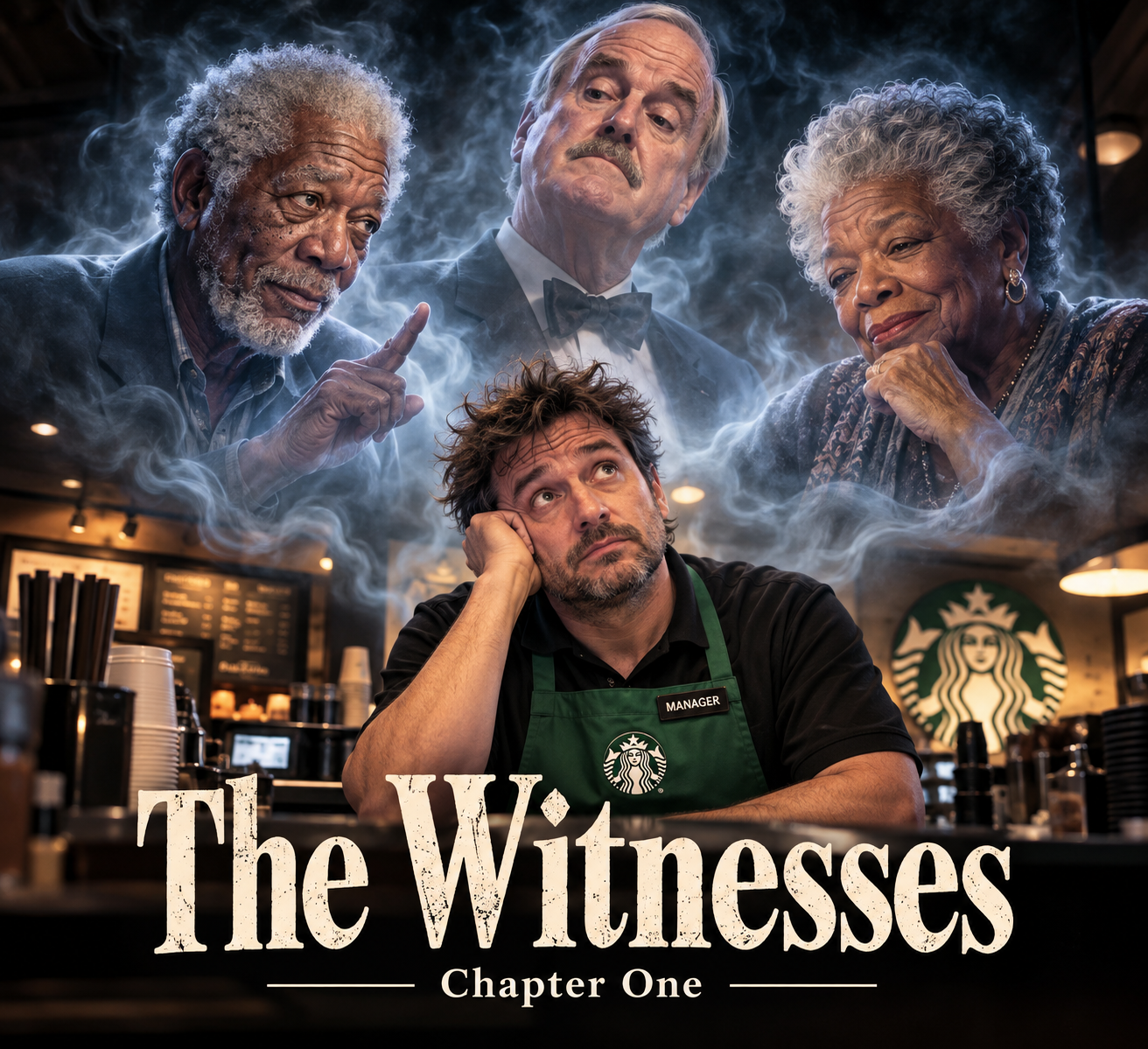
Chapter One
In Which Nothing Happens
The voice began on a Tuesday morning while Monte Walsh was standing in his kitchen, holding an unopened package of bacon over the garbage can.
For the fourth consecutive day, Monte considered making breakfast.
Monte looked up.
The apartment was silent except for the radiator, which was engaged in its annual attempt to communicate with the dead by banging a length of pipe against another length of pipe.
He looked toward the living room. The television was off.
He would not make breakfast.
The voice was deep, unhurried and possessed of the sort of authority ordinarily reserved for the Almighty, the President of the United States in movies, or a high school principal announcing that someone had smeared dog shit across the school trophy case.
Monte continued holding the bacon.
“Hello?”
Monte said hello to an empty kitchen.
The voice sounded exactly like Morgan Freeman.
Not sort of like Morgan Freeman. Not a man with a pleasant bass voice who might be hired to read the audiobook version of a Walter Cronkite biography. It was Morgan Freeman. The calm, seasoned, faintly amused voice of a man who had played God, the president and Nelson Mandela and therefore had earned the right to explain virtually anything.
Monte set the bacon on the counter.
“Who’s there?”
There was no one there.
Monte turned in a slow circle, which was the universal physical response of people who heard mysterious voices despite the complete lack of evidence that voices could be visually located by turning around.
His apartment was small enough that a comprehensive search required almost no turning at all. The kitchen occupied one end of the living room, separated from it by a counter Monte had once planned to use for entertaining. Instead, it housed three weeks of unopened mail, a bottle of Maker’s Mark, two coffee mugs, a dead basil plant and a stack of books about writing.
Monte owned twenty-three books about writing. He had written eleven pages in the past three years.
He stared at the dead plant.
The basil had died in June.
“Shut up.”
Monte had watered it twice since then.
“Shut the fuck up.”
The radiator banged. A bus wheezed to a stop outside. From the apartment upstairs came the sound of a toilet flushing, followed by the rapid footfalls of the Labrador that lived above him and apparently considered plumbing a personal threat.
Monte remained still.
Nothing. He waited. Still nothing. He let out a breath, picked up the bacon and opened the garbage can.
And so Monte threw away nine dollars’ worth of food rather than spend eleven minutes cooking it.
Monte dropped the bacon on the floor.
“Jesus Christ.”
Monte had not attended church since 1987.
“I’m aware of that.”
The voice did not respond.
Monte was forty years old, though he thought of himself as thirty-five with an administrative error. He was tall enough to appear imposing from a distance and soft enough around the middle to dispel the impression up close. His hair had begun retreating in an orderly fashion, unlike the rest of his body, which had surrendered all at once.
He wore black jeans, a black T-shirt, and the exhausted expression of a man who had spent fifteen years explaining to customers that “extra hot” was not a measurable temperature.
He had managed the Starbucks at the corner of Clark and Berwyn for four years. It was not the life he had imagined. This was primarily because Monte had never imagined a life with sufficient detail to compare it against reality.
At twenty, he had believed he would be famous. For what, exactly, remained fluid.
Acting, probably. Writing, maybe. Radio, possibly.
He had once spent eleven months working overnight at a tiny oldies station in Iowa, spinning records for truck drivers, insomniacs and elderly women who called to request “Unchained Melody” and then remained on the line to describe their dead husbands.
Later, he had moved to Chicago, taken classes at Second City and started a theater company with three other men who owned no theater, no money and one working automobile between them. The company lasted six years. One of the men became a dentist. One moved to Los Angeles and now appeared in commercials demonstrating the warning signs of irritable bowel syndrome. The third married a woman from Naperville and vanished into the western suburbs as completely as Amelia Earhart into the Pacific.
Monte became a Starbucks manager.
There had been no dramatic surrender. No single moment when he placed his artistic ambitions in a cardboard box and carried them to the curb. Life rarely provided that kind of ceremony. Instead, dreams were generally abandoned the way people gained weight—one small, reasonable decision at a time.
A temporary job became a regular job. A regular job came with insurance. Insurance came with dental. Dental was surprisingly difficult to walk away from.
Monte told people he managed the store because he was good at it.
“I am good at it.”
He was.
Monte waited.
“And?”
No answer.
The voice had apparently learned the most infuriating rhetorical technique in human history: allowing another person to complete the insult.
Monte stepped over the bacon, grabbed his coat and left the apartment.
Outside, Chicago was conducting one of its seasonal experiments to determine how much abuse its residents would tolerate before relocating to Arizona. The temperature was twenty-three degrees, but the wind had weaponized it. It shot down Clark Street carrying ice, discarded receipts and the spiritual despair of everyone waiting for the 22 bus.
Monte pulled his knit cap down over his ears.
“You still there?”
A woman walking a small white dog glanced at him.
Monte smiled.
“AirPods,” he said, pointing at his ear.
He was not wearing AirPods.
The woman accelerated.
Monte had once believed technology would make people look less insane while talking to themselves.
Monte stopped walking.
“You can see her?”
No.
“But you know she was there.”
Yes.
“Are you God?”
There was a pause.
A CTA bus groaned past without stopping, packed with commuters pressed against the windows like refugees fleeing a country where everyone had been forced to dress business casual.
Monte had always imagined that if God spoke to him, the conversation would begin with God identifying himself.
“So you’re not God?”
Monte had also imagined that if God spoke to him, he would ask a more interesting first question.
“Okay, fuck you.”
A man in a Bears jacket walking behind him said, “Same to you, pal.”
Monte picked up his pace.
The Starbucks opened at five. By seven it had become a refugee camp for people fleeing their own homes.
There were commuters ordering drinks with the grim urgency of trauma surgeons. There were freelancers who purchased one drip coffee and occupied a four-person table until lunchtime. There were mothers with strollers the size of armored personnel carriers. There were actors, real estate agents, nurses, college students and at least one man who seemed to spend every morning writing a manifesto in purple ink.
Monte knew most of them by name. More importantly, he knew them by drink. Human beings were inconsistent, irrational creatures capable of divorce, reinvention, religious conversion, and murder, but they ordered the same coffee every goddamned day.
“Morning, boss,” said Leon.
Leon was twenty-three, thin and perpetually tired. His apron was twisted, one shoelace was untied and his name tag read LEN because the O had fallen off three months earlier.
“You’re late.”
“I’m four minutes late.”
“That’s what late means.”
“I was here. I was in the bathroom.”
“You clocked in after going to the bathroom.”
“I don’t work here until I clock in.”
“You were using a bathroom I pay you to clean.”
“Starbucks owns the bathroom.”
“I am currently Starbucks.”
Leon stared at him.
“You okay?”
“I’m fine.”
Monte was not fine.
Monte looked toward the ceiling. Leon followed his gaze.
“What?”
“Nothing.”
“Is there a leak?”
“No.”
“Then why are you looking up there?”
“I was thinking.”
“You look up when you think?”
“I don’t know, Leon. Maybe. Go stock the milks.”
Leon walked away.
Monte disliked Leon because Leon reminded him of himself at twenty-three.
“That’s not true.”
Leon turned around.
“What’s not true?”
“Nothing.”
“You keep saying things.”
“Milk.”
“All right.”
Leon went to the refrigerator.
Monte stepped behind the counter and surveyed his kingdom.
There was Tasha on register, already operating at an emotional temperature better suited for prison intake. There was Sadie on bar, moving with the precise hostility of a concert pianist forced to perform “Chopsticks” for toddlers. Leon was stocking dairy with no discernible system. In the corner, a new hire named Kyle was wiping the same table he had been wiping since Monte arrived.
Kyle had been hired because he had appeared enthusiastic during the interview. Monte had since learned that Kyle’s enthusiasm was less a personality trait than a temporary weather condition.
The morning rush was thinning.
A woman in an expensive coat approached the counter holding a drink as if it contained a severed finger.
“I asked for no foam.”
Tasha looked at the cup.
“There’s no foam.”
The woman removed the lid.
A delicate ring of bubbles clung to the inside.
“What do you call that?”
Tasha leaned closer.
“Coffee?”
The woman’s face tightened.
Monte stepped in.
“Good morning. We can remake that for you.”
“I don’t have time for you to remake it.”
“We can refund it.”
“I don’t want a refund. I want what I ordered.”
“We can make what you ordered.”
“I just told you I don’t have time.”
Monte nodded.
There was a particular kind of customer complaint that had no desired resolution. The purpose was not to correct the beverage but to transfer misery from one person to another, like emotional bedbugs.
“I understand,” he said.
Monte did not understand.
The woman looked past him.
“Excuse me?”
“I didn’t say anything.”
“You said you didn’t understand.”
“No, I said I understand.”
“You absolutely said you didn’t.”
Monte looked at Tasha.
Tasha looked at him.
“I heard ‘I understand,’” Tasha said.
“Thank you.”
The customer narrowed her eyes.
The woman had been awake since four-thirty because her husband had rolled over in bed and called her Denise.
Monte pressed his lips together.
The woman’s name was printed on the cup.
CYNTHIA.
He looked at her wedding ring. He looked at her face. The anger there had nothing to do with foam. It had likely never had anything to do with foam.
“I’m sorry,” Monte said, and this time he meant it.
Cynthia blinked.
Monte dumped the drink and remade it himself.
He poured the milk slowly, holding back the bubbles with a spoon. When he handed it to her, she looked into the cup.
“Thank you,” she said quietly.
“Of course.”
She left.
Tasha watched her go.
“What the hell was that?”
“What?”
“You were nice.”
“I’m always nice.”
“You’re professionally polite. That was different.”
“I don’t know what you’re talking about.”
Monte knew exactly what she was talking about.
He moved to the pastry case.
“Okay,” he whispered. “How did you know?”
Know what?
“About her husband.”
No response.
“Can you read minds?”
Silence.
“Are you inside my head?”
Nothing.
“You sound smug for someone who refuses to answer direct questions.”
Kyle looked up from his table.
“Are you talking to me?”
“No.”
“Okay.”
Kyle resumed wiping.
Monte had hired Kyle despite knowing, within ninety seconds of the interview, that Kyle would be useless.
“I believe in giving people opportunities.”
Monte had been tired of interviewing.
“Both things can be true.”
They often were.
Monte paused.
That was the first time the voice had responded to him directly without disguising the response as narration.
It had not only heard him. It had considered his argument. That seemed significant. Then again, his mind had potentially manufactured Morgan Freeman as an invisible roommate, so Monte’s standards for significance were rapidly eroding.
He went into the back room and closed the door. The back room was six feet wide and smelled of cardboard, bleach and coffee beans. A metal desk occupied one wall. Schedules, invoices and corporate notices were taped to every available surface.
One notice advised partners to create moments of genuine human connection. Another reminded them that bathroom cleaning times were to be reduced by twelve percent. This contradiction did not trouble the corporation.
Monte sat at the desk.
“Let’s establish some rules.”
Monte attempted to establish rules for the disembodied voice narrating his life.
“Rule one: stop doing that.”
No answer.
“Rule two: tell me what you are.”
Nothing.
“Rule three: don’t talk about other people.”
The voice remained silent.
“Are you listening?”
Yes.
Monte leaned back.
“All right.”
There were several possible explanations.
Brain tumor. Psychotic break. Sleep deprivation. Carbon monoxide poisoning. Elaborate prank. Actual supernatural event. Monte disliked every option but found the supernatural event preferable to the tumor, which said something bleak about the American healthcare system.
“Can anyone else hear you?”
No.
“Why not?”
Silence.
“Why me?”
Nothing.
“Can you predict the future?”
At eleven seventeen, Monte would receive a text message from Amanda.
Monte checked the clock.
10:42.
“That’s not predicting the future. She texts me every day.”
Amanda had not texted Monte yesterday.
“That doesn’t mean anything.”
It meant something to Monte.
“No, it didn’t.”
The back-room door opened. Sadie poked her head inside.
“Are you doing a conference call?”
“No.”
“Were you just talking?”
“I was rehearsing.”
“For what?”
Monte searched for an answer.
“The district meeting.”
“That’s next month.”
“I like to prepare.”
Sadie stared at him for several seconds. She was thirty-one, sharp-eyed and impossible to bullshit, which Monte admired in other people only when it was directed at someone else.
“Should I be worried?” she asked.
“No.”
“Okay.”
She did not leave.
“What?”
“Cynthia came back.”
“The no-foam woman?”
“She tipped twenty dollars.”
Monte looked past Sadie toward the café.
Cynthia was gone.
“She say why?”
“She said you were kind.”
Sadie’s expression suggested this was less an explanation than a medical symptom. Then she closed the door.
Monte checked the clock again.
10:45.
Amanda.
They had been seeing each other for eleven months, although “seeing” implied a level of visual commitment neither had demonstrated. They met two or three nights a week. She sometimes stayed over. He sometimes stayed at her place. They had toothbrushes in both apartments but no photographs together.
Amanda was thirty-seven, divorced and worked in development for a nonprofit that taught urban children to express themselves through circus arts. Monte did not entirely understand the organization’s mission, but Amanda could explain anything while removing her bra, which had limited his questions.
They had never discussed exclusivity. Neither was sleeping with anyone else. They had never discussed love. Both had thought about it. They had never discussed the future because the present was functioning well enough and human beings rarely examined machinery while it was still moving.
Monte took out his phone.
There was no message.
“You going to tell me what she’ll say?”
No.
“Why?”
Because Monte would spend the next thirty-two minutes imagining every possible message, which was the closest he had come to considering the future of their relationship.
“That’s not fair.”
Truth and fairness were introduced to one another centuries ago and had not spoken since.
“That sounds like something Morgan Freeman would say.”
No response.
Monte put the phone down.
At 10:51, he picked it up.
Nothing.
At 10:58, he checked again.
Nothing.
At 11:03, he sent Amanda a text.
How’s your morning?
He watched the screen.
The small gray dots appeared. Disappeared. Appeared again. Then vanished.
No message came.
Monte put the phone face down.
Monte believed putting the phone face down demonstrated indifference.
“Is this what you do? Just point out every stupid thing?”
No.
“What else do you do?”
I point out the things Monte called stupid because calling them painful would require him to change.
Monte stood abruptly, knocking the chair against the wall.
“Okay. We’re done.”
He opened the door and walked back onto the floor.
The store had entered the dead period between morning commuters and lunch. Tasha was counting the register. Leon had disappeared. Kyle was wiping another table with the slow circular motion of a man hypnotizing himself.
Monte began restocking lids.
At twenty-six, Monte had performed a monologue before four hundred people and believed applause meant he had found his purpose.
Grande lids.
At thirty-one, he had hosted a radio program heard by fewer than two hundred people and believed small audiences were more authentic.
Venti lids.
At thirty-five, he had stopped auditioning.
“Stop.”
Tasha glanced over.
“What?”
“Nothing.”
At thirty-eight, Monte had stopped telling people he was taking a break from acting.
“Shut up.”
The store went quiet. Tasha froze with the cash drawer open. Kyle stopped wiping. A customer near the window removed one earbud.
Monte realized he had shouted.
“Sorry,” he said. “Not you.”
“Who, then?” Tasha asked.
“The—”
Monte stopped.
There was no version of the truth that improved the situation.
“The lids.”
“The lids?”
“They’re sticking together.”
Tasha looked at the stack in his hands.
“And you told them to shut up?”
“It has been a difficult morning.”
Tasha slowly closed the register.
“Maybe you should go home.”
“I’m not going home.”
“You’re yelling at plastic.”
“I am not yelling at plastic.”
“You just apologized to plastic.”
“I apologized to you.”
“After yelling at plastic.”
Monte’s employees were concerned because they liked him.
He looked at them.
Tasha’s irritation was gone. Sadie had come around the counter. Even Kyle appeared alert. They were watching him with genuine concern. Not because he was their manager. Not because the schedule depended on his continued mental health.
Because they liked him.
Monte had not known that. He was suddenly embarrassed in a way yelling at drink lids could not explain.
“I’m okay,” he said. “I didn’t sleep much.”
Sadie folded her arms.
“You sure?”
“Yeah.”
“I can close.”
“I know.”
“You should go.”
Monte nodded.
“All right.”
He took off his apron.
Monte interpreted accepting help as evidence of weakness.
“I do not.”
This was because he had spent most of his adult life confusing independence with invulnerability.
Monte stopped.
Sadie was still looking at him.
“What?” she asked.
“Nothing.”
He grabbed his coat.
At 11:17, his phone buzzed. He took it out.
Amanda had written:
Can we have dinner tonight? I think we need to talk.
Monte read the message twice. He read it a third time, because repetition occasionally transformed words into different words if fear wanted them badly enough.
The voice said nothing.
“What does she mean?”
Nothing.
“Is she ending it?”
Silence.
“Did she meet someone?”
No answer.
Monte pushed through the front door and stepped onto Clark Street. The wind hit him hard enough to make his eyes water.
“Tell me.”
Monte wanted the voice to predict Amanda’s decision so he would not have to make one of his own.
He walked north.
Cars hissed through gray slush. A man outside the liquor store smoked a cigarette beneath a NO SMOKING sign. Two women in workout clothes carried yoga mats and enormous coffees, having apparently decided inner peace required accessories.
Monte typed a reply.
Sure. Where?
He deleted it.
Typed:
Everything okay?
Deleted that.
Typed:
Looking forward to it.
Deleted that too.
Monte had spent eleven months avoiding a conversation and was now offended Amanda had scheduled it without consulting him.
“Whose side are you on?”
There were not always sides.
“There are always sides.”
That belief had cost Monte more than he knew.
Monte stopped at the corner of Clark and Foster.
Across the street was a diner he had visited at least once a week for nine years. It had cracked vinyl booths, coffee that tasted like heated rainwater and a waitress named Stella who called everyone honey with equal measures of affection and contempt.
Monte went inside.
Stella saw him and pointed toward his usual booth.
“Coffee?”
“Yes.”
“Food?”
“No.”
“Then you look worse than usual.”
He sat. Stella brought coffee and poured it without asking whether he wanted room. Monte took out his phone.
Amanda’s message remained there, patiently refusing to become less threatening.
He typed:
Yes. My place? Seven?
He sent it.
The response came immediately.
Okay.
No heart. No smiley face. Not even a period, which felt aggressive despite the fact that Amanda almost never used punctuation in text messages.
Monte put the phone down.
“Tell me what happens tonight.”
The man in the next booth looked over.
Monte ignored him.
“I know you can hear me.”
Yes.
“Then answer.”
No.
“Why not?”
For several seconds, the only sounds were silverware against plates and a Cubs discussion occurring at the counter with the intensity of hostage negotiations.
Then the voice returned.
Because Monte believed knowledge would protect him from pain.
Monte gripped the coffee mug.
“Wouldn’t it?”
No.
“Then what’s the point of you?”
The voice did not answer.
Monte laughed once, without humor.
“Of course.”
Stella approached with the pot.
“You all right, honey?”
“Fine.”
She topped off his coffee.
“You don’t look fine.”
“I’m having a strange day.”
“Every day is strange. Most people are too boring to notice.”
She walked away.
Monte watched her return to the counter.
Stella had wanted to be a singer.
Monte looked up.
“No.”
She had moved to Chicago in 1979 with one suitcase and forty-three dollars.
“Stop.”
She had performed in nightclubs for eight years.
“I said stop.”
She had loved a married trumpet player who promised to leave his wife.
Monte stood. The coffee sloshed over the rim. Stella turned.
“You need something?”
Monte stared at her.
She was in her sixties. Maybe older. Her hair was dyed the color of polished copper. Her eyeliner extended into wings. There was a blue note tattooed on the inside of her left wrist.
“Did you sing?” Monte asked.
Stella’s face changed. Not dramatically. A tiny shift around the eyes.
“A long time ago.”
“Jazz?”
“Some.”
“Did you know a trumpet player?”
The diner seemed to recede around them. Stella put the coffee pot down.
“Who told you that?”
Monte had no answer.
“Was he married?”
Stella’s expression hardened.
“Who the hell are you talking to?”
The man in the next booth was openly watching now. Monte reached for his wallet and threw ten dollars on the table.
“I’m sorry.”
He grabbed his coat and left.
Outside, the wind had grown worse.
Monte walked without direction, turning east toward the lake. The buildings thinned as he approached Sheridan. The air smelled of snow and exhaust and the vast cold body of Lake Michigan waiting beyond the high-rises.
“You said you couldn’t see people.”
I cannot.
“But you know them.”
Sometimes.
“You know what they think?”
Not exactly.
“You know what they’ve done?”
Sometimes.
“You know what they’re going to do?”
Occasionally.
Monte stopped beneath the elevated tracks. Above him, a train passed with a metallic roar, shaking rust and dirt loose from the beams.
“Then tell me what Amanda wants.”
Silence.
Monte shouted over the train.
“Tell me!”
People on the sidewalk looked at him. A cyclist swerved. Monte did not care.
“Tell me if she’s leaving.”
The train passed. The city became quiet again, or as quiet as Chicago ever became.
Then the voice spoke.
Amanda loved Monte.
He closed his eyes.
The relief was immediate and humiliating.
“Okay.”
Monte loved Amanda.
He opened his eyes.
“No.”
He had loved her for seven months.
“No.”
He first understood this on a Sunday afternoon when Amanda fell asleep on his couch while watching a movie she had chosen and he disliked.
Monte began walking again.
“You’re wrong.”
He had covered her with a blanket.
“That doesn’t mean anything.”
He had turned down the television.
“People do that.”
He had watched her sleep for eleven minutes.
“What the fresh hell?”
Monte had considered waking her.
“Stop.”
Instead, he sat beside her and did nothing.
Monte reached the lake.
The water was iron gray. Waves struck the concrete wall and exploded upward in white spray. The skyline rose behind him, indifferent and beautiful, a monument to ambition built by people who had presumably managed to do more with their lives than supervise steamed milk.
He stood at the edge, staring at the water.
“Why didn’t I tell her?”
This time the voice answered immediately.
Because if Amanda knew Monte loved her, she could disappoint him.
The wind pulled at his coat.
“And if I didn’t tell her?”
She could only leave.
Monte stared out at the lake. The distinction felt both absurd and exact. All his life, he had believed catastrophe arrived in motion: the car crash, the fist, the slammed door, the sudden call in the night. He had never considered the possibility that catastrophe might also be composed of stillness.
The unmade breakfast.
The unwritten page.
The audition not scheduled.
The question not asked.
The woman not told.
Nothing had happened.
That was the problem.
Monte took out his phone.
He typed:
I’m glad we’re talking tonight. There are things I should have said a while ago.
He stared at it.
His thumb hovered over SEND.
Monte would not send the message.
“Fuck you.”
He pressed SEND. The message vanished upward. For a moment, Monte felt triumphant.
Then the voice spoke again.
Monte believed he had proven the narrator wrong.
His phone buzzed.
Amanda had replied.
Me too.
Monte looked at the two words.
“What does that mean?”
The voice was silent.
“Come on.”
Nothing. Monte laughed. It came out louder than he intended, and a woman jogging past gave him a wide berth. He put the phone into his pocket.
“All right,” he said. “Who are you?”
The waves struck the wall. The wind moved through the bare trees. Far behind him, the city performed its daily miracle of continuing despite everyone in it. The voice waited so long Monte began to think it would not answer.
Then, with the patience of a teacher watching a slow student finally approach the correct question, Morgan Freeman said:
Excellent.
Monte frowned.
“Excellent what?”
Now we can begin.