The strangest funeral that I’d ever been to was my Uncle George’s. My dad’s brother, he’d been sick most of his life. Smaller and weaker than the other kids, he was a magnet for ailments. By the time he was eighteen, the notches in his hospital bedpost represented jaundice, growth hormone deficiency, mononucleosis, hemophilia, hemorrhoids, chicken pox, six mole removals (all benign) and pink eye no less than two dozen times. Throw in an annual case of mild-to-severe influenza and asthma, too. He was also one of the first recorded cases of peanut allergy. COVID would have loved Uncle George.
At twenty-one years old, one of his kidneys failed. My grandfather was the donor. A year later, Uncle George was diagnosed with leukemia. Miraculously, he never rejected the kidney and beat the leukemia. However, at thirty, they found a tumor in his brain the size of a ruby red grapefruit. Two weeks after starting chemo, he developed shingles.
He died at thirty-six in a car accident. An ambulance ran him over.
I was only seven years old. I remember my mom and dad walking me up to the dark wood casket. Uncle George’s wife, Aunt Bonnie, was greeting people. I remember that her tears left tracks along her cheeks the way a bucket of water cut through the sand near the sand castles I built on the beach in South Carolina where our family vacationed. And I remember wondering then if Aunt Bonnie was made of sand. The casket scared me. Aunt Bonnie’s crying face scared me. The collective sadness in the room scared me.
My mom nudged me toward Aunt Bonnie. She leaned down and hugged me. I winced at the sound of her snorting sobs slamming into my eardrum. She pulled away but held onto my shoulders and at eye level with me said, “Oh, Andy, your Uncle George would be so happy that you are here.”
That sentence confounded me. Why would Uncle George be happy I was at his funeral? Way I figured it, the disappointment he was dead would’ve trumped any joy he had from knowing the guest list.
I’ve been to a lot of funerals since then, and it remained the oddest of the lot. Until I attended Casey Basch’s funeral thirty years later.
The funeral home’s marquee looked like it belonged outside an old movie house.
CASEY BASCH – FUNERAL TODAY!
The exclamation mark had to be a mistake. Maybe it was a prank—the work of teenagers out the night before? There was probably a church sign somewhere in town that read JESUS LOVES DICK. But then again, maybe the funeral director was just that excited about this particular funeral. After all, death is big money in the funeral-home business. And when it’s the funeral of a guy like Casey Basch, you know you’re going to have a top-of-the-line mourning with hundreds, if not thousands of people stopping by to pay their respects. Casey’s funeral was the kind of funeral that the professionals talk about at the National Funeral Directors Association International Convention & Expo. It was the funeral of their dreams. A funeral like Casey’s is what they call the Big Dance. Or so I assume.
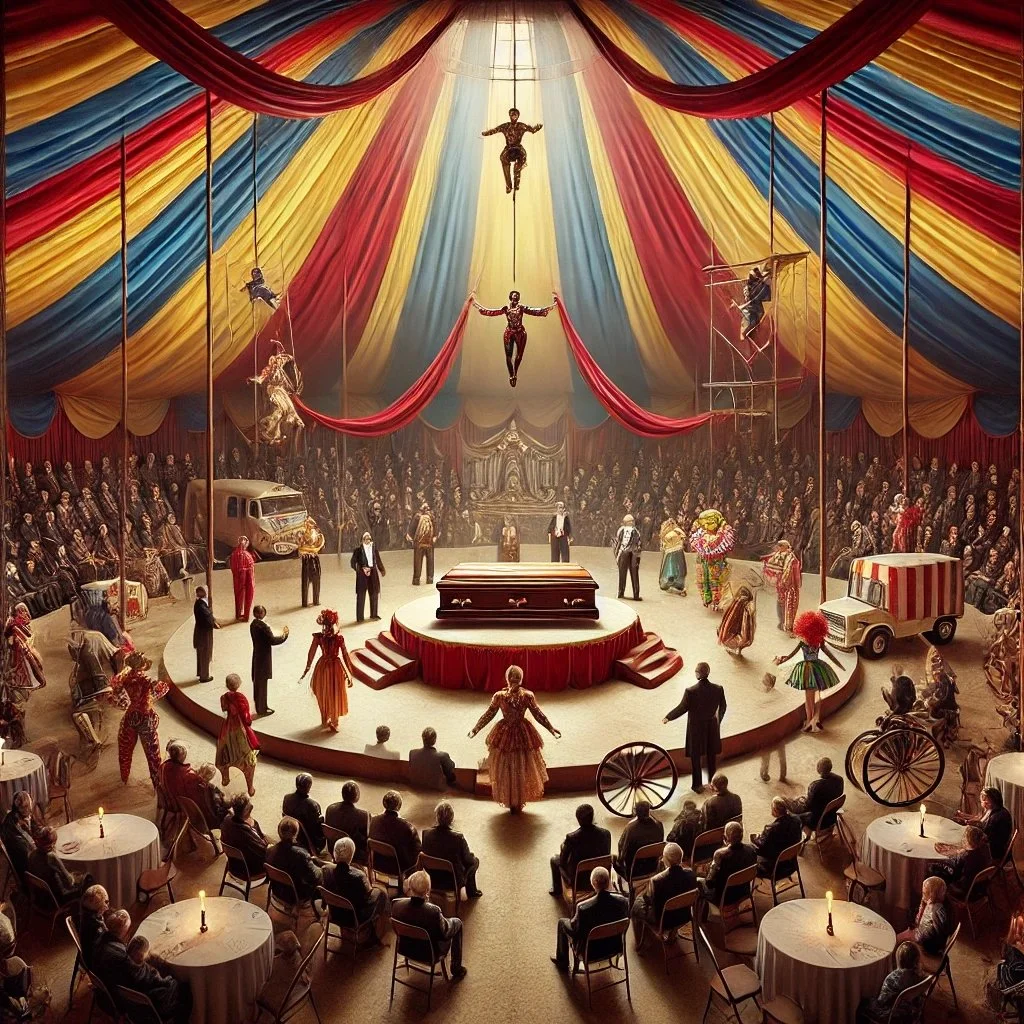
The casket was made of oak sourced from a bespoke Michigan sawmill. Its gleaming brass handles had been upcycled from the bell of a 19th century Great Lakes shipping vessel. It was nicer than any apartment I’d ever lived in. But he deserved it. Casey Basch deserved to have the best of everything before we dropped him in the ground to rot away—not that his casket would ever allow moisture to get through. It was hermetically sealed.
His wife, Emily, had purchased the most complete and expensive package offered. There was a leather-bound guest book for everyone to sign—hand assembled by a local Chicago artisan bookmaker who made his own paper and sourced the leather from a free-range cattle farm in Wisconsin. A string trio played familiar, but unnamable arrangements. Mourners scrolled through interactive scrapbooks on large touchscreen monitors where hundreds of photos and videos, and newspaper and magazine clippings were organized in digital albums. Many of those same photos were compiled into a slideshow with wipes and dissolves transitioning between each image displayed on an enormous monitor positioned on the wall behind and above the casket—Casey and Emily at their wedding; Casey playing little league; Casey and his two young daughters; Casey and Barack Obama; Casey on the aft deck of a deep sea fishing boat holding up his sizable catch… The casket was made of oak sourced from a bespoke Michigan sawmill. Its gleaming brass handles had been upcycled from the bell of a 19th century Great Lakes shipping vessel. It was nicer than any apartment I’d ever lived in. But he deserved it. Casey Basch deserved to have the best of everything before we dropped him in the ground to rot away—not that his casket would ever allow moisture to get through. It was hermetically sealed.
What Casey didn’t deserve was to have his casket remain open. Like I said, I’d been to plenty of funerals, and not once had I been to one with an open casket when the deceased died from a gunshot wound to the head. Granted, this was my first suicide funeral, but it seemed to me caskets come with lids for a reason. You don’t drive a convertible with the top down when it’s raining. The same principle applies here.
I had to imagine most of the money and attention to detail for Casey’s funeral went toward cleaning him up. Or piecing him back together. I saw what he looked like before the makeup and glue was applied. The mortician had done an impressive job considering the source material. Still, he looked like he was made out of Play-Doh.
It was an exercise in denial, which is fine, since denial is one of the stages of grief that the rest of us have to go through. Giving Casey a brave face was everyone’s way of putting on their own brave faces and denying that a man so wonderful could do something so horrible. As if by showing him off like that, we’d forget that he put a .38 in his mouth and blew his skull across the primary bath. That’d we’d forget that his wife and daughters found his body moments after they heard the pop of the gun. That we’d forget that Emily slipped on his blood and brains as she ran to her husband’s corpse slumped between the wall and the toilet like a sack of rotten potatoes, leaving a little of her own blood on the bathroom tile when she cracked her head against the floor.
Maybe they could all forget that. But I couldn’t. I couldn’t forget the sound of Emily’s brokenhearted wails into the phone when she called me just minutes after it happened. I couldn’t forget seeing Emily and her daughters sitting on the bathroom floor, hugging Casey’s body, covered in his blood sobbing uncontrollably but silently. I couldn’t forget seeing Emily’s bloody hair and thinking how romantic it was that hers and Casey’s blood had pooled together. One last moment of unity between the two.
More than just strange, the funeral was a farce. I couldn’t take it anymore.
“Where are you going?” my fiancé Lindsay asked me.
“Outside. I need air.”
“I’ll come with you.”
“No thanks. A minute alone, please.”
She kissed me on the cheek and I fought my way through the crowds of people—friends, family, co-workers, politicians, TV anchors, and journalists—a salmon swimming upstream against his contemporaries. It was a beautiful summer day in Chicago. Days like this were often spent aboard Casey’s boat on Lake Michigan. I sat down on the curb next to the marquee and loosened my tie.
“Lindsay said you wanted to be alone. Me, too,” said Ali as she plopped down on the curb next to me. “Hell of a way to kill a Saturday.”
“Kill a Saturday. Nicely done.”
“Glad you think so. I tried that line with Chris. She didn’t think it was funny.”
“It’s not exactly wife-friendly humor.”
Ali pulled a silver flask from her oversized suit coat breast pocket. It was adorned with several Avengers stickers. “Sip?”
“Devin know you’re using his flask?” I asked before pouring the bourbon into my mouth.
“This is what happens when you have a five-year-old. I’m telling you, Andy, don’t leave anything unattended when kids are around. They’ll smack stickers on it faster and with more stealth than Seal Team 6.”
“Maybe you shouldn’t leave your flask lying around.”
“The kid likes to explore kitchen cabinets. I don’t know what to tell you.”
I handed the flask back to Ali. She took a drink.
“Casey Basch,” I said with disbelief.
“Casey Basch,” Ali echoed.
“Where once there were three, now there are two.”
“Three little monkeys jumping on the bed. One went nuts and blew off his fucking head.” Ali sat back proud of herself.
“You love those children’s songs.”
“It’s all Chris will let me play in the car. My metal and punk CDs have become my dirty secret again like when I was in junior high. Jesus, my wife has become my mother.”
“Maybe I’m still in shock over the whole thing because I’m not feeling much of anything right now. I should be devastated, you know? But Jesus, I just never saw this coming. Casey was the last guy on earth I’d peg for suicidal.”
“Me, too. It could also be that the circus going on inside is hardly the place for two people like us to mourn the passing of their best friend. Did you even know he had a gun?”
“No! I’m not even sure that it was his. Can you rent those things?”
“In Chicago? Probably.”
Ali took another sip from the flask before passing it to me. I took a long pull. “Goddammit, my head hurts,” I said. Headaches were a problem for me. I’d been having brain-crushing pain since I graduated college, and it started getting worse around the time I proposed to Lindsay, about a year earlier. One psychologist I was seeing believed they were due to the stress I felt as a result of the insurmountable pressure I was straddled with to live up to my idea of success, and the expectations of Lindsay, my father and, well, everyone. The shrink called them unrealistic goals. I’d get stomachaches, too. Maybe the shrink was right but she had yet to supply me with a way to relieve those pressures. So I had another psychiatrist to supply me with the right drugs, which allowed me to get through the day.
Ali reached for the flask again but I didn’t give it up. I fished a bottle of pills prescribed by my psychiatrist from my suit coat pocket, popped one in my mouth and washed it down with another swig of bourbon.
“You know who doesn’t get headaches anymore?” Ali asked.
“Casey Basch.”
“Casey Basch.”
The pain in my head dispersed. “I just don’t understand it. He was perfectly fine the day before. And I know that’s how these things go. But that last good day is usually preceded by stretches of terrible days and the reason the day before a suicide is such a good day is because the person has made the decision to kill himself.”
“Or herself.”
“Or herself. So once they resign to be free of their mortal coils, they’re finally in a good mood. But Casey never had terrible days. It’s like he just—I don’t know—lost his mind.”
“No, man.” Ali put her arm around my shoulder. “He didn’t lose his mind. He blew it out of his skull and all over the bathroom walls.”
“True. Shit. What do we do now?” I asked.
“Right now? We just sit here. We’ll deal with this shit once the circus of idiocy has wrapped up.”
Casey had done everything right. He wasn’t just living the American Dream, he fucking was the American Dream. So Jesus Christ, if Casey Basch can’t hack it, what chance does anybody else have?
After the funeral, we went to Ali and Chris’ place. They lived in a beautiful old house with a gigantic yard by city standards on the north side of Chicago. Chris was picking up their five-year-old son Devin from his swim lesson and their ten-month-old son Mikey from the babysitter. Ali, Lindsay, and I drank beers in the kitchen. The walls were adorned with messy drawings and art made of construction paper and cotton balls clearly done by the young boys. There were Avengers and Minecraft stickers speckled across the kitchen table.
“If I heard one more person say, ‘He looks so good,’ that room was going to need another casket,” I said.
“For you? Or the person who said it?” asked Ali.
“Okay, two more caskets.”
“I think he did look good. Considering,” Lindsay said with a shrug.
“He looked like a claymation doll,” Ali said.
“Specifically, Mr. Bill,” I said.
“Oh, that’s even better!”
“You’re both disgusting,” said Lindsay. “How can you joke about this?”
“This is what my therapists call deflecting. I’m not supposed to do it, but habits are hard to break,” I said.
“It’s what we do, Lindsay,” Ali said. “Casey would be saying the same things if it had been one of us.”
“I never understand the three of you.”
“What I don’t understand,” I said, “is why people say that someone looks good when they’re dead. No one looks good when they’re dead. They look dead. Not Crypt Keeper dead, but dead.”
“I just feel so bad for Emily,” said Lindsay. “She’s a widow. She’s not even forty yet.”
“Of course you feel bad for her. Her husband blew his brains out,” Ali said.
“And she’s such a neat freak,” I said. “You guys didn’t see the place. It was a mess. Does blood even come out of bathroom tile grout?”
“Seriously, Andy, knock it off,” Lindsay said.
“It’s a valid question.”
“It’s just so hard to believe. I mean you guys were his best friends. He never let on that anything was wrong?”
“He never said anything to me,” Ali said.
“I thought you guys could read each other’s minds.”
“If that were the case, then it’s safe to say that with Casey, the writing is on the wall.”
I laughed hard and nearly shot beer through my nose.
“One more and I’m leaving,” Lindsay threatened. She stood to get another round of beers from the refrigerator. “I just wonder what happens now. And not only with Emily and the girls but at the office. Casey was that place. He built it and I know that the only reason we ever secured the clients we did was because of Casey. People adored him. You know, Hillary Clinton called him every week just to say hi.”
“That’s because he pulled her ass out of more fires than she could count,” I said.
“Well, sure, that’s what he was hired to do. That’s the world of a political public relations strategist. But Hillary doesn’t have time to make polite phone calls to just anyone.”
“She does now,” Ali said.
“You know what I mean. Who is going to take his place? Will the agency close? Holy shit. What if it closes? I’ll be out of a job. Andy, we need to move up our wedding date. We need to have everything paid for before I’m unemployed.”
“Relax, Lindsay. Everything will be fine.” I wasn’t lying when I said that to her, but I also wasn’t totally telling the truth. Because I had no idea what would happen next. I did, however, know that getting married sooner wasn’t something I was willing to entertain. Couldn’t pinpoint why, but when Lindsay said it, my gut wrenched itself into a million knots. And while Lindsay panicked about the uncertain nature of the future—a kind of panic I traditionally specialized in—I was, at that moment, more concerned with the past. Specifically, four days ago when my best friend took his own life.
“I just want to know why,” I said. “Al, you and I never saw it coming. I doubt Emily had any inkling. And there was no note that we know of. We’re really in the dark here. As for what comes next, well, we go on, I suppose. We do what people do when someone they love dies. We mourn. I can accept that Casey is gone. That sucks. I mean, that really, really fucking sucks. I loved him. He was more than my brother. The three of us, you know? So, yeah. He’s dead and that sucks. But why did he die in that way? Why suicide? Why the violent display? He was so happy. And he had every reason to be happy: a great career, a wonderful family, financially comfortable, loads of friends, prestige. Casey had done everything right. He wasn’t just living the American Dream, he fucking was the American Dream. So Jesus Christ, if Casey Basch can’t hack it, what chance does anybody else have?”
“The answers, my friend, are splattered all over that bathroom,” said Ali. “The only one who can answer your question can’t answer your question.”
“Maybe Emily should hire an investigator,” said Lindsay.
“You can try and talk her into that,” I said.
“Oh, shit!” Lindsay said remembering something. “Without Casey to stand up in the wedding, our wedding party is uneven. We’re unbalanced!”
“Whoa. You can’t give us shit for making suicide jokes if you’re going to freak out about pointless crap like that,” Ali scolded.
“You’re right. Oh my God. What’s wrong with me?”
“The thing is,” I said to Ali, “you might actually profit off of this whole thing.”
“How do you figure?”
“Your next End City series book. Call it, End City: Suicide Kings.”
“There’s enough teenage suicide out there without another best seller to pound the idea into their heads,” she said.
“Sure, but why not have the characters start offing themselves? Your books are about the end of days, dude. They’re all running around with diseases, starving, fighting zombies and government foot soldiers. And your main character can’t even drive yet.”
“She got her license in the new book. Thanks for reading, dick.”
“Do I look like a young adult, to you? I’m thirty-seven years old. I don’t read Y.A.”
“Oh, screw you, I’m seven months older than you and I write Y.A.”
“I’ve read the new book, Al. I love it,” said Lindsay. She sat back down at the kitchen table with three fresh beers.
“Thanks, but you clearly have terrible taste in literature. If you can even call what I do literature. Even if I wanted to go that dark, my publisher prefers to take all of my ideas and turn them into slightly lighter and more inspiring pap.”
“Ali, your books are still pretty dark,” I said. And here’s your chance to put this series to rest and move onto something else. The heroes live in a pretty shitty situation. Just kill them off. One by one. A death in every chapter. They make some kind of suicide pact or something. I mean, wouldn’t it make sense to get out sooner than later?”
“Andy Lakemaker, you know nothing of the publishing world. I could never kill off my main character. She’s a sixteen-year-old girl. She’s become a strong role model for teenage girls around the world—and thirty-five-year-old Lindsay over here. If I killed her, it would destroy the idea of fighting for survival and finding purpose and hope when it seems there is none.”
“Are you telling me that End City is a series about hope and perseverance? Jesus, Al, I never took you for such an optimist.”
I had annoyed her. “No. I’m not saying that at all. But that’s what the publisher is selling. You’re a brand-managing marketing guy, so you should understand that. I’m not writing the truth; I’m writing what sells.”
“There’s a spin for everything,” Lindsay said.
“She gets it. Hell, maybe she should be the new president of Basch and Associates Global,” said Ali.
“Whatever. This is probably why I hate my job, I’m no good at it. So fine, Ms. Ashton. Go on and write your lies. Collect the huge royalty checks. Go on all the morning news shows, be a guest contributor to NPR. As long as your wife can buy new furniture whenever she wants and your kid has stickers to decorate that furniture.”
“Do you get this aggressive with your therapist?” Ali asked.
“Not all of them.”
“He gets this way with me,” Lindsay said as she smiled at me and took a drink of her beer.
The room was getting tense but fortunately, we were saved from my certain escalation when Chris walked in with the kids. Devin ripped through the front door and into the kitchen.
“Mommy!” he screamed as he leapt onto Ali’s lap.
“Aarrrgh! The chlorine monster! This is cleanest you’ve smelled in weeks.”
“It’s why we signed him up. Let someone else bathe him,” Chris said as she entered the kitchen with baby Mikey on her hip. “Lindsay, would you—”
“I’ll hold him,” Lindsay offered before Chris could finish her thought.
Lindsay took Mikey and walked in small circles in the kitchen bouncing the baby in her arms while cooing at him and making funny faces. The baby loved it. Mikey was typically a screamer but never with Lindsay. Seeing her with Mikey was like looking into the future when she would be bouncing and cooing at our own children. The thought re-wrenched my guts.
“Say hi to Andy and Lindsay, Devin,” Chris instructed her young son.
He barely made eye contact with either of us when he said, “Hi.” Chris continued forcing her son toward social niceties.
“Why don’t you tell everyone how swimming lessons went today?”
“My coach said I’m the fastest swimmer in class. I can hold my breath longer than anyone else. I don’t even have to pinch my nose.”
“My little boy is a man today,” Ali said.
“That’s pretty cool, Devin,” I said. “What’s your favorite stroke?
“I don’t know.”
“Why would you?”
Devin gave me a stern look and said, “You’re sitting in my seat, Andy.”
“I am?” I gestured to the booster seat, which was covered in stickers. “I thought that one was your seat.”
“No. I’m too big for that now.” He walked to the booster seat then shoved it onto the floor and climbed onto the chair as the plastic seat thudded against the wall. “I’m almost six.”
“Whoa!” Ali said. “Not cool, Devin.”
“Devin Joseph!” Chris said, showing her level of anger with him by stating his first and middle name. “Pick that seat up right now. That is not how we do things. If you don’t want to sit in the booster seat, then you can take it off the chair and put it in the corner of the kitchen nicely. We’ve been through this before.” Devin picked up the seat and did as his mother suggested. “Now apologize to Andy.”
“I’m sorry.”
“All’s forgiven, my dude.”
“Give the kid some confidence and this is what happens,” Chris said. “Typical male.”
“At least he’s alpha,” Ali said. Chris glared at him. “What? He must get it from you. I’ve never had confidence in my life.”
“Have you all eaten? I’m making mac and cheese with hot dogs for Devin. I can make enough for all of us.”
“Thanks, babe,” said Ali. Then she turned to me and Lindsay, who had sat back down at the table with Mikey still cradled in her arms, and said, “Welcome to the home of a bestselling novelist where we feed you the lunch of a kindergartner.”
“Quiet,” Chris said. “So, how are you guys doing? Some funeral, huh?”
“Oh, lots of laughs,” I said.
“They’ve been making jokes about it all afternoon,” said Lindsay.
“They think they’re hilarious.”
“Why didn’t you bring Devin? I asked. “Perfect opportunity to teach the kid about death and funerals early on. That way he’ll be prepared when his friends start chewing on gun barrels for sport.”
“I don’t think so,” said Chris. “Besides, he gets enough of the macabre with his mom’s End City books all over the house.”
“What!? They’re on a bookshelf. Jeez. Even I don’t like looking at them.”
“I feel so awful for Emily,” Chris said. “She’s all alone with those two little girls. And she’s such a neat freak. I’m not sure blood comes out of bathroom tile grout.”
“That’s what I said!”
“It’s just so crazy,” Lindsay said. “I mean, suicide.”
“What’s suicide?” Devin asked.
“It’s an option, buddy,” I said.
“Come on, man,” said Ali.
“Don’t coddle your kid.”
“You want lunch, Andy? Then behave,” Chris said.
“Suicide is a very bad and a very sad thing,” I said correcting my previous remark.
“Is that how Casey died?”
“Yes, Sweetie. But let’s not talk about sad things,” said Chris. “Lunch is almost ready. Can you please set the table for everyone? How’s the wedding planning coming, you guys?”
“And that’s not sad?” I asked.
“Stop being a jerk,” Lindsay said.
“I’m sorry. I’ve had a rough day.”
“We all have,” she said. “Casey was a friend to all of us. He was my boss. He introduced you and I. We vacationed with him and Emily. I babysat those girls. The whole thing is tragic. I don’t know what we even do next.”
“Yeah, speaking of how close we all are,” Ali said, “why aren’t we with Emily and the girls right now? Shouldn’t we be there supporting her?”
“Her sister is awful,” Chris and Lindsay said simultaneously. They laughed at each other.
“Jinx!” Devin shouted. Ten, nine, eight, seven, six, five, four, three, two, one—CURSED! Now you can’t talk until I say your whole name.” Chris shot him a look.
“Yeah, not today, kiddo,” Ali told him. He turned back to Lindsay and Chris. “Oh, right. You two never got over the whole thing with our wedding. Women can’t be the fairer sex because we never forgive.”
“You are, by far, the most sexist lesbian in known history,” Chris said to her wife.
“Do you remember what Meghan did that made you so upset?” Ali asked. Lindsay looked down at her beer bottle. Chris glared at Ali. “Exactly. Me either. Look, Emily knows where we all stand. Meghan heads back to New York in a few days. We’ll be there for her then.”
My phone vibrated and chimed in my suit coat breast pocket. It was an alarm reminding me of a therapy appointment. “Oh, shit.”
“Language,” said Chris reprimanding me.
“We have to go,” I said to Lindsay. “I forgot I have an appointment with Dr. Gunn.”
“Which one is that?” Ali asked.
“The one with the pills.”
I slugged back the rest of my beer. Lindsay placed Mikey into his high chair.
“I swear, the money you spend on therapy… We could pay for our wedding twice over.”
“Trust me, Linds, this is a far greater investment in your future,” Ali said. “Get his head straight now before he decides to redecorate your bathroom with that head, leaving you alone with two hungry kids.”
“Okay. I’m done. Nice timing, Al,” Lindsay said.
We hugged and said our I love yous to our friends. I high-fived Devin and tried to do the same with Mikey but the concept was lost on him.
David Himmel is the author of the books Hope Idiotic, The Last DJ, and A Camp Story. An award-winning journalist, he has contributed to several news outlets including POLITICO and The Atlantic. Leader of his two sons and their dog, he's a sailor who does not spend enough time on his boat. Subscribe to his Substack, The Autopsy .