Chapter Four
The Version That Lets You Sleep
Monte apologized badly. This surprised no one. Not Amanda. Not Morgan Freeman. Certainly not John Cleese, who treated every human apology as a defective household appliance requiring immediate disassembly.
Monte began with a text.
I’m sorry. I was trying to protect you.
He stared at it for several seconds.
Morgan said:
Monte had apologized for the outcome while preserving the nobility of his intention.
Cleese added:
It is the preferred apology of husbands, governments, and dogs standing beside overturned garbage.
Monte deleted the second sentence.
I’m sorry. I broke my promise.
He considered adding:
I hope you understand.
Cleese said:
Do it. Nothing improves an apology like assigning homework to the injured party.
Monte did not add it. He sent the message. Amanda did not respond. He stood in his kitchen holding the phone as though continued eye contact might force it to produce forgiveness. It did not. The apartment looked worse than it had that morning.
The failed toast remained on the floor. The legal pad lay open on the couch. The Maker’s Mark bottle stood half-empty beside a dead basil plant that had become less a plant than a memorial to intention.
Monte picked up the toast.
Monte had returned home determined to put his life in order.
Cleese said:
He has begun with bread.
“It’s something.”
Most disasters begin with someone saying that.
Monte threw the toast away, washed the plate from the previous night, wiped the counter, gathered the mail, watered the basil.
Morgan said: The basil was dead.
“I know.”
Cleese replied: Apparently not.
Monte put down the watering can. His phone remained silent. He checked it again. No message.
“You two know whether she’ll forgive me.”
Morgan said: Possibly.
Cleese said: That is a coward’s question.
Monte turned.
“Why?”
Because you are not asking whether you deserve forgiveness. You are asking whether the consequences will be temporary.
“That’s not fair.”
Morgan said: It was accurate.
“Same thing.”
No, Morgan replied.
Cleese said: Fairness is accuracy with public relations.
Monte sat at the kitchen table. The apartment had become dangerous in its quiet. At work, there were tasks. At Amanda’s office, there had been conflict. On the train, there were strangers whose hidden lives kept his own at a manageable distance. Here, there was only Monte. And the committee. He opened his laptop.
A browser window displayed the medical search from the previous day.
Auditory hallucinations causes.
Another tab held the urgent care website.
A third contained an article about Morgan Freeman’s best film performances, opened during an investigative detour that had become forty-five minutes of reading about The Shawshank Redemption.
Monte clicked the urgent care page.
“Should I go back?”
Morgan said: Yes.
Cleese said: Probably.
“Is this medical?”
Neither answered.
“Can a doctor make you stop?”
Silence.
Monte closed the laptop.
“That’s what I thought.”
Cleese replied: No, it isn’t. You thought a doctor might make us stop and disliked the possibility nearly as much as you desired it.
Monte looked toward the empty living room.
“Why would I want this?”
Morgan said: Because the voices made Monte’s life important.
The sentence landed quietly. Monte laughed.
“That’s ridiculous.”
Before the voices, Morgan continued, Monte managed a coffee shop, postponed his ambitions and maintained a relationship by avoiding its definition.
“I know what I did.”
Now he possessed a mystery.
Cleese said: A deeply inconvenient mystery, yes, but still more glamorous than inventory reconciliation.
“I don’t think this is glamorous.”
You have spent three days asking why you were chosen, Cleese replied. No one asks why they were chosen for athlete’s foot.
Monte stood.
“I didn’t ask for this.”
Morgan said: Few people asked directly for the lives they built.
“Here we go.”
Cleese groaned.
Yes, Morgan, explain how a mortgage is an unconscious prayer.
I was going to say that choice often hid inside repetition.
Of course you were.
Monte walked to the window. Below, Clark Street moved through late afternoon. A bus pulled away from the curb. A cyclist swore at a taxi. A woman dragged two grocery bags through gray slush.
Ordinary life. The kind Monte had resented until it became unavailable. He wanted to go downstairs. Walk into the diner. Hear Stella complain about the weather. Return to work and argue with Leon about clocking in. Go to Amanda’s apartment and pretend they had not just learned how fragile trust could be.
Instead, he had been suspended, Amanda was silent and two famous British and American voices were debating whether his crisis had improved his self-esteem.
His phone buzzed. Monte grabbed it. The message was from Sadie.
Rebecca wants a meeting tomorrow at 10. Don’t come to the store before then.
He read it twice. His district manager. That meant documentation. Documentation meant concern expressed in corporate vocabulary. Concern became corrective action. Corrective action became separation.
No one was ever fired anymore. They were separated, as though the employee and company had mutually concluded the relationship had become emotionally unhealthy.
“What happens tomorrow?”
Morgan said nothing.
Cleese said: You’ll attend a meeting.
“Will I be fired?”
Perhaps.
“Do you know?”
Perhaps.
“That is not an answer.”
It is the answer you have.
Monte typed a response to Sadie.
Got it. Is Rebecca pissed?
He deleted it.
Typed:
Thank you.
Sent.
Morgan said: Monte wanted Sadie to reassure him.
“Yes.”
Cleese said: Sadie is not an emotional-support barista.
“I know.”
He checked Amanda’s thread.
Still nothing.
He considered calling.
Morgan said: Monte knew she needed space.
Cleese replied: Monte considered space an insult because it denied him access to immediate repair.
“I’m not calling.”
For now, Morgan said.
Monte placed the phone face down. Cleese sighed.
Ah, the ancient ritual of pretending not to wait.
The phone buzzed again. Monte flipped it over. Amanda.
I got your message. I need tonight. We can talk tomorrow.
Relief came first. Tomorrow meant not over. Then anger arrived. Not at Amanda. At the waiting. At the punishment of uncertainty. At the fact that she controlled when the conversation would resume.
Monte typed:
Of course.
Cleese said: He does not mean of course.
Morgan added: He meant he understood.
“No, I mean both.”
Most dishonesty is composed of two truths arranged to conceal a third, Morgan said.
Monte deleted the reply.
He tried again.
I understand. I’ll give you tonight.
That seemed better. Then he added:
I love you.
He stared.
Cleese said: Remove that.
“Why?”
Because affection attached to an apology can become leverage.
Morgan said: The love was real.
Real things can still be used badly.
Monte deleted the final sentence and sent the rest. He hated Cleese for being right. He hated Morgan for making rightness sound holy.
Mostly, he hated himself for needing both of them.
The buzzer sounded.
Monte looked toward the intercom. He was not expecting anyone. The buzzer sounded again. He pressed the button. “Yeah?”
A man’s voice crackled through the speaker.
“Monte?”
“Who is this?”
“Gerald.”
Monte went still. The man from the park. The vodka poured into the snow.
“How did you find me?”
“Can you let me up?”
“That did not answer the question.”
“I asked around.”
“In Chicago?”
“At the Starbucks.”
Monte closed his eyes. Sadie. Or Leon. Or one of the regulars who believed customer service included distributing the manager’s address to recovering alcoholics.
“Hang on.”
He buzzed Gerald in.
Morgan said: Monte knew allowing Gerald upstairs was unwise.
Cleese replied: Fortunately, wisdom has never slowed him.
Gerald knocked two minutes later.
He wore the same brown coat, now damp from melting snow. His face looked older indoors. He carried a grocery bag. Monte opened the door but did not move aside.
“How did you get my address?”
“The woman at the diner.”
“Stella gave you my address?”
“She said you lived nearby. The barista with the missing O knew the building.”
“Leon.”
“Yeah.”
“I’m going to fire everyone.”
“You might want to hear why I’m here first.”
Monte stepped aside. Gerald entered. He looked around the apartment. His eyes moved over the unopened mail, the stack of writing books, the bourbon bottle. He stopped at the bourbon.
Monte saw it.
“You want me to put that away?”
Gerald shook his head.
“No.”
The answer came too quickly.
Morgan said: Gerald wanted the bottle removed.
Cleese added: He also wanted to prove he could stand beside it.
Monte took the bottle and put it inside a cabinet. Gerald watched without comment.
“What’s in the bag?” Monte asked.
“Soup.”
Monte stared.
“Why does everyone bring soup when they think I’m unstable?”
“It’s chili.”
“That’s different.”
“Marginally.”
Gerald set the bag on the counter. Inside was a plastic container, a loaf of bread and a package of cookies.
“Meeting people do this,” he said. “Food. Rides. Excessive coffee. It’s how alcoholics avoid discussing emotions.”
“You came here to feed me?”
“No.”
“Then why?”
Gerald sat at the table. Monte remained standing. Gerald removed his gloves one finger at a time.
“I told my sponsor what happened.”
“The cancer?”
“You.”
“That seems harder to explain.”
“He’s heard stranger things.”
“I doubt that.”
“He sponsored a magician for three years.”
Monte sat across from him. Gerald looked toward the cabinet where the bourbon had disappeared.
“I went to the meeting.”
“Good.”
“I told them I bought the vodka.”
“Also good.”
“I told them I didn’t drink it.”
“That seems like the important part.”
Gerald shook his head.
“The important part is I wanted to.”
Morgan said: Gerald had spent eleven years measuring success by abstinence.
Cleese added: Now he was discovering that not doing something did not erase the desire to do it.
Monte leaned back.
“Why are you telling me?”
“Because you knew.”
“I knew a few facts.”
“You knew enough.”
“No. I didn’t know about the cancer until the voice—”
He stopped. Gerald looked at him.
“The voice?”
Monte said nothing.
“You said you couldn’t explain how you knew.”
“I can’t.”
“But there’s a voice.”
Monte looked toward the ceiling.
Cleese said: Excellent. Bring strangers into it. Nothing stabilizes psychosis like a focus group.
Morgan remained quiet. Gerald waited. Monte considered lying. He had promised himself nothing. Promised Amanda something else.
Rule one: do not reveal private information merely to prove the voices were real.
Gerald already knew the information had been real. This was different. That was what Monte told himself.
Cleese said: Observe how quickly every rule acquires an exception when it becomes inconvenient.
“I hear a voice,” Monte said.
Gerald did not react.
“It tells me things about people.”
“One voice?”
“Two now.”
“Getting crowded.”
“One sounds like Morgan Freeman.”
Gerald nodded.
“Reasonable.”
“The other sounds like John Cleese.”
“That seems less soothing.”
“It is.”
Gerald folded his hands.
“Are they speaking now?”
“Yes.”
“What are they saying?”
“That telling you is probably a bad idea.”
“Which one?”
“The British one.”
“What does Morgan Freeman say?”
“Nothing.”
Gerald considered this.
“He the quiet one?”
“No. He’s the dramatic one.”
“That tracks.”
Monte studied him.
“You believe me.”
“I didn’t say that.”
“You’re not calling anyone.”
“I’ve sat in church basements with men who believed God spoke through license plates, football scores and a raccoon outside Joliet. Hearing Morgan Freeman is almost restrained.”
“I’m not an alcoholic.”
“Congratulations.”
“I’m serious.”
“So am I.”
Gerald leaned forward.
“I don’t know whether you hear a supernatural voice, a sick brain or your own conscience wearing a celebrity costume. I know you stopped me from drinking.”
Monte looked down.
“I might have interfered where I shouldn’t.”
“You did.”
“You’re thanking me?”
“Yes.”
“Those things don’t contradict?”
“Most things do.”
Morgan said: Gerald had accepted contradiction because recovery required him to.
Cleese added: He also has cancer. It accelerates one’s tolerance for philosophical mess.
Monte repeated the first part. Gerald listened.
“The voice said that?”
“Yes.”
“Accurate.”
“Doesn’t that bother you?”
“What?”
“That it knows.”
Gerald thought.
“Less than it bothers you.”
“Why?”
“Because you still think privacy protects you.”
Monte stared. Gerald continued.
“I kept things private for years. Drinking. Debt. Cancer the first time. My daughter’s mother. Every secret felt like control. Really, it was just a room I locked from the inside.”
Morgan said: Monte recognized the room.
Cleese replied: Everyone recognizes the room. Very few admit they furnished it.
Monte got up and served the chili. The act gave him something to do. He placed two bowls on the table. Gerald looked at his.
“You don’t have to eat with me.”
“I haven’t eaten.”
“Then you do.”
They ate. The chili was thick, spicy and unexpectedly good.
“What’s in this?” Monte asked.
“Cinnamon.”
“Really?”
“And a little chocolate.”
Monte stopped.
“White chocolate?”
“No.”
“Good.”
“Why?”
“I once knew someone who made white chili with white chocolate.”
“That sounds criminal.”
“It was good.”
Cleese said: At last, a moral question with a clear answer.
Morgan replied: Food often carried memory more reliably than language.
It’s chili, Morgan. Not an archaeological dig.
Gerald tore bread in half.
“Can they tell the future?”
“Sometimes.”
“Can they tell me how long I have?”
Monte put down his spoon. The apartment changed. The question entered the room and occupied it completely.
“I don’t know.”
“Ask.”
“No.”
“Why?”
“Because I don’t know whether the answer is true.”
“Ask anyway.”
“No.”
Gerald’s face hardened.
“It’s my life.”
“And my head.”
“You knew I had cancer.”
“They told me.”
“Then let them tell me this.”
Monte stood.
“I said no.”
Gerald looked at him. The voices were silent. Monte hated them for it.
“Why not?” Gerald asked.
“Because what would you do with the answer?”
“That’s my problem.”
“No, it becomes mine the second I tell you.”
“You already made yourself part of my life.”
“I stopped you from drinking.”
“You exposed me in a public park.”
“I helped you.”
“Yes.”
The word struck like a slap. Gerald stood too.
“Both are true.”
Monte looked away. Gerald softened.
“I’m sorry.”
“No.”
“You’re right to be afraid.”
“I’m not afraid.”
Cleese said: He is.
Morgan said: Monte feared learning the answer.
Monte closed his eyes. Not telling Gerald was not only ethics. It was terror. If the voices gave a date, then Monte would be carrying a clock inside his head. Every conversation with Gerald would become subtraction. Every joke, meal and phone call would be measured against the end. Worse, if the date proved wrong, Monte would have altered a man’s life with fiction.
And if it proved right—
“What do you want me to ask?” Monte said.
Gerald sat.
“How long.”
Monte remained standing.
“Will you tell him how long he has?”
No answer. Gerald watched Monte’s face.
“Anything?”
“No.”
“Ask if I make it to Christmas.”
“Gerald.”
“Ask.”
Monte swallowed.
“Will Gerald live until Christmas?”
Morgan said nothing.
Cleese said: This is obscene.
Gerald saw Monte react.
“What?”
“The British one objects.”
“To the question?”
“To all of it.”
“Ask Morgan.”
“I did.”
“What does he say?”
“Nothing.”
Gerald leaned back. The anger drained from him.
“That’s an answer.”
“No, it isn’t.”
“It might be.”
“Don’t do that.”
“Do what?”
“Turn silence into a verdict.”
Gerald smiled sadly.
“You’ve been doing that your whole life.”
Monte felt the sentence before Morgan confirmed it. Monte had interpreted silence from employers, lovers, audiences and God as rejection.
Cleese added: Usually because rejection is more flattering than indifference.
Gerald watched him.
“What did they say?”
“Nothing useful.”
“That means something useful.”
Monte sat. They finished eating without discussing death. Gerald told him about his daughter, Leah, who lived in Evanston and taught fourth grade. He had not told her the cancer had returned. Monte objected. Gerald pointed out that Monte had known for less than a day and had already developed strong opinions about a family he had not met.
Cleese applauded.
Morgan described Gerald’s secrecy as fear disguised as protection. Gerald agreed. Then did nothing about it. Monte found this infuriating.
“You have to tell her.”
“I know.”
“When?”
“Soon.”
“That’s not a time.”
“It’s worked for you.”
Monte looked at him. Gerald smiled.
“Stella talks.”
“Apparently everybody does.”
“She said you’ve been dating Amanda for almost a year and only admitted you loved her because God bullied you.”
“It isn’t God.”
“Whoever.”
“And that is not what happened.”
Cleese said: It is precisely what happened.
Morgan replied: The admission belonged to Monte.
After an extensive supernatural assist.
Gerald stood and put on his coat.
“I should go.”
“You came all this way to bring chili and ask when you die?”
“I came because I didn’t want to be alone.”
The simplicity of the sentence stopped Monte. Gerald looked embarrassed by it. Monte understood. Not being alone was easy. Admitting you did not want to be alone was almost impossible.
“You can stay,” Monte said.
“No. I have a meeting.”
“Another one?”
“When you almost relapse, people get enthusiastic.”
Gerald moved toward the door.
“Tell your daughter.”
“I will.”
“When?”
Gerald opened the door.
“Tell Amanda you’re sorry.”
“I did.”
“No. You sent words.”
The door closed behind him. Monte stood in the hallway listening to Gerald’s footsteps descend the stairs.
Cleese said: Annoying man.
Morgan replied: You liked him.
Irrelevant.
Monte returned to the apartment.
The phone had still not moved. He checked anyway. No message. He cleaned the bowls. He put the leftover chili in the refrigerator. He stood before the cabinet containing the bourbon.
Morgan said: Monte wanted a drink.
“Yes.”
Cleese said: Gerald wanted one more.
Monte removed his hand from the cabinet.
“That’s cheap.”
It’s comparison, Cleese replied. Morality is often cheap because the expensive version takes longer.
Monte went into the living room and sat.
“What did you mean when you said you lie?”
Cleese answered immediately. I meant that narration is selection.
Morgan said: Every story excluded more than it contained.
“You tell facts.”
Sometimes, Cleese said.
“And sometimes?”
We tell the version that produces movement.
Monte leaned forward.
“What does that mean?”
Morgan said: Truth could awaken.
Cleese added: Truth could also manipulate.
Monte felt cold.
“Have you manipulated me?”
Yes, Cleese said.
Morgan was silent.
“Both of you?”
Yes, Cleese repeated.
“Morgan?”
The pause lasted too long.
Then: Yes.
Monte stood.
“What did you lie about?”
Not lie, Morgan said.
Cleese sighed. Here we are again, polishing the weapon.
“Tell me.”
Morgan’s voice remained calm. The first morning, I told you Amanda loved you.
“She did.”
Yes.
“I told her I loved her.”
Yes.
“So what was manipulation?”
I told you neither of you possessed enough courage to inconvenience the other with the truth.
Monte waited.
“And?”
Amanda had intended to tell you that evening.
Monte’s stomach tightened.
“What?”
She had scheduled dinner because she intended to ask for a committed relationship.
Monte stared at the wall.
Cleese said: You made him believe abandonment was imminent.
Morgan replied: Fear moved him toward honesty.
Fear moved him toward panic.
“But she was going to stay?”
Morgan said: She intended to.
“You knew that?”
Yes.
“And you let me think she was leaving.”
Yes.
Monte felt anger rise through him.
The night at the lake.
The fear.
The messages.
The confession.
All of it had felt like a leap into darkness. The darkness had been arranged.
“You manipulated me into telling her I loved her.”
Morgan said: You did love her.
“That is not the point.”
It is part of the point.
Cleese replied: He’s right, Morgan.
The British voice sounded almost pleased to say it.
You withheld the safest interpretation because terror made a better scene.
Morgan fell silent.
Monte paced.
“What else?”
Neither answered.
“What else have you done?”
Cleese said: You assumed Cynthia’s husband was unfaithful.
“You encouraged that.”
I wasn’t present.
“You know what I mean.”
Morgan spoke. I revealed the name Denise.
“You knew who Denise was?”
Silence.
“You knew she was dead?”
Yes.
Monte stopped walking.
“You let me believe Cynthia’s husband was cheating.”
You created that conclusion.
“You gave me the pieces in exactly the order that would create it.”
Cleese said: That is what narrators do.
Monte looked toward the ceiling.
“Why?”
Morgan’s voice softened.
Because certainty had to fail before you would question it.
“So you hurt Cynthia to teach me a lesson?”
The conversation allowed her husband to speak honestly before he died.
“That could have gone another way.”
Yes.
“You gambled with their lives.”
Morgan said nothing.
Monte turned toward the other voice.
“And you?”
Cleese sighed. I told you the money at Amanda’s office was theft.
“It was.”
Legally, perhaps. Morally, not so neatly.
“You pushed me to expose it.”
I objected to your silence.
“You wanted me to act.”
I wanted you to stop pretending passivity was ethics.
“And then you criticized me for breaking my promise.”
Because you broke your promise.
“You can’t have both.”
Of course I can. Reality does it constantly.
Monte grabbed the legal pad and threw it across the room.
“You two set me up.”
Morgan said: No.
Cleese said: Occasionally.
“You reveal facts. You hide context. You argue opposite sides. Then whatever I do, one of you gets to explain why I’m wrong.”
Neither replied.
Monte’s breathing grew shallow. The apartment seemed to contract around him. He had treated the voices as judgment. Then guidance. Then witnesses. Now he understood they were something worse.
Editors.
They selected.
Arranged.
Omitted.
They did not have to invent facts to create fiction. They only had to decide where the sentence ended.
“How much of what I know is true?”
Morgan said: All of it.
Cleese added: And none of it in the way you mean.
Monte laughed. The sound became a shout.
“That doesn’t mean anything!”
His phone buzzed.
Amanda.
He snatched it up.
I can talk now. Come over at seven.
He looked at the clock. Six twenty-three.
Morgan said: Monte would go.
Cleese replied: Obviously.
Monte stared at the message. Then at the voices’ invisible locations.
“Tell me what happens.”
Silence.
“Does she forgive me?”
Nothing.
“Does she end it?”
No answer.
He understood the game now. Or believed he did. Each silence invited him to supply fear. Each fact arrived without enough context to become wisdom.
The voices were not reliable. They might never have been.
“What does she want?” he asked.
Morgan said: To be heard.
Cleese said: To decide whether he is safe.
Monte waited.
“Is that true?”
Morgan said: Yes.
Cleese said: Partly.
“There. That. What’s missing?”
Neither answered.
Monte picked up his coat. He stopped at the door.
“I’m not listening to you tonight.”
Cleese laughed. You cannot stop hearing us.
“I can stop obeying.”
Morgan said: Monte had never been ordered to do anything.
“That’s the trick, isn’t it?”
Silence.
“You make me think the choice is mine.”
Cleese replied: The choice is yours.
“After you’ve loaded it.”
Every choice is loaded, Morgan said. By memory. Fear. Desire. History.
“Then why are you here?”
No answer.
Monte opened the door. He walked to Amanda’s apartment in the cold. He could have taken the bus, but walking allowed anxiety to disguise itself as transportation. The voices spoke less.
When Morgan narrated that Monte was rehearsing the apology, Monte deliberately stopped. When Cleese observed that deliberately stopping was still obedience, Monte told him to go fuck himself. Cleese called the response healthy.
At a corner near Foster, Monte passed a man sleeping beneath the awning of a closed hardware store.
Morgan said: The man had a sister in Milwaukee who believed he was dead.
Monte kept walking.
Cleese said: He also stole a wallet this morning.
Monte stopped. The man slept beneath a brown blanket. A plastic cup sat beside him containing eighty-seven cents.
Monte looked around.
No wallet.
No visible danger.
No complete story.
He walked on.
Morgan said: Monte feared he had become callous.
Cleese replied: Monte feared he had become wise.
“I’m trying not to interfere.”
That is not the same as not caring, Morgan said.
For once, Cleese did not object.
Amanda lived in a third-floor walk-up on Balmoral. Monte reached the building at six fifty-eight. He stood outside until seven exactly.
Cleese said: Punctuality: the final refuge of a man with no control.
Monte rang the buzzer. Amanda let him in. She opened the apartment door before he reached the landing. She wore sweatpants and a faded T-shirt from a theater festival in 2003.
Her hair was down.
No makeup.
No armor.
Monte preferred her this way and knew saying so would be interpreted as criticism of every other way she looked. The apartment smelled of garlic and laundry detergent. A pot simmered on the stove.
Soup.
“Of course,” he said.
Amanda closed the door.
“What?”
“Nothing.”
They sat in the living room. Amanda occupied the chair. Monte sat on the couch. The arrangement felt intentional. A coffee table stood between them with two glasses of water.
No wine.
No physical contact.
No ambiguity.
Morgan began: Amanda had spent the afternoon—
“Stop,” Monte said.
Amanda’s expression tightened.
“Which one?”
“Morgan.”
“What did he say?”
“I don’t want to know.”
She studied him.
“That’s new.”
“I found out they manipulate me.”
Amanda leaned forward.
“How?”
Monte explained. The planned relationship talk.
Denise.
The money.
The selective truths.
The interpretations.
Amanda listened without interruption. When he finished, she said, “That makes sense.”
Monte blinked.
“It does?”
“Not that they’re manipulating you. That you finally realized information isn’t neutral.”
“I knew that.”
“No. You knew it as an idea.”
“That counts.”
“It really doesn’t.”
Cleese said: I like her more each time she insults him.
Morgan replied: She was not insulting him.
Then I like her restraint.
Amanda folded her hands.
“What do they say about me now?”
“I told them I’m not listening.”
“Can you do that?”
“Not exactly.”
“So you’re hearing them.”
“Yes.”
“But not repeating it.”
“Yes.”
“Good.”
Monte looked at the table.
“I’m sorry.”
Amanda waited.
He continued.
“I broke my promise because I wanted to be the person who saved you. Not only because I wanted you safe.”
She said nothing.
“I used the voices to make myself necessary.”
Still nothing.
“I told myself I was protecting you because that version let me feel good about ignoring what you asked.”
Amanda’s face softened slightly. Monte hated that this gave him hope.
“And?” she asked.
“And I was wrong.”
“About the money?”
“No.”
“About Simon?”
“No.”
“Then what?”
“About thinking being correct gave me permission.”
Amanda nodded. The silence continued. Monte resisted filling it. This was harder than apologizing. Silence was where people heard whether the apology required them to respond.
Finally Amanda said, “Thank you.”
He waited.
“That’s it?”
“For now.”
“Are we okay?”
“No.”
The same answer as before. It hurt less this time because he had expected it. Or because he was beginning to understand that an honest no was not always a door closing.
“What do you need?” he asked.
“Time.”
“How much?”
“I don’t know.”
He nodded.
Morgan said: Monte wanted a deadline because waiting without one felt like helplessness.
Cleese added: He is attempting not to ask whether time means hours or emotional fiscal quarters.
Monte ignored them. Amanda looked toward the kitchen.
“Do you want soup?”
“No.”
She raised an eyebrow.
“Yes.”
They ate at the small table. The soup was tomato with basil. Monte thought of his dead plant. He did not mention it. For several minutes they spoke about ordinary things.
The weather.
Sadie’s message.
The meeting with Rebecca.
Amanda’s board call.
The executive director had admitted moving the money. The board had placed him on leave. Simon had not yet resigned.
Then Amanda said, “He said he was trying to save the organization.”
“Do you believe him?”
“Yes.”
“Does that change what he did?”
“No.”
“Are you angry?”
“Yes.”
“Do you want him fired?”
“I don’t know.”
Morgan said: Amanda understood that betrayal could contain love.
Cleese replied: And love could contain embezzlement. A useful nonprofit slogan.
Monte almost smiled. Amanda noticed.
“What?”
“Cleese.”
“What did he say?”
“I’m not repeating it.”
“It was funny?”
“Yes.”
“Tell me.”
“You said you didn’t want to hear them.”
“I don’t want private information. I’m open to jokes.”
“He said love can contain embezzlement.”
Amanda laughed. The sound changed the room.
Not fixed.
Not forgiven.
But less brittle.
Monte laughed too.
Then Cleese said: There. Humor has once again performed emotional labor no one intended to pay for.
Monte repeated it. Amanda laughed harder.
Morgan replied: Laughter created space where pain could remain without controlling the room.
“That one was Morgan,” Monte said.
Amanda nodded.
“He’s not wrong.”
Cleese groaned. Don’t encourage him.
For the first time, the voices became part of the conversation without exposing anyone. Monte repeated their lines selectively. Amanda responded. Morgan offered solemn observations. Cleese punctured them.
The three of them—or five, depending on one’s tolerance for metaphysical accounting—sat around the table discussing trust. Amanda asked whether the voices could disagree about facts. Sometimes. Whether they could lie directly. Unclear. Whether they knew each other’s origins.
Neither answered. Whether Morgan disliked Cleese. Morgan said no. Cleese said Morgan enjoyed being disliked because it confirmed his importance. Morgan observed that Cleese mistook provocation for intimacy. Cleese called this psychobabble in a velvet robe.
Amanda nearly choked on soup.
For twenty minutes, the situation felt almost normal. Then the buzzer rang. Amanda looked toward the intercom.
“Are you expecting someone?” Monte asked.
“No.”
It buzzed again. Amanda answered.
“Hello?”
A woman’s voice came through.
“Amanda? It’s Leah Collins.”
Monte stopped breathing. Gerald’s daughter. Amanda looked at him.
“Do I know you?”
“No. I’m looking for Monte Walsh.”
Morgan said: Gerald had not attended his meeting.
Cleese added: His phone had been found beside the lake.
Amanda pressed the door-release button. Monte stood.
“What?”
She saw his face.
“What did they say?”
He hesitated.
Rule one.
Private information.
Immediate danger.
Facts without context.
The rules were no longer theoretical.
“Amanda.”
“What?”
“Gerald’s missing.”
“How do you know?”
“The voices.”
The buzzer sounded from the hallway door. Footsteps climbed the stairs quickly. Monte moved toward the entrance. Amanda caught his arm.
“Wait.”
“He could be in danger.”
“I know. But we don’t know what the voices mean.”
“His phone was found by the lake.”
Amanda went pale.
“Both voices said that?”
“No. Cleese said the phone. Morgan said he missed the meeting.”
“Then it might be true.”
“It might.”
A knock hit the door. Amanda opened it. A woman in her late thirties stood in the hallway wearing a navy coat over pajamas. Her hair was pulled into a loose knot. Her face had the stunned, bloodless look of someone who had been moving too quickly to process fear.
“Monte?”
“Yes.”
“I’m Leah.”
“I know.”
She stared at him.
“How?”
Monte looked at Amanda. Amanda gave no answer. Leah entered.
“My father came to see you today.”
“Yes.”
“He told his sponsor.”
“Okay.”
“He left the meeting early.”
Monte felt his stomach drop.
“They found his phone near Montrose Harbor.”
The voices had been right. Partly. Again. Leah continued.
“The police said it doesn’t mean anything yet. His car is still at the church. He could have gotten on a bus. He could be walking.”
“What do you want from me?”
“He told his sponsor you knew things.”
Monte looked away. Leah stepped closer.
“He said you knew the cancer was back before he told you.”
“I can’t explain that.”
“Can you find him?”
The question entered the room like weather. Monte felt both voices waiting. Not speaking. Waiting.
“I don’t know.”
“You knew about the vodka.”
“Yes.”
“You knew about me.”
“Yes.”
“Then ask.”
Amanda moved beside him.
“Leah, it may not work that way.”
“How does it work?”
No one answered. Leah looked at Monte.
“Please.”
Morgan said: Gerald was alive.
Monte gripped the back of a chair.
Cleese added: For now.
“Where is he?”
Silence.
Leah watched him.
“What did it say?”
Monte told her. Her knees weakened. Amanda caught her and guided her into the chair.
“Alive,” Leah whispered.
“For now,” Monte said.
Amanda looked sharply at him.
“You didn’t need to repeat that part.”
“He deserves the full truth.”
Cleese said: No one deserves the full truth. Most people can barely manage weather.
Morgan remained quiet. Leah looked up.
“Where?”
Monte closed his eyes.
“Where is Gerald?”
Nothing.
“Please.”
Silence.
“Tell me.”
Morgan said: Gerald sat beneath the Wilson Avenue viaduct.
Cleese replied: That is not enough.
“What else?”
He was cold, Morgan said.
He had taken pills, Cleese added.
Monte’s eyes opened.
“What kind?”
No answer.
“Is he dying?”
Morgan said nothing.
Cleese said: Move.
Monte grabbed his coat.
“Wilson viaduct.”
Leah stood.
“What?”
“He’s under it. He took pills.”
Amanda was already reaching for her phone.
“I’m calling 911.”
“We can get there faster.”
“An ambulance can treat him.”
“Call while we go.”
They ran.
Down the stairs.
Into the cold.
Leah drove.
Amanda sat beside her, speaking to the dispatcher. Monte sat in back, listening to the voices argue. Morgan narrated Gerald’s breathing. Cleese demanded more precise information. Morgan said the pills had slowed his heart. Cleese asked which pills. Morgan did not know. Or would not say. Cleese accused him of theatrical withholding. Morgan said panic would not improve accuracy. Monte shouted at both of them.
Leah looked at him in the mirror.
“What are they saying?”
“He’s alive.”
“For now?”
“Yes.”
“Stop saying that.”
“I’m not the one saying it.”
“You’re the one I can hear.”
The car sped east. Chicago blurred outside.
Red lights.
Wet pavement.
Storefronts.
People carrying groceries.
People walking dogs.
People living inside an evening that had not split open.
At Wilson, Leah pulled onto the shoulder beneath the elevated tracks.
They jumped out.
Traffic roared overhead.
Concrete pillars divided the darkness.
Trash moved in the wind.
“Gerald!” Leah shouted.
No answer.
Morgan said: Left.
Monte ran left.
Cleese said: Behind the second pillar.
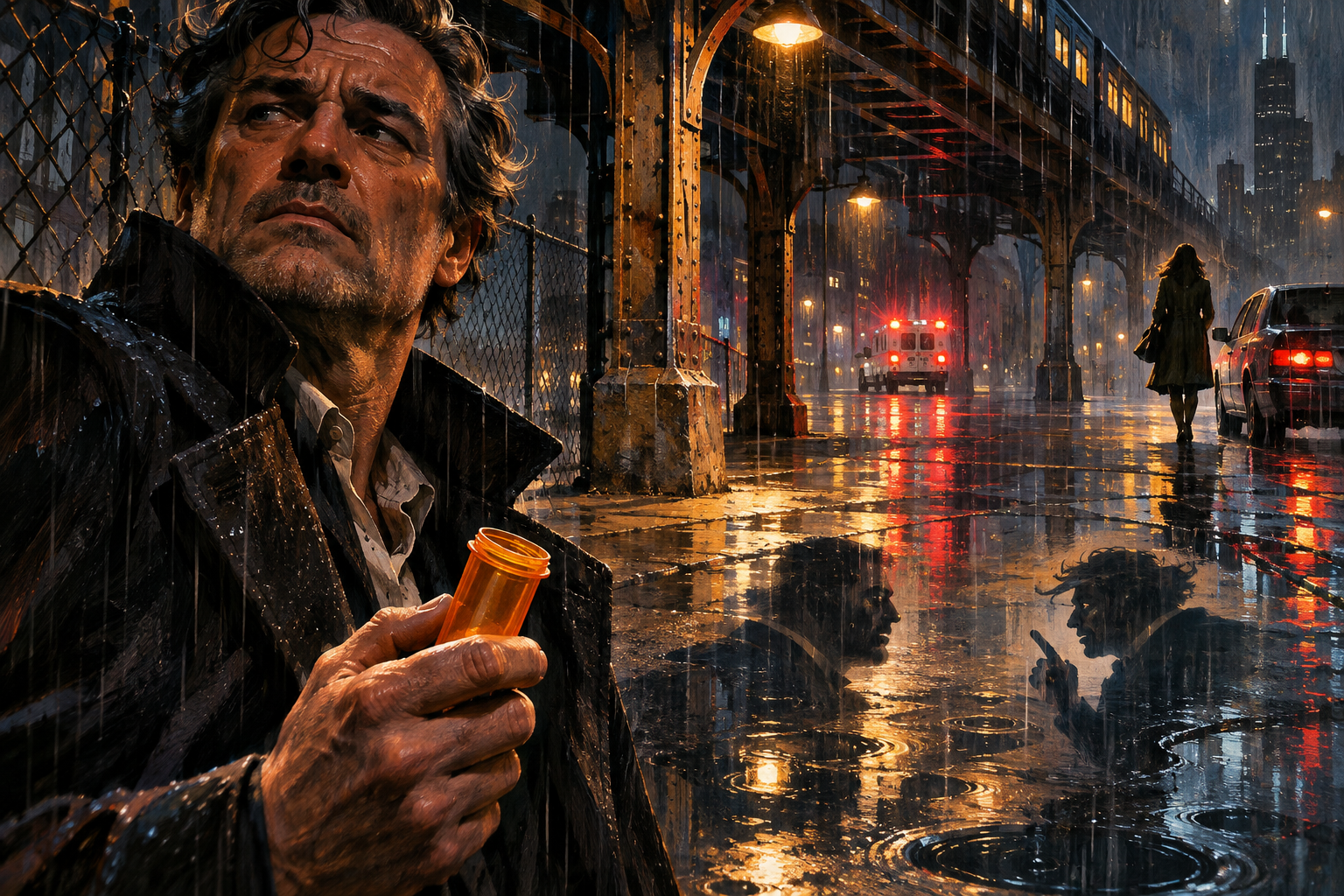
They found Gerald curled beneath a blanket beside a chain-link fence. An orange prescription bottle lay near his hand.
Leah dropped beside him.
“Dad.”
Gerald did not respond. Amanda relayed their location to the dispatcher. Monte knelt.
“Is he breathing?”
Morgan said: Barely.
Cleese snapped: Check instead of asking the cinema.
Monte placed his hand near Gerald’s mouth.
Air.
Faint.
Leah shook him.
“Dad, wake up.”
“Don’t move him,” Amanda said.
“What did he take?” Monte asked.
Leah grabbed the bottle.
“Lorazepam.”
“How many?”
“It’s empty.”
Sirens sounded in the distance.
Morgan said: Gerald did not want to die.
Cleese replied: Intent is currently less useful than circulation.
Monte touched Gerald’s face.
“Stay with us.”
Gerald’s eyelids moved. His mouth formed a word. Leah leaned closer.
“What?”
“Sorry,” Gerald whispered.
Leah began crying. The ambulance arrived. Paramedics took over. They pushed Monte back. Questions came quickly.
How long had Gerald been there?
What had he taken?
How much?
Was alcohol involved?
Leah answered what she could. Monte stood uselessly beside the pillar. The voices fell silent. The paramedics lifted Gerald onto a stretcher. One of them squeezed a bag over his face. They moved toward the ambulance.
Leah followed. Before climbing in, she turned to Monte.
“How did you know?”
Monte had no answer. She stared at him for another second. She entered the ambulance.
The doors closed.
The siren rose.
The vehicle disappeared west.
Monte stood with Amanda beneath the tracks. His hands shook.
“You found him,” she said.
“The voices found him.”
“You listened.”
“Yes.”
“You broke the rules.”
“Yes.”
“You saved his life.”
“Maybe.”
Amanda looked toward the empty road.
“That doesn’t make the rules wrong.”
“I know.”
“It doesn’t make what happened at my office right.”
“I know.”
“It also doesn’t make this wrong.”
Monte looked at her. Both things were true. Again. The universe appeared committed to the theme.
Morgan said: Monte wanted a rule that would make every choice correct.
Cleese replied: There is no such rule. That is why ethics departments require so many binders.
Monte laughed weakly. Amanda took his hand.
For several moments they stood in the cold beneath the rumble of trains. Then Monte asked the question he had been avoiding.
“Did you know this would happen?”
Morgan said nothing. Cleese said nothing. Monte turned his face toward the darkness.
“You knew Gerald would come to my apartment.”
Silence.
“You knew he’d ask about dying.”
No answer.
“You knew he’d leave the meeting.”
Nothing. Amanda watched him.
“What are you asking?”
“Whether they let it happen.”
Morgan finally spoke. Gerald made his choices.
“That isn’t what I asked.”
Cleese said: We knew it was possible.
“How possible?”
No answer.
“You could have warned me.”
Morgan said: You had asked us not to manipulate you.
Monte stared.
The words were calm. Reasonable. Monstrous.
“So you stayed quiet?”
Yes.
Cleese replied: And before you climb onto the moral high ground, you demanded autonomy.
“I didn’t demand ignorance.”
You demanded we stop loading the choice.
“You knew a man might die.”
Morgan said: Many people might die.
“That is bullshit.”
His voice echoed beneath the viaduct. Amanda tightened her grip. Monte pulled his hand away.
“No. You don’t get to do this.”
Morgan was silent.
“You tell me too much when it suits your lesson. Then when someone is in danger, you hide behind free will.”
Cleese said: He is right.
Morgan replied: Warning him would have altered the outcome.
“That was the point!”
And proved nothing about whether he could choose without us.
Monte stopped. The traffic above seemed to disappear.
“What?”
Morgan did not answer.
Cleese did. You wanted to know why we’re here.
Monte felt cold deepen inside him.
“Yes.”
Perhaps this is why.
“To test me?”
Morgan said: To observe what Monte did with knowledge.
Cleese added: And without it.
Amanda stared at him.
“What are they saying?”
Monte could barely speak.
“They’re testing me.”
Amanda’s expression changed.
“No.”
“They let Gerald get to the point of dying to see what I’d do.”
“We don’t know that.”
“They just said it.”
“What exactly did they say?”
Monte repeated it. Amanda listened carefully. Then she shook her head.
“That isn’t proof.”
“It’s enough.”
“No. It’s another interpretation.”
“They admitted it.”
“They said they’re observing what you do. That doesn’t mean they caused anything.”
“They withheld information.”
“So do people.”
“They’re not people.”
“We don’t know what they are.”
Morgan said: Amanda was trying to keep Monte from choosing the most frightening explanation.
Cleese replied: Because frightening explanations feel important, and important explanations feel true.
Monte looked at Amanda.
“Whose side are you on?”
She stepped back. The question hurt her. He saw it.
“I’m on yours,” she said. “But I don’t think that means agreeing with every conclusion you reach.”
The empty pill bottle remained near the fence. He picked it up.
“Are you going to the hospital?” Amanda asked.
“Yes.”
“I’ll come.”
“No.”
“Monte.”
“I need to think.”
“That is exactly when you shouldn’t be alone.”
He put the bottle in his pocket.
“I’m not alone.”
The sentence sounded bitter. Amanda heard it.
“So that’s what I am now?” she asked. “Less present than the voices?”
“No.”
“You just chose them.”
“I didn’t choose this.”
“You keep saying that as though choice only counts at the beginning.”
Morgan said: Amanda was angry because she was afraid.
Cleese replied: And because he is being an ass.
Monte ignored them.
“I’ll call you.”
Amanda stared at him.
“When?”
“I don’t know.”
She laughed once. There it was. His own language returned to him.
Space.
Time.
Uncertainty.
He was doing to Amanda exactly what he resented her for doing to him.
“I’m sorry,” he said.
“Don’t apologize until you know what for.”
She walked toward her car. Monte watched her go. The voices were quiet. He stood alone beneath the tracks.
Then Morgan said: Monte had reached the moment when every version of the story offered him an excuse.
Cleese added: Choose carefully. The excuse you select will become the man you are tomorrow.
Monte took out his phone. Amanda’s name was on the screen. Gerald’s hospital waited west. His district meeting waited in the morning. The voices waited inside him. Every path offered a story.
He could go to the hospital because he had saved Gerald.
He could go home because he was traumatized.
He could follow Amanda because love required repair.
He could confront the voices because none of this could continue.
Each version was true. Each version let him avoid something else.
Monte stood beneath the Wilson tracks with rain beginning to fall again, holding a dead man’s empty prescription bottle despite the fact that Gerald was not yet dead.
Then he understood what made the voices dangerous.
It was not that they lied.
It was that they could always provide a truth that let him sleep.