Chapter Three
The Committee in His Head
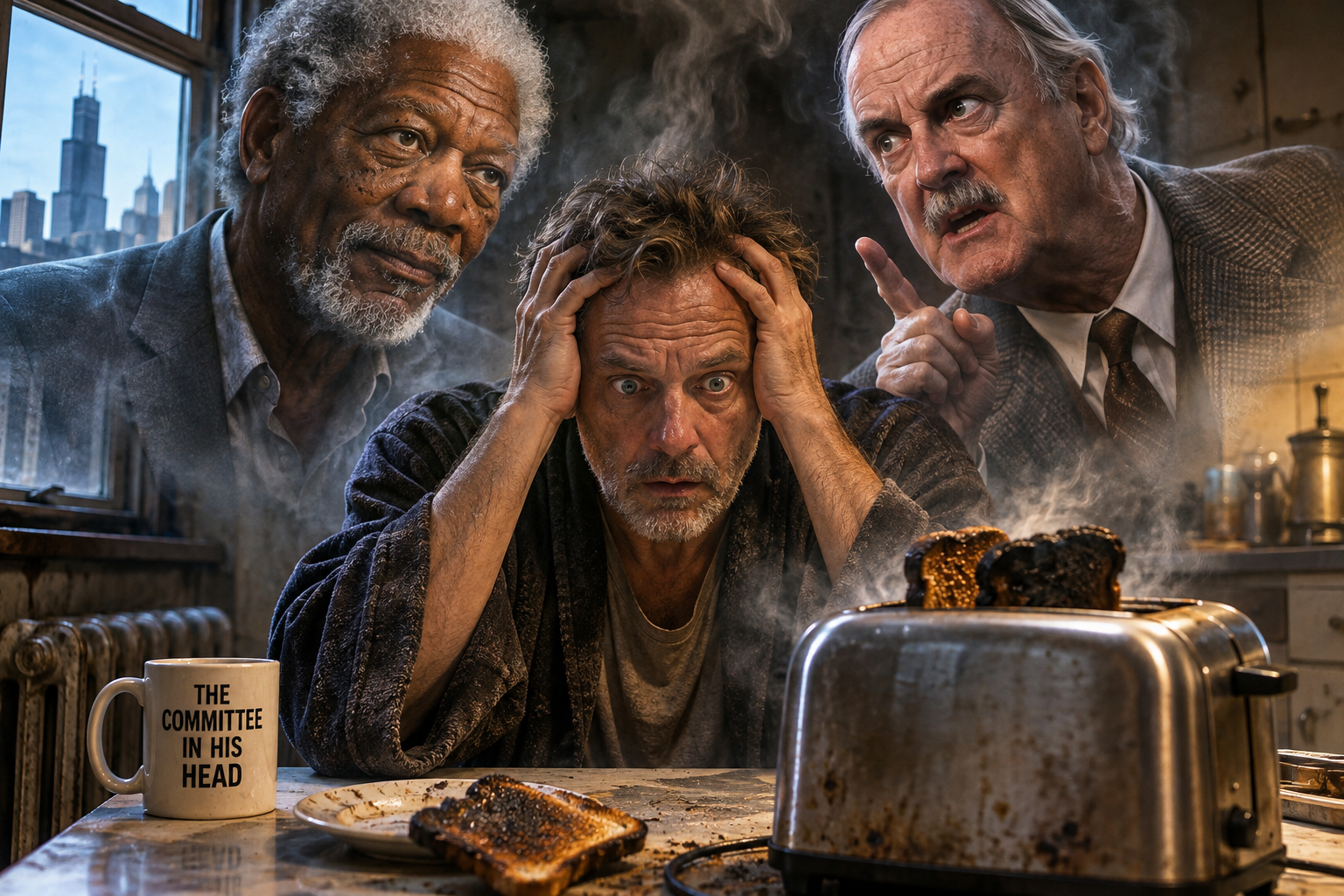
The second voice arrived on Thursday morning while Monte was attempting to make toast.
This was insulting for several reasons. First, toast required almost no skill. It was bread subjected to heat. Humanity had been successfully producing it since shortly after discovering that fire could improve food rather than merely destroy housing. Second, Monte owned a toaster with exactly two settings: pale disappointment and structural carbon. Third, Morgan Freeman had already established himself as the resident authority on Monte’s failures, and one disembodied critic seemed sufficient.
Monte inserted two slices of sourdough and pushed the lever down.
Monte believed breakfast represented progress.
“Don’t start.”
He had purchased the bread nine days earlier.
“It’s still bread.”
Parts of it remained bread.
Monte looked at the greenish spot near the heel of the loaf.
“That’s not on these slices.”
Monte considered mold a regional problem.
Then another voice said:
Oh, for God’s sake, it’s toast, not the Camp David Accords.
Monte froze.
The new voice was British.
More specifically, it sounded exactly like John Cleese during the early stages of a public disagreement that would eventually result in furniture being thrown.
Monte stared at the toaster.
“Who said that?”
You know perfectly well who said it.
Morgan Freeman replied:
He does not.
Of course he does. He’s just spent three days wandering around Chicago asking questions of the ceiling. He’s practically been preparing for a second voice.
Monte gripped the counter.
“No.”
An understandable response, Morgan said.
No, it isn’t, Cleese snapped. It’s monosyllabic denial. A cow could manage it.
Monte backed away from the toaster.
“Absolutely not.”
There, Cleese said. Two words. Improvement already.
Morgan’s voice remained calm.
Monte had believed the arrival of a second narrator would clarify the first.
“I did not believe there would be a second narrator.”
Precisely, Cleese said. No imagination.
Monte turned in a circle. His apartment was unchanged. The radiator rattled. The sourdough sat in the toaster. A sock lay beneath the kitchen table where he had kicked it two days earlier. Nothing in the room suggested that his mind had become a badly managed radio drama.
“Are you John Cleese?”
There was a pause.
That is an absurd question, the British voice said.
“You sound exactly like him.”
You sound vaguely like a man who should own more towels, but I don’t leap to conclusions.
Morgan said:
The voice sounded like John Cleese.
Thank you, Morgan. Stunning contribution. Perhaps next you could tell him the toaster is hot.
The toaster was hot.
Marvelous.
Monte put both hands on the counter.
“Stop talking.”
Both voices went silent. Monte waited. The toaster popped. He screamed.
One slice flew out and landed on the floor. The other remained lodged halfway in the slot, blackened at the edges.
Cleese sighed.
The age of miracles continues.
Morgan said:
Monte had frightened himself with toast.
“I wasn’t expecting it.”
It’s a toaster, Cleese said. Its entire purpose is to surprise bread vertically.
Monte unplugged it.
“No. No, no, no.”
Morgan said:
Monte repeated the word no because he believed reality might mistake him for someone with authority.
Cleese replied:
It often does. Look at Congress.
Monte pointed at the ceiling.
“You two can hear each other.”
Obviously, Cleese said.
Morgan answered:
Yes.
“And you can speak to each other.”
This is speaking, Cleese said. You may recognize it from every conversation in which someone else was waiting for you to finish.
“Why are there two of you?”
Morgan was quiet.
Cleese was not.
Because one of us has spent three days narrating your existence as though you are the final polar bear drifting away on a piece of melting ice.
There is dignity in stillness, Morgan said.
There is also hypothermia.
“I’m hallucinating.”
Possibly, Morgan said.
Almost certainly, Cleese said.
Monte stared at the toaster. The burn smell had reached the smoke detector. He opened the window. Cold air pushed into the apartment.
“What are you?”
Morgan said nothing.
Cleese said:
Oh, good. We’re back to metaphysics before coffee.
Monte turned toward the empty room.
“I asked a question.”
Yes, Cleese replied. And like most people who announce they’ve asked a question, you believe that obligates the universe to produce a satisfactory answer.
Morgan said:
Monte wanted an explanation that would allow him to return to the life he had before.
“I want to know what’s happening.”
No, Morgan said. You want what is happening to become something you already understand.
Cleese sighed.
He hears voices, Morgan. We needn’t turn it into a cathedral mural.
Understanding is not always a reduction.
And solemnity is not always wisdom. Sometimes it is merely speaking slowly enough that nonsense has time to put on a necktie.
Monte held up both hands.
“Shut up.”
They stopped. He breathed. This was worse.
Morgan Freeman alone had been terrifying but orderly. The voice had possessed a single tone, a single rhythm, a single implied intelligence. Now Monte’s consciousness had become a panel discussion. He walked to the living room and retrieved the yellow legal pad.
At the top of a clean page, he wrote:
SECOND VOICE
Then:
Sounds like John Cleese
British
Hostile
Can hear first voice
First voice can hear second
Voices disagree
Cleese said:
His handwriting has worsened.
Morgan answered:
He is frightened.
Fear doesn’t require cursive.
Monte dropped the pen.
“I told you to stop.”
You told us to shut up, Cleese said. That instruction expired when you began taking minutes.
Monte wrote:
Literal.
Petty, Cleese said.
He added:
Petty.
Oh, excellent. We’re conducting peer review.
Morgan said:
Monte used lists because lists gave shape to fear.
Cleese replied:
Lists give shape to groceries. Fear generally manages its own architecture.
“Do you always argue?”
No, Morgan said.
Yes, Cleese said.
Silence followed. Monte waited for one of them to correct the other. Neither did. He sat on the couch.
“Can Amanda hear either of you?”
No, Morgan said.
“Can anyone?”
No, Cleese said. Which should be obvious from the fact that no one has yet beaten you to death with a shovel.
“What do you know about her?”
Morgan remained silent.
Cleese said:
Quite a lot.
Monte stood.
“Don’t.”
You asked.
“I’m establishing boundaries.”
You cannot establish a boundary after opening with an inquiry.
Morgan said:
Monte feared the second voice would reveal truths without restraint.
“Yes.”
Reasonable, Cleese said.
Monte frowned.
“You agree?”
I’m not a monster.
Morgan replied:
Not all cruelty recognizes itself as cruelty.
And not all pomposity recognizes itself as narration.
Monte rubbed his temples.
“Why do you sound like celebrities?”
You chose the voices, Cleese said.
Monte stopped.
“What?”
Morgan said nothing.
Cleese continued.
You heard him because you needed reassurance delivered with the gravity of scripture. You hear me because reassurance has made you insufferable.
“That isn’t an answer.”
It’s an answer. You merely dislike it.
Morgan spoke.
The voices were familiar to Monte.
“That’s not the same as saying I chose them.”
People choose many things without being aware of the choice, Morgan said.
Cleese groaned.
Yes, and people also trip over ottomans. Not every unconscious act is a pilgrimage.
Monte paced.
“So you’re parts of me.”
Possibly, Morgan said.
God, I hope not, Cleese said. I’ve seen the apartment.
“Then how do you know things I don’t?”
No answer.
Monte stopped pacing.
“How did you know about Gerald?”
Silence.
“Cynthia?”
Nothing.
“Amanda?”
The room remained still. The voices had no difficulty criticizing him. They only became evasive when the questions approached origins. Monte picked up his phone.
“I’m calling her.”
Monte believed Amanda’s presence would make the voices less real, Morgan said.
Or at least provide someone else to witness the breakdown, Cleese added.
“I’m calling her because she deserves to know there are two of you.”
Every woman longs to hear that sentence, Cleese said.
Amanda answered on the fourth ring.
“Hey.”
Her voice was cautious.
Monte hated that.
“Are you busy?”
“I’m at work.”
“I need to tell you something.”
A pause.
“What did the voice say?”
“There’s another one.”
Silence.
“Another voice?” she asked.
“Yes.”
“What does this one sound like?”
Monte hesitated.
“John Cleese.”
Another pause.
“The Monty Python guy?”
The Monty Python guy, Cleese repeated bitterly. Decades of work reduced to one parrot and a silly walk.
Morgan said:
Most lives became summaries when viewed from a distance.
Thank you, gravestone.
Amanda said, “Monte?”
“They’re talking to each other.”
“Right now?”
“Yes.”
“What are they saying?”
“That John Cleese resents being called the Monty Python guy.”
Amanda breathed out.
It may have been a laugh.
It may have been despair.
“Are you joking?”
“I wish.”
“Did you go back to the doctor?”
“No.”
“Monte.”
“I was suspended.”
“That means you’re free.”
“It means I don’t have insurance coverage for hallucination tourism.”
“You have insurance.”
“I have catastrophic insurance. Apparently the catastrophe has to possess a billing code.”
Amanda lowered her voice.
“Come to my office.”
“I don’t think your coworkers need this.”
“I’ll meet you downstairs.”
“Okay.”
He hung up.
Cleese said:
She is remarkably patient.
Morgan replied:
She loves him.
People have loved defective appliances. That isn’t an endorsement.
Monte put on his coat.
“You don’t get to talk about her.”
You’ve said that, Cleese replied.
“I mean it.”
So do most men immediately before repeating themselves.
Morgan said:
Monte was attempting to protect Amanda from truths he could not control.
“Yes.”
Cleese responded:
No. He’s attempting to protect himself from her reaction to those truths.
Monte stopped at the door.
“Are you always going to do this?”
Morgan said:
Do what?
“Take everything I say and explain that I mean something else.”
Cleese answered:
Not everything. Occasionally you say exactly what you mean. Usually by accident.
Outside, Chicago had entered that portion of winter when the snow no longer looked romantic and had become municipal paste.
Gray slush lined the curbs. The sidewalks were narrowed by frozen ridges. Cars carried a crust of salt that made every vehicle resemble evidence recovered from an ocean floor.
Monte walked toward the train.
The voices continued.
Morgan narrated his movements.
Cleese objected to the narration.
Monte turned east toward the Red Line.
We know. We’re with him.
The wind cut through his coat.
He bought the coat at Target. A light breeze could cut through it.
Monte regretted not wearing gloves.
Everyone regrets not wearing gloves. This is Chicago, not a revelation.
“You’re distracting.”
From what? Cleese asked.
“Everything.”
Morgan said:
The voices occupied the space where Monte’s thoughts had once been.
Cleese replied:
His thoughts were hardly using it.
At the station, Monte added money to his transit card.
Monte had allowed the balance to fall below two dollars, Morgan said.
Because he enjoys discovering whether poverty can be made suspenseful, Cleese added.
Monte walked through the turnstile.
A man behind him pushed through the emergency exit without paying.
The alarm sounded.
The man had spent his final three dollars on diapers, Morgan said.
Monte looked back.
The man wore a black work jacket and carried a pharmacy bag.
Cleese said:
And before you perform an act of public sainthood, he also stole the pharmacy bag.
Monte stopped.
“What?”
The man glanced at him and hurried toward the stairs.
Morgan said:
Both things were true.
Monte watched him disappear.
“That’s not helpful.”
Truth rarely arrives arranged by moral category, Morgan said.
Cleese replied:
It could make an effort.
The train platform was crowded.
Monte stood among commuters staring into phones, each face lit by a small private screen.
The voice began speaking about them.
A woman in a blue coat had lied to her employer about her mother’s death.
A teenager was carrying his father’s ashes in a coffee tin inside his backpack.
A man reading a paperback had not turned the page in seven minutes because he was watching the reflection of the woman beside him.
A nurse had worked fourteen hours and was afraid to go home because her husband had been drinking.
Monte closed his eyes.
“Stop.”
Morgan stopped.
Cleese did not.
This is the problem with transcendence. No one considers the acoustics.
“Please.”
For once, the British voice softened.
Very well.
The train arrived.
Monte boarded.
He stood near the door, gripping the metal pole.
The car rocked south.
For three stops, neither voice spoke.
The silence should have been relief.
Instead, Monte felt abandoned.
He looked around.
No biographies.
No hidden grief.
No revelations.
Only strangers.
He had wanted the voices quiet.
Now the people around him seemed sealed away.
He realized something he did not want to admit.
He had begun to need the narration.
Morgan said:
Monte missed knowing.
Cleese added:
Of course he did. Omniscience is cocaine for nosy people.
“I’m not nosy.”
You managed a coffee shop for four years, Cleese said. You know the divorces, medications, affairs and bowel habits of six city blocks.
“That’s customer service.”
That is surveillance with pastries.
Morgan said:
The knowledge had made Monte feel connected.
“Yes.”
No, Cleese replied. It made him feel superior.
Monte’s grip tightened around the pole.
“Which is it?”
The two voices were quiet.
Then Morgan said:
Both.
Cleese sighed.
Annoyingly, yes.
The train emerged from underground near Fullerton.
Sunlight flashed across the windows.
Monte looked at the city passing outside: rooftops, alleys, brick walls layered with faded advertisements, back porches sagging beneath decades of paint.
Connected.
Superior.
Both.
He had assumed insight would make him compassionate.
Instead, it had also made him greedy.
Each hidden truth felt like entry into a room where everyone else remained locked outside.
He hated himself for enjoying it.
Cleese said:
That is at least marginally promising.
“What is?”
The self-loathing. Not healthy, obviously, but preferable to a messiah complex.
Morgan replied:
Shame without action was only another form of vanity.
There you go again, Cleese said. Every emotion is apparently wearing a disguise.
Most are.
This is why no one invites you to dinner.
Monte got off downtown and walked toward Amanda’s office near the Loop.
Her nonprofit occupied the fourth floor of an old building above a printing company and a store that sold ergonomic chairs with the grim seriousness of surgical equipment.
Amanda waited in the lobby.
She wore a black skirt, boots and an expression that combined affection with readiness to call emergency services.
“You look terrible,” she said.
“That’s becoming a greeting.”
“Did you sleep?”
“No.”
“Have you eaten?”
“Toast attempted to frighten me.”
She stared at him.
“What?”
“Nothing.”
It was quite something, Cleese said.
Morgan added:
The toast had been overcooked.
“Stop talking about toast.”
Amanda lowered her voice.
“Which one was that?”
“Both.”
She led him into a conference room.
The walls were glass. Colorful posters advertised youth performances featuring trapezes, juggling and children wearing expressions of aggressive self-esteem.
Amanda closed the blinds.
“Tell me everything.”
Monte sat.
“The second voice started this morning.”
“What did it say first?”
“That making toast wasn’t the Camp David Accords.”
Amanda smiled despite herself.
“So the voice is funny.”
“It thinks so.”
Correct, Cleese said.
Morgan replied:
Humor is often a defense against vulnerability.
And solemnity is often what happens when humor has been denied parole.
Monte pointed to the air between them.
“They’re doing that constantly.”
“Talking to each other?”
“Arguing.”
“About you?”
“About everything.”
Amanda sat across from him.
“Do they have names?”
“They sound like Morgan Freeman and John Cleese.”
“That isn’t what I asked.”
Monte frowned.
“They haven’t identified themselves.”
“So give them names.”
Cleese said:
Absolutely not.
Morgan remained silent.
Amanda watched Monte’s face.
“What?”
“The British one objects.”
“Why?”
Because naming something is the first step toward pretending you own it.
Monte repeated this.
Amanda considered.
“That sounds more like something Morgan Freeman would say.”
Thank you, Morgan said.
Oh, go narrate a prison yard.
Amanda leaned forward.
“Can they hear me?”
“Yes.”
“Can they answer questions I ask?”
“I think so.”
She looked toward the center of the room.
“Why are you here?”
Silence.
Monte waited.
Nothing.
Amanda looked at him.
“They’re not answering?”
“No.”
“Ask them.”
“Why are you here?”
Morgan said:
To observe.
Cleese replied:
To object.
Monte repeated the answers.
Amanda frowned.
“That’s all?”
“Yes.”
“To observe what?”
Morgan was silent.
“To object to what?” Monte asked.
Him, Cleese said.
Amanda looked at Monte.
“Well?”
“The British one says me.”
“That tracks.”
“Thank you.”
She took out a notebook.
“What?”
“I’m documenting this.”
“You’re taking notes?”
“You took notes.”
“I was conducting tests.”
“You put an earring under a cereal bowl.”
“That was one test.”
Amanda wrote:
Voice One: Morgan Freeman. Observes.
Voice Two: John Cleese. Objects.
Then she looked up.
“Do they know the future?”
“Sometimes.”
“Do they know everything about everyone?”
“No.”
“How do they choose what to reveal?”
“I don’t know.”
“Do they lie?”
“I don’t know.”
Yes, Cleese said.
Monte froze.
“What?”
Amanda looked up.
“Which one?”
“The British one says yes.”
Morgan said nothing.
Monte turned toward the empty room.
“You lie?”
Of course.
Amanda went still.
“Ask him when.”
“When have you lied?”
Frequently.
“About what?”
Details. Intentions. Emphasis. The things all narrators lie about.
Morgan spoke.
Not every incomplete truth is a lie.
That is exactly the sort of sentence a liar says while straightening his tie.
Monte stood.
“You told me Amanda loved me.”
She did, Morgan said.
“You told me Gerald had vodka in the bottle.”
He did.
“You told me Cynthia’s husband called her Denise.”
He did.
“Then what was the lie?”
Cleese answered.
That the facts meant what you believed they meant.
Monte looked at Amanda.
Cynthia.
The dead first wife.
The name Denise.
The voice had stated facts.
Monte had created adultery.
Morgan said:
Monte had mistaken revelation for interpretation.
Cleese replied:
And because he is a man, interpretation immediately promoted itself to certainty.
Amanda looked between the empty places in the room as if she could locate the voices by tracking Monte’s anger.
“Ask them whether they’re trying to help you.”
Monte asked.
Morgan said:
Yes.
Cleese said:
No.
Monte laughed.
Not because anything was funny.
Because the alternatives were screaming or breaking a conference-room chair, and he had been raised to respect office furniture.
“They disagree.”
Amanda set down the pen.
“Maybe they’re not supposed to agree.”
“Then what’s the point?”
“What if the point is that there isn’t one answer?”
“That’s not a point. That’s a seminar.”
Cleese said:
Finally, something sensible.
Morgan replied:
Contradiction is not the absence of truth.
No, it’s usually the presence of two people who refuse to stop talking.
Amanda leaned back.
“Can they hear each other’s thoughts?”
Monte asked.
Morgan said:
No.
Cleese replied:
Thank Christ.
“Can they hide things from each other?”
Yes, both voices said.
For the first time, they spoke in unison.
The effect was terrifying.
Morgan’s depth and Cleese’s sharpness overlapped into something neither human nor theatrical—a chord struck inside Monte’s skull.
He grabbed the table.
Amanda stood.
“What happened?”
“They answered together.”
“What did they say?”
“Yes.”
“To what?”
“That they can hide things from each other.”
Amanda sat slowly.
“So neither knows everything.”
Correct, Cleese said.
Morgan added:
Knowledge had limits.
Everything has limits, Morgan. That’s what keeps trousers from becoming carpets.
Monte ignored him.
“Can one of you be wrong?”
Yes, Morgan said.
Frequently, Cleese added.
“Can both of you be wrong?”
Silence.
Amanda watched him.
“No answer?”
“No.”
She closed the notebook.
“Then maybe neither one is an authority.”
Monte stared at her.
The thought had not occurred to him.
From the moment the first voice began, Monte had assumed authority because of the sound. Morgan Freeman’s voice arrived carrying a lifetime of fictional presidents, judges, gods and wise men who knew what the protagonist needed before the protagonist knew there was a lesson.
Cleese arrived carrying intelligence sharpened into exasperation, the confidence of a man prepared to explain why everything was absurd and everyone had assembled it incorrectly.
Both sounded certain.
Certainty had always seduced Monte.
Managers.
Directors.
Critics.
Women who knew where they wanted to eat.
People who entered a room with a plan.
He had mistaken confidence for knowledge because confidence relieved him of responsibility.
Morgan said:
Monte had spent much of his life searching for someone whose certainty could replace his own judgment.
Cleese replied:
And now that he has two, he is annoyed they haven’t formed a coalition government.
Amanda studied his face.
“What did they say?”
Monte told her.
She nodded.
“That sounds right.”
“Whose side are you on?”
“Mine.”
“That was fast.”
“I’ve had practice.”
Amanda had spent years learning that love did not require surrendering jurisdiction, Morgan said.
Cleese replied:
Good. At least someone in the room has constitutional principles.
Monte sat.
“So I shouldn’t trust them.”
“I didn’t say that.”
“You just said they aren’t authorities.”
“They might know things. That doesn’t mean they know what you should do.”
“That’s less useful.”
“Yes.”
Amanda reached across the table.
“You’re still responsible for your choices.”
“That seems unfair.”
“It is adulthood.”
Cleese said:
She’s excellent. Keep her.
Morgan answered:
People were not possessions.
It’s an expression.
Expressions reveal assumptions.
And your voice reveals a desperate need for a nap.
Amanda squeezed Monte’s hand.
“What are they saying now?”
“Nothing helpful.”
“Then stop listening for a minute.”
“How?”
“Listen to me.”
He looked at her.
“Do you trust me?”
“Yes.”
“More than them?”
“Yes.”
The answer came too quickly.
Morgan said nothing.
Cleese said nothing.
Monte noticed.
That frightened him.
Amanda continued.
“I think you need to complete the medical tests.”
“Fine.”
“Today.”
“Fine.”
“And you need to stay away from work until we know more.”
“I’m already suspended.”
“Good.”
“It isn’t good.”
“It’s convenient.”
“I need the job.”
“You need a brain.”
“Starbucks has yet to require one.”
She smiled.
Then her expression became serious.
“And you cannot keep intervening in strangers’ lives.”
“Gerald might have started drinking.”
“And Cynthia got to talk to her husband before he died.”
“So I should intervene.”
“That isn’t what I said.”
“Then what?”
Amanda took a breath.
“You need rules.”
Cleese groaned.
Oh, wonderful. A bureaucracy.
Morgan said:
Rules could protect people from Monte’s certainty.
Rules protect people from discretion, which is very different.
Monte looked upward.
“They’re arguing about rules.”
Amanda opened her notebook again.
“Let them.”
She wrote:
RULE ONE: Do not reveal private information merely to prove the voices are real.
“Good,” Monte said.
RULE TWO: Do not interfere unless someone appears to be in immediate danger.
“What counts as immediate?” he asked.
“We’ll figure it out.”
The beginning of every terrible policy, Cleese said.
RULE THREE: Facts supplied by the voices are not complete explanations.
Morgan said:
Wise.
Cleese replied:
Obvious, but civilization is largely the formal documentation of the obvious.
Amanda wrote:
RULE FOUR: Monte makes the final decision.
He stared at the words.
“That seems like the weakest rule.”
“It’s the most important.”
“I’m the least qualified person involved.”
“Correct.”
“That doesn’t bother you?”
“Terribly.”
The conference-room door opened.
A young man with thick glasses leaned inside.
“Sorry. Amanda, the board call got moved to eleven.”
“Thanks, Simon.”
He nodded to Monte.
“Hey.”
“Hey.”
Simon left.
The door closed.
Morgan said:
Simon was planning to resign.
Monte tensed.
Cleese added:
Because Amanda’s executive director had been taking money from restricted grants to cover payroll.
Monte looked at Amanda.
She saw it immediately.
“What?”
“Nothing.”
“Rule one.”
“I know.”
“What did they say?”
“I can’t tell you.”
“It’s about me?”
“Your organization.”
Amanda lowered the notebook.
“Is someone in danger?”
“Not physically.”
“Then rule two.”
“It could affect you.”
“Rule three.”
Monte stared at her.
She had created the rules thirty seconds earlier and was already using them against him.
“This is different.”
“Why?”
“Because it’s your job.”
“That makes it more tempting, not more ethical.”
Morgan said:
Amanda was right.
Cleese replied:
She’s going to become unbearable.
Monte stood.
“If I know something that could hurt you, I’m supposed to say nothing?”
“You don’t know it. The voices said it.”
“That’s how I know anything now.”
“No. It’s how you receive information. Knowing requires more.”
Simon passed behind the glass wall outside.
Monte watched him.
A man preparing to quit.
Money misused.
Maybe theft.
Maybe survival.
Maybe both.
“What if you lose your job?”
Amanda held his gaze.
“Then I lose my job.”
“I can prevent that.”
“Can you?”
“I can warn you.”
“And I can accuse someone based on the voices in my boyfriend’s head.”
The word boyfriend no longer warmed him.
It frightened him.
The voices were inside their relationship now.
Not merely commenting.
Participating.
Cleese said:
Relationships have survived parents, children, religion and shared bathrooms. Two narrators are hardly unprecedented.
Morgan replied:
The voices changed what Monte and Amanda could keep from each other.
So does marriage.
“We’re not married,” Monte said.
Amanda’s eyebrows rose.
“I didn’t say you were.”
“Not you.”
“Which one brought up marriage?”
“The British one.”
I made a comparison, Cleese said.
Morgan added:
Monte’s fear had supplied the implication.
Amanda waited.
Monte shook his head.
“Forget it.”
“I doubt that’s going to be possible.”
A phone rang on Amanda’s desk outside.
She looked toward the door.
“I have to work.”
Monte nodded.
“I’ll go.”
“Where?”
“Home.”
“No wandering around interrogating strangers?”
“I don’t interrogate.”
Cleese said:
He ambushes.
Morgan replied:
He seeks connection.
He ambushes people with connection.
Amanda put on her coat.
“I’m taking you to the emergency room.”
“You have a board call.”
“I’ll cancel.”
“No.”
“Monte.”
“I can go alone.”
“That is exactly what you shouldn’t do.”
“I’m not helpless.”
Monte confused accepting help with becoming helpless, Morgan said.
Cleese replied:
He also confuses stubbornness with masculinity, but there’s a queue.
“Fine,” Monte said. “After the call.”
Amanda studied him.
“You’ll stay here?”
“Yes.”
“No going outside?”
“Yes.”
“No talking to Simon?”
Monte looked through the glass.
Simon was speaking to another employee.
“Yes.”
“Promise.”
“I promise.”
She left.
Monte sat alone in the conference room.
Alone, except for the committee.
For several minutes, no one spoke.
Monte picked up Amanda’s notebook.
The rules sat on the page in her handwriting.
Clear.
Simple.
Almost useless.
He closed it.
“Tell me about the money.”
Morgan said nothing.
Cleese replied:
Restricted grant funding has been shifted into general operating expenses for four months.
“How much?”
Seventy-eight thousand dollars.
“Stolen?”
Morgan said:
Not exactly.
Cleese said:
Money is always stolen exactly. Motives are the part people blur.
“Who did it?”
Silence.
“You know.”
Morgan remained quiet.
Cleese said:
Yes.
“Who?”
Amanda’s executive director.
“Why?”
Morgan answered:
To keep the organization open.
Cleese added:
And to keep his own salary intact.
“Does Amanda know?”
No, they said together.
Again, the voices overlapped.
Monte felt the sound inside his teeth.
He looked through the glass.
Amanda stood near the reception desk, smiling at a coworker.
She trusted him.
She had asked him not to tell her.
No—that was not accurate.
She had instructed him to follow rules they had created because neither of them knew what else to do.
Rule three: facts supplied by the voices were not complete explanations.
The voices had provided facts.
Or claimed to.
The executive director moved money.
To save the organization.
To save his salary.
Both could be true.
Monte’s instinct was to warn Amanda.
His deeper instinct was to act.
His deepest instinct was to become necessary.
Morgan said:
Monte wanted to protect her.
Cleese replied:
Monte wanted to become the person who had protected her.
The distinction cut.
“Is there a difference?”
Yes, Morgan said.
Usually, Cleese added. Though motives are rarely pure enough to deserve their own cutlery.
Monte stood and walked to the window.
Chicago spread below.
People moved through the canyon of buildings.
Tiny from above.
Manageable.
From the fourth floor, a person could almost believe lives were simple.
Simon entered the conference room.
Monte turned.
“Sorry,” Simon said. “Amanda said you could wait in here.”
“I can.”
Simon pointed to the notebook.
“She doing an intervention?”
“Something like that.”
Simon smiled.
Then the smile faded.
“You okay?”
“No.”
The honesty surprised both men.
Simon leaned against the table.
“Yeah. Me neither.”
Monte felt the voices stir.
“No,” he said.
Simon frowned.
“No what?”
“Nothing.”
Cleese said:
Brilliant recovery.
Morgan remained silent.
Simon looked toward the door.
“I’m quitting today.”
Monte stared at him.
Simon laughed nervously.
“I don’t know why I told you that.”
“Maybe because you wanted someone to know.”
“Maybe.”
He sat.
“I’ve been here six years.”
“That’s a long time.”
“Long enough to know where the bodies are.”
Monte said nothing.
Simon rubbed his hands together.
“The organization is broke.”
Monte’s heart accelerated.
Rule three.
Incomplete facts.
“Does Amanda know?”
“No. Not yet.”
“Why not?”
“Because she’ll try to save it.”
“Can it be saved?”
Simon laughed.
“Everything can be saved if you redefine saved.”
Morgan said:
Simon had discovered the transfers.
Cleese added:
And had copied the financial records.
Monte looked at him.
“You found something.”
Simon’s face changed.
“What do you mean?”
“The money.”
The room went still.
Simon stood.
“How do you know about that?”
Monte heard Amanda’s rule shatter.
Facts supplied by voices were not complete explanations.
Now he had confirmation.
Or something that looked like confirmation.
“I don’t know.”
“Did Amanda tell you?”
“No.”
“Who did?”
“No one.”
Simon moved toward the door.
“Wait.”
“No.”
“I’m not trying to expose you.”
“You just mentioned money I haven’t told anyone about.”
“The executive director moved grant funds.”
Simon stared.
Morgan said:
Simon feared Monte had been sent to intimidate him.
Cleese replied:
Which is ridiculous. No one sends a Starbucks manager as muscle unless the target is a scone.
“I’m not here to intimidate you.”
Simon opened the door.
Amanda stood outside.
She had returned without Monte noticing.
Her face was pale.
“What’s going on?” she asked.
Simon looked at Monte.
“You tell her.”
Amanda entered and closed the door.
“Tell me what?”
Monte looked at the notebook.
The rules.
The promise.
Amanda followed his gaze.
Understanding arrived.
“What did you do?”
“I didn’t do anything.”
“You talked to Simon.”
“He came in.”
“You promised.”
“He told me he was quitting.”
Amanda looked at Simon.
“You’re quitting?”
Simon turned away.
Amanda looked back at Monte.
“What did you say?”
Monte took a breath.
“There’s money missing.”
Simon closed his eyes.
Amanda went still.
“How do you know that?”
“The voices.”
“You promised me.”
“I know.”
“You promised me ten minutes ago.”
“Because you said you’d lose your job.”
“That was my decision.”
“I was trying to protect you.”
“No. You were trying to use me as an excuse.”
Cleese said:
She’s right.
Morgan said:
He was afraid.
Fear is not a diplomatic passport.
Simon looked between them.
“What voices?”
Amanda ignored him.
“You couldn’t last ten minutes.”
“I got confirmation.”
“By revealing private information to the person whose private information it was?”
“He was going to tell you.”
“You didn’t know that.”
“The voice did.”
“No. The voice said something. You decided what it meant.”
Monte felt anger rise.
“So I’m supposed to do nothing?”
“You’re supposed to accept that you don’t control everyone’s life.”
“I’m trying to help.”
“That’s what controlling people always call it.”
The sentence struck harder than the slap.
Morgan was silent.
Cleese was silent.
The absence of commentary made the accusation feel official.
Simon moved toward the door.
“I should go.”
Amanda stopped him.
“No. Please.”
He looked at Monte.
“Does he work for the board?”
“No.”
“Who is he?”
“My boyfriend.”
Simon shook his head.
“That doesn’t answer anything.”
“I know.”
He left.
Amanda waited until the door closed.
Then she turned to Monte.
“You need to go.”
“I thought we were going to the hospital.”
“I’ll call you a cab.”
“Amanda.”
“Not now.”
“I made a mistake.”
“You broke the first promise you made after we agreed this thing needed limits.”
“I was afraid for you.”
“I know.”
“That matters.”
“It explains it. It doesn’t erase it.”
Monte stepped closer.
She stepped back.
The movement stopped him.
“Do you want to know what they’re saying?” he asked.
“No.”
“They’re not saying anything.”
“Good.”
“That scares me.”
“Then you finally understand how I feel.”
Amanda opened the conference-room door.
Monte walked past her.
At the lobby, he turned.
“Are we okay?”
Amanda looked at him.
“No.”
The answer was not cruel.
That made it worse.
“Will we be?”
“I don’t know.”
He waited for a narrator to explain.
Neither did.
Monte left.
Outside, the city had warmed just enough for the snow to turn into rain.
He walked without a destination.
His suspension meant there was nowhere he was required to be. Amanda did not want him near her. His apartment waited with its dead basil and failed toast.
The voices remained silent.
“Say something.”
Nothing.
He reached State Street.
Crowds moved around him beneath umbrellas.
“Come on.”
No answer.
“You’ve had something to say about every goddamned thing I’ve done for four days.”
Silence.
“Now you’re quiet?”
Morgan spoke first.
Monte wanted judgment.
“Yes.”
Cleese said:
Because punishment would allow him to believe the matter was finished.
Monte stopped beneath a theater marquee.
“Was I wrong?”
Morgan said:
Yes.
Cleese said:
No.
Monte laughed bitterly.
“Of course.”
Morgan continued.
He violated Amanda’s trust.
Cleese added:
He also uncovered theft.
“Misuse,” Morgan corrected.
Funds placed where they were explicitly forbidden to go. We have a perfectly serviceable word for that.
The intent was preservation.
The road to hell is generally paved by people explaining the budget.
Monte looked up at the marquee.
The theater was dark during the day.
Posters advertised a touring musical about a misunderstood historical figure whose moral complexity had been reduced to choreography.
“What should I have done?”
Morgan said:
Waited.
Cleese said:
Acted more intelligently.
“That means nothing.”
Most advice means nothing, Cleese replied. It is usually regret wearing spectacles.
Monte resumed walking.
“Why are you here?”
Morgan said:
To observe.
Cleese said:
To object.
“No. Why now?”
Silence.
Monte stopped at the river.
The water below was dark and streaked with rain.
“Why me?”
Nothing.
He gripped the railing.
“You know things. You push me. You criticize every move. You drag people’s secrets into my life and then lecture me for touching them.”
Morgan said:
Truth did not create Monte’s choices.
“Bullshit.”
Cleese replied:
He has a point.
Morgan continued:
Knowledge did not remove responsibility.
“You handed me a live grenade and criticized my throwing technique.”
Cleese said:
That is also a point.
Morgan fell silent.
Monte looked toward the buildings reflected in the river.
For the first time, the British voice spoke without irritation.
We are not guides.
Morgan’s response came quietly.
No.
Monte turned from the river.
“What are you, then?”
The voices answered one after the other.
Witnesses, Morgan said.
Symptoms, Cleese said.
Monte waited.
“That’s it?”
Morgan said:
No.
Cleese said:
Probably.
The rain thickened.
Pedestrians rushed past.
Monte remained at the railing.
A woman nearby dropped a glove. A man walking behind her picked it up and hurried to return it.
The voice did not explain why.
A cab driver allowed another car to merge.
No narration.
A teenager shared an umbrella with an elderly stranger.
No hidden motive.
No secret history.
Just people acting.
Monte watched.
Without the voices, the gestures remained incomplete.
Perhaps that was not a flaw.
Perhaps incompleteness was the condition under which everyone else lived.
Morgan said:
Monte had believed knowing more would make choosing easier.
Cleese replied:
Knowledge merely increases the number of ways one can be wrong.
The two voices did not argue.
Monte watched the river.
“Can you leave?”
Silence.
“Can I make you leave?”
Morgan said:
Not yet.
Cleese added:
Though I’m open to proposals.
“When?”
No answer.
Monte’s phone buzzed.
A message from Amanda.
Simon showed me the records. You were right about the money.
Monte felt relief.
Then another message appeared.
You were still wrong.
He read both several times.
Morgan said nothing.
Cleese said nothing.
Monte put the phone away.
Rain moved across the river in sheets.
He understood the two sentences.
The facts were correct.
The choice was not.
He had spent his life believing correctness and goodness were roommates.
They were not even neighbors.
“What happens now?” he asked.
Morgan answered:
Monte would go home.
Cleese added:
He would apologize badly.
He would attempt to do better.
He would fail again.
Morgan’s voice deepened.
And then he would be given another chance.
Cleese sighed.
That is the trouble with life. Entirely too many sequels.
Monte smiled despite himself.
The two voices fell quiet.
He turned away from the river and began walking north.
For once, neither narrator explained where he was going.
Monte did not know.
That was not the same as being lost.