Chapter Three
The Experiment
Monte woke at 6:17 with the conviction that something terrible was going to happen at 8:43.
This was not unusual. Monte frequently woke with the conviction that something terrible was going to happen. Most mornings, the terrible thing turned out to be work, an unpaid bill, or the realization that he had reached an age when sleeping incorrectly could injure him. This morning was different. He had been given an appointment with the inexplicable, and the inexplicable had been irritatingly specific.
He checked his phone.
6:18.
Two hours and twenty-five minutes until whatever Morgan Freeman had promised him. Monte lay on his back and stared at the ceiling.
“Are you there?”
Monte already knew the answer Morgan said nothing.
“Eight forty-three. You remember saying that?”
Silence.
“Because I do. I was there.”
Monte considered the possibility that the voice had gone away. He had spent the previous several days wanting precisely that. Now the prospect irritated him. It was like being invited to a meeting by someone who refused to provide an agenda and then failed to attend.
“You don’t get to make a prediction like that and disappear.”
Monte sat up.
“Wonderful. Good morning to you, too.”
He showered, shaved, dressed, and made coffee. He considered calling Amanda, but she had gone home the previous evening after insisting that he visit urgent care. They had negotiated a morning appointment. He had agreed. She had kissed him goodbye with the expression of a woman who loved a man and was seriously considering having him examined by professionals.
At 7:26, he sent her a text.
Good morning. Still going to urgent care. Just need to do something first.
He stared at the message before sending it. The phrase “just need to do something first” had been responsible for a significant percentage of human disasters, but he could think of no better way to describe waiting for a supernatural narrator to reveal an unspecified truth.
Amanda replied four minutes later.
What something?
Monte put the phone in his pocket. He had no intention of answering a question he could not answer without sounding insane.
At 7:51, he left the apartment.
Chicago was gray and cold. Snow from the previous night lay along the curbs in exhausted piles, already acquiring the color and consistency of industrial waste. The sidewalks had been salted into a gritty paste. Wind moved down Clark Street, finding every opening in Monte’s coat with the precision of a debt collector.
He walked north without a destination.
“Am I supposed to go somewhere?”
Morgan did not answer.
“Is this one of those things where I have to follow my instincts?”
Monte had spent most of his life mistaking impulse for instinct.
“That’s not an answer.”
It was an observation.
“Those are becoming less helpful.”
He stopped outside a convenience store and looked at his phone.
8:06.
Thirty-seven minutes.
He considered buying a newspaper, then remembered newspapers had become a luxury product for people nostalgic for yesterday’s bad news. He bought a bottle of water instead. The cashier did not look up from his phone. Monte briefly wondered whether the voice knew anything about him, then decided he had already learned enough about the dangers of unsolicited biography from Stella at the diner.
He walked toward the park.
There were people everywhere. A woman pushing a stroller with one hand while arguing into a headset. Two men in construction jackets sharing a cigarette. A teenager standing motionless beside a bus shelter, watching a video with the expression of someone witnessing a minor religious revelation. Every one of them possessed a history Monte could not see, a collection of private failures and small victories, a life as complicated and incomprehensible as his own.
Until recently, Monte had found this comforting. Now it felt like a challenge.
At 8:31, he entered the park.
The paths had been cleared, leaving narrow ribbons of wet pavement between banks of snow. Bare trees scratched at the sky. A few runners moved past with the grim determination of people who had confused suffering with virtue. An elderly woman walked a small dog wearing a sweater considerably more expensive than Monte’s coat.
Monte sat on a bench and waited.
8:36.
“Five minutes.”
No answer.
8:39.
“I’m here.”
The voice remained silent.
8:42.
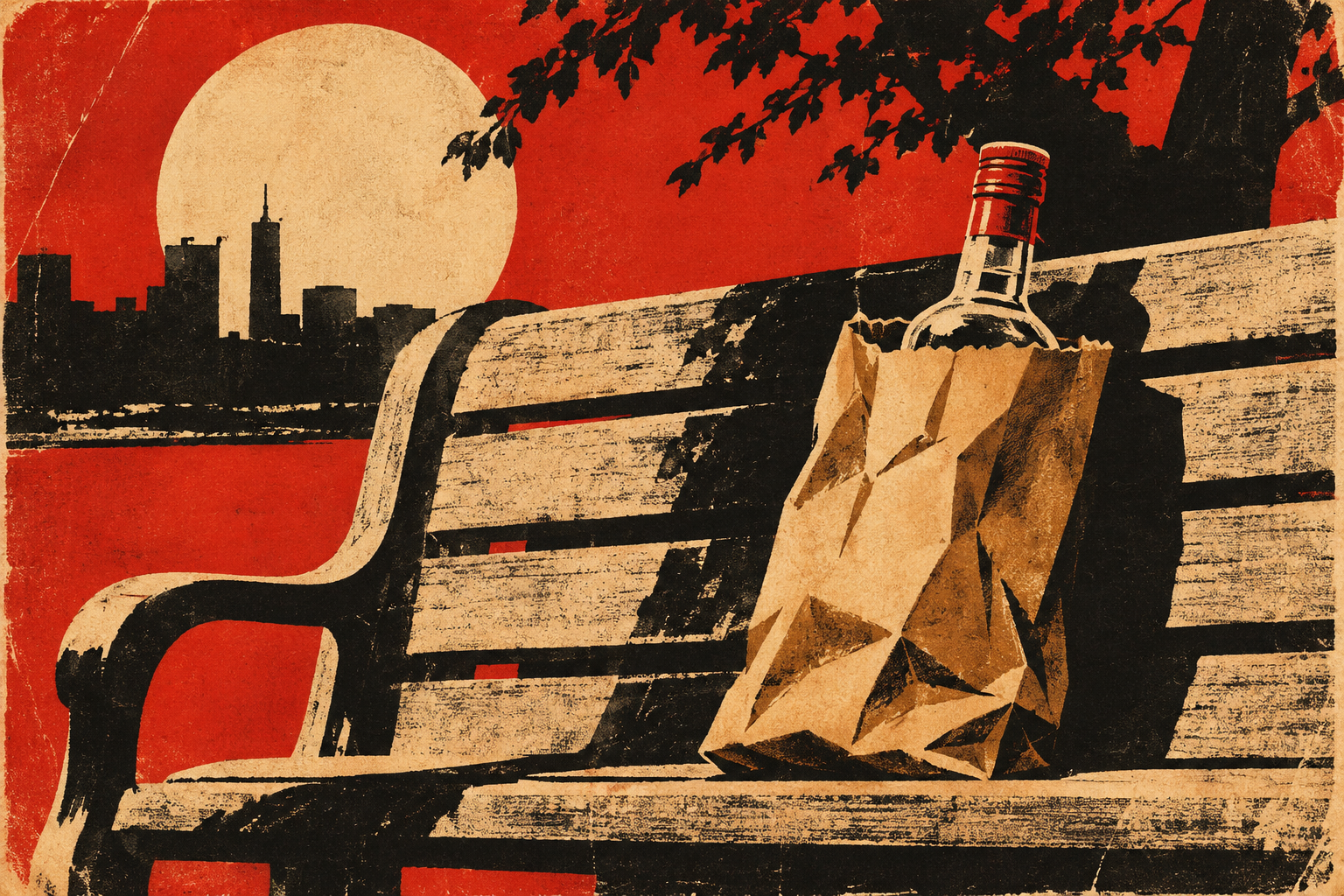
Monte stood. He looked around. Nothing remarkable was happening. A jogger stretched against a tree. A city worker emptied a trash can. A man in a brown coat sat on a bench across the path, holding a paper bag between his knees.
8:43.
Morgan spoke.
The man in the brown coat had been sober for eleven years.
Monte turned.
“What?”
The man sat with his shoulders hunched against the cold. He was perhaps sixty-five, with a broad face, thinning gray hair, and the weary posture of someone who had spent years carrying something heavier than his body. His brown coat was old but clean. His shoes were polished. A pair of black gloves rested beside him.
His name was Gerald. Gerald had purchased a bottle of vodka twenty-three minutes earlier.
Monte looked at the paper bag. The bottle was inside it. For several seconds, Monte could hear nothing except traffic beyond the park and the soft scrape of a shovel against pavement.
“That’s it?”
Gerald looked up.
“Excuse me?”
Monte realized he had spoken aloud.
“Nothing. Sorry.”
Gerald returned his attention to the bag.
Monte stepped away from the bench. His heart was beating faster. He had been expecting something impossible: an apparition, a glimpse of the future, a crack in the fabric of reality through which some cosmic explanation might leak. Instead, the voice had identified a stranger with a drinking problem.
That was disappointing. It was also testable. Monte looked at Gerald again.
“How do I know you’re right?” he whispered.
The voice did not respond.
“You could be making it up.”
Gerald had attended his last recovery meeting on Tuesday.
Monte stopped walking.
He had told the group he was doing well.
“Okay.”
He had been lying.
Monte looked toward the man on the bench. Gerald had opened the paper bag and was staring into it. His hands remained outside. He appeared to be negotiating with something that could not be seen.
“Tell me something else.”
Monte knew the request was wrong before he finished making it. He also knew that knowing something was wrong had never prevented him from doing it when the wrong thing promised an answer he wanted.
Gerald had eleven years, four months, and six days of sobriety.
Monte repeated the number under his breath. “Eleven years. Four months. Six days.”
It was precise enough to be either miraculous or fabricated. He had no way of distinguishing the two. The voice had told him things about Stella that seemed impossible to know, but he had not stayed long enough to confirm them. He had fled when her expression changed. The encounter had proved only that he could frighten a waitress.
This was different.
He could ask Gerald.
He could establish a fact.
He could know.
Monte crossed the path.
“Excuse me.”
Gerald looked up again.
“Yes?”
“Can I ask you something?”
“You just did.”
Monte smiled. Gerald did not.
“Fair enough. I’m sorry to bother you.”
“Then don’t.”
Gerald looked back at the bag.
Monte should have left. He understood this with the clarity usually reserved for mistakes already committed. The man was alone in a park on a freezing morning, holding something he apparently did not want to hold. Whatever was happening belonged to him.
But Monte had been listening to a voice that sounded like Morgan Freeman, and he was rapidly approaching the limits of his tolerance for uncertainty.
“Your name’s Gerald, right?”
Gerald’s head came up.
“Do I know you?”
“No.”
“Then how do you know my name?”
Monte hesitated.
“Someone mentioned you.”
“Who?”
“That’s complicated.”
Gerald studied him. His expression shifted from irritation to suspicion.
“Are you selling something?”
“No.”
“Are you from the church?”
“No.”
“Then what do you want?”
Monte looked at the bag.
“I think you might need some help.”
Gerald followed his gaze. He folded the top of the bag shut.
“I’m fine.”
“Are you?”
“Yes.”
Monte heard himself ask the next question before he had decided to speak.
“Then why’d you buy the vodka?”
Gerald went completely still. The effect was immediate and unmistakable. His face lost color. His eyes moved from Monte to the bag and back again. He looked toward the path, checking whether anyone had heard.
“What did you say?”
Monte felt a surge of excitement. He had been right. Not approximately right. Not right in the vague, flattering way of fortune cookies and personality tests. Right about a specific object concealed inside a paper bag held by a man he had never met.
“There’s vodka in there.”
Gerald stood.
“Who are you?”
“My name’s Monte.”
“I didn’t ask your name.”
“Look, I know this is strange.”
“You have no idea.”
A couple walking past slowed. Gerald noticed them and lowered his voice.
“Did someone send you?”
“No.”
“Are you following me?”
“No.”
“Then how the hell do you know what’s in this bag?”
Monte opened his mouth. Nothing useful came out.
Morgan said: Monte had wanted confirmation.
“Not now,” Monte muttered.
Gerald stepped back.
“Who are you talking to?”
“Nobody.”
“Jesus Christ.”
Gerald turned to leave.
Monte panicked. He had the proof in front of him, but it was walking away. The entire morning would collapse into another ambiguous encounter, another story he could tell Amanda that would sound like evidence of a brain injury. He needed one more confirmation, something the man could not dismiss as a lucky guess.
“Eleven years,” Monte said.
Gerald stopped.
“Eleven years, four months, and six days.”
The words landed between them. Gerald turned slowly.
“What?”
“That’s how long you’ve been sober.”
A runner passed behind them. The city worker had stopped shoveling and was watching. The couple had paused several yards away, pretending to examine a tree with an interest no tree had ever deserved.
Gerald looked around.
“Keep your voice down.”
Monte heard him. He understood the request. He even intended to comply. But the look on Gerald’s face was confirmation, and confirmation was intoxicating.
“You told your group on Tuesday you were doing well,” Monte continued. “But you weren’t. You bought that bottle this morning, and you’ve been sitting here trying to decide whether to drink it.”
“Shut up.”
Monte stopped.
Gerald’s face had changed. The suspicion was gone. So was the anger, or at least the simple version of it. What remained was something more difficult to watch.
Fear. Not fear of Monte physically hurting him. Fear of being known.
The city worker looked away. The couple resumed walking. A woman with a dog glanced at Gerald’s paper bag, then at Gerald, and adjusted her path to give him more room. Monte became aware of how loudly he had been speaking.
“I’m sorry.”
Gerald stared at him.
“Who told you?”
“I can’t explain.”
“Try.”
Monte looked at the ground.
“I know things sometimes.”
“About people?”
“Yes.”
“People you don’t know.”
“Yes.”
Gerald laughed. It was a dry, ugly sound.
“That’s a hell of a trick.”
“It’s not a trick.”
“Then what is it?”
Monte had no answer.
Gerald looked toward the people moving through the park. The couple was gone. The city worker had returned to his shovel. The world had resumed its ordinary business, leaving Gerald standing beside a stranger who had announced his private humiliation to anyone close enough to hear.
“Eleven years,” Gerald said quietly.
Monte looked up.
“Eleven years without a drink. You know what that means?”
Monte started to answer.
“No. You don’t.”
Gerald sat down heavily.
“It means weddings with ginger ale. Funerals with coffee. Christmases where everybody else gets drunk and tells the same goddamn stories they’ve been telling for twenty years, and you sit there smiling because you remember what happens when you join them.”
He looked at the bag.
“It means waking up every morning and deciding not to do something that would make the next hour easier and the rest of your life worse.”
Monte stood beside the bench. Gerald continued.
“It means calling somebody when you don’t want to call anybody. Sitting in church basements listening to men talk about feelings when you’d rather have your teeth pulled. It means finding out that the thing you thought was killing you was also the thing you were using to avoid everything else.
“Eleven years,” Gerald repeated. “And this morning I bought a bottle.”
He looked up at Monte.
“I hadn’t opened it.”
“I know.”
Gerald’s expression hardened.
“Of course you do.”
Monte felt the first real weight of what he had done. He had approached Gerald believing he was conducting an experiment. The experiment had produced a result. Unfortunately, the result was a human being sitting on a bench with his dignity scattered across the snow.
“I wasn’t trying to embarrass you.”
“Then what were you trying to do?”
Monte considered lying. He could say he had been concerned. He could say he had recognized a man in trouble. He could claim some instinct for suffering, some deep and compassionate understanding of the human condition.
All of those explanations contained enough truth to be useful. None was the reason he had crossed the path.
“I wanted to see if something was real.”
Gerald stared at him.
“Something?”
“Something that’s been happening to me.”
“So you picked me.”
Monte looked away.
“I didn’t pick you exactly.”
“That’s comforting.”
“I was told about you.”
“By who?”
“I can’t explain that.”
Gerald shook his head.
“Then I guess we’re both having a strange morning.”
Monte sat at the far end of the bench. Gerald did not object, although he moved the bag to the other side of his body. For a while, neither spoke.
A bus hissed to a stop beyond the park. Somewhere a car horn sounded. The elderly woman and her overdressed dog made another circuit of the path, both apparently dissatisfied with the pace of the other.
Monte checked his phone.
9:02.
The appointment with the impossible had lasted nineteen minutes.
“Are you going to drink it?” he asked.
Gerald looked at him.
“You don’t get to ask me that.”
“Right.”
“You don’t know me.”
“I know.”
“No, you don’t. You know a few facts. There’s a difference.”
Morgan said: Gerald was correct.
Monte closed his eyes.
“Please don’t.”
Gerald turned.
“What?”
“Nothing.”
“You keep saying that.”
“It’s been a complicated week.”
Gerald looked at him for a long moment.
“Yeah,” he said. “I can see that.”
Monte stood.
“I should go.”
“Probably.”
He took two steps, then stopped.
“Gerald?”
The older man looked up with the expression of someone regretting that he had not chosen a more remote park.
“I’m sorry.”
Gerald considered him.
“For what?”
Monte almost said for embarrassing you. It was the obvious answer. It was also insufficient.
“For treating you like a question I needed answered.”
Gerald looked down at the paper bag.
“That,” he said, “is a strange apology.”
“I’ve been told I’m bad at them.”
“You are.”
Monte nodded.
“Fair.”
He turned away.
“Monte.”
He stopped.
Gerald was looking at the bottle. He pulled it from the bag. Clear glass. Blue label. The ordinary commercial packaging of a product that had nearly destroyed his life. Monte watched him unscrew the cap. For one terrible second, he thought the man was going to drink.
Instead, Gerald stood, walked to the edge of the path, and poured the vodka into the snow.
The liquid disappeared almost immediately, sinking into the dirty white bank. There was no dramatic gesture, no triumphant declaration, no music swelling over a hard-won victory. Just a man emptying a bottle while the morning continued around him.
Gerald held it upside down until the last drops fell. He replaced the cap and put the bottle in the trash. Monte felt relief. Gerald turned toward him.
“Don’t look so pleased with yourself.”
Monte’s relief vanished.
“I didn’t—”
“Yes, you did.”
Gerald pulled on his gloves.
“You think you saved me.”
Monte considered the empty bottle.
“Didn’t I?”
Gerald looked at him for a long time.
“Maybe.”
The answer was less satisfying than Monte had hoped. Gerald picked up the paper bag and folded it into a small square.
“Maybe I was going to drink it. Maybe I was going to pour it out anyway. Maybe you scared me enough that I changed my mind. I don’t know.”
He slipped the folded bag into his coat pocket.
“But I made the decision.”
Monte nodded.
“You did.”
“And if I buy another bottle tomorrow, that’s my decision too.”
“I hope you don’t.”
“So do I.”
Gerald started toward the park entrance. He walked slowly, favoring one knee, with the careful determination of a man who had no confidence in the day ahead but intended to get through it anyway.
Monte watched him go.
“Gerald.”
The man stopped without turning.
“There’s a meeting today, right?”
Gerald looked back.
“How would you know that?”
Monte said nothing. Gerald shook his head.
“Of course.”
He resumed walking.
Monte stood beside the bench until Gerald disappeared beyond the trees. The park seemed unchanged. The city worker shoveled. The runners ran. The woman with the dog continued negotiating the terms of their exercise.
Everything was exactly as it had been before 8:43. Except Monte knew the voice was real.
Or at least he knew it possessed information he could not explain. He had wanted proof, and he had received it. He had imagined the moment would bring relief, perhaps even a sense of wonder. Instead, he felt as though he had opened a locked door and discovered that the room belonged to someone else.
“You knew what would happen,” he said.
Morgan did not answer.
“You knew I’d talk to him.”
Silence.
“You knew I’d say those things.”
Monte waited.
Finally, Morgan spoke.
Monte had wanted to know whether the voice was telling the truth.
“Yes.”
Now he knew.
Monte looked toward the trash can where Gerald had discarded the bottle.
“And?”
The voice remained silent. Monte understood the silence as refusal. He was wrong. It was not refusing to answer his question. The answer was standing in the park, surrounded by people whose lives he had no right to enter merely because he possessed a key.
His phone buzzed. Amanda.
Where are you? The clinic appointment is in forty minutes.
Monte stared at the message.
He typed:
I found out something.
He deleted it.
Something happened.
He deleted that too.
Finally, he wrote:
On my way.
He sent the message and began walking.
For several blocks, the voice said nothing. Monte was grateful for the silence until he realized gratitude was another way of avoiding what had happened. He had spent the morning treating another man’s suffering as evidence. The evidence had been convincing.
That was the problem.
At the corner of Clark and Foster, Monte stopped at a red light. He watched a woman help an elderly man cross the street. A delivery driver carried boxes into a restaurant. A teenager dropped a glove and hurried back to retrieve it.
Ordinary people. Ordinary lives. Private disasters waiting patiently behind ordinary faces.
“Can you tell me things about all of them?” Monte asked.
Morgan answered.
Sometimes.
Monte watched the pedestrians.
“Even things they don’t want anyone to know?”
Yes.
The light changed. Monte did not move.
“Then I need rules.”
Morgan remained quiet.
“Rules about what I ask. What I say. What I do with whatever you tell me.”
Monte believed rules would make the situation manageable.
“Will they?”
Not entirely.
Monte sighed.
“That’s the closest thing to encouragement you’ve given me.”
He would make rules. He would write them down. He would establish boundaries between knowing and speaking, between curiosity and cruelty, between helping someone and using them to satisfy his own need for certainty.
He would begin with the simplest rule he could imagine.
Do not reveal private information merely to prove the voice is real.
It seemed obvious. Monte had always been excellent at recognizing the obvious immediately after violating it. Behind him, the city continued without explanation. Somewhere north of Clark Street, a man named Gerald was walking toward a meeting he had not intended to attend, carrying eleven years of sobriety and a new story he would have considerable difficulty explaining.
Monte did not know whether Gerald would make it through the day.
For once, he decided not to ask.