By the time Chuck met Julie, he had developed a type so specific it should have been listed in the diagnostic manual.
She had to be beautiful, obviously, but not in a way that suggested ease. Easy beauty made him suspicious. He preferred beauty with some visible damage around the edges: chipped black nail polish, an old scar through one eyebrow, a laugh that arrived half a second too late, as though it had been cleared by legal counsel. She should have at least one ex-boyfriend she described as a narcissist, one parent she no longer spoke to, and a job she hated but refused to leave because the dysfunction had become a kind of salary.
She should text at two in the morning.
She should disappear for three days.
She should say she had never felt safe with anyone before, then punish him for making her feel safe.
Most important, she had to possess the mysterious combination of vulnerability and menace that caused Chuck to believe two things at once: that she desperately needed him and that she might kill him in his sleep.
Chuck called this chemistry.
His sister called it a hostage situation.
His therapist, Dr. Klein, called it “repetition compulsion,” which Chuck thought sounded like either a progressive-rock album or a very specialized sex crime.
“You keep choosing the same woman,” Dr. Klein told him.
“They’re not the same.”
“One was a tattoo artist, one sold commercial real estate, and one taught second grade.”
“Exactly.”
“They had different occupations.”
“And hair.”
“The hair is not the relevant distinction.”
Chuck leaned back on the therapist’s couch and stared at the framed print on the opposite wall. It was one of those tranquil watercolor beaches no human being had ever actually visited. The sky was coral, the ocean was lavender, and there were no people, jellyfish, beer cans, or parking restrictions.
“What’s the relevant distinction?” Chuck asked.
“There isn’t one.”
Chuck considered this rude.
At forty-two, he had been through enough relationships to recognize the pattern, but recognition had not translated into prevention. He could identify the land mine perfectly. He could describe its dimensions, age, manufacture, explosive capacity, and preferred brand of cigarette. Then he would step directly on it.
There had been Andrea, who made jewelry out of animal bones and told him on their second date that monogamy was a tool of colonial oppression. Chuck had nodded solemnly and ordered another bourbon.
There had been Marcy, who once threw his laptop into a bathtub because she believed he had flirted with a waitress at an Ethiopian restaurant. Chuck had not flirted with the waitress. He had asked for a fork.
There had been Danielle, who moved into his apartment after six weeks, redecorated the living room in something she called “desert goth,” and left nine months later with his television, his winter coat, and a handwritten note that said, You never really saw me.
Chuck had seen her take the television.
Then there was Renee, who had broken his nose with a ceramic ashtray and spent the next morning explaining that he had triggered her abandonment wound by attempting to leave the room.
Chuck stayed with Renee another four months.
He was not an idiot, at least not globally. He could hold down a job, prepare several impressive meals, and explain compound interest to frightened relatives. He worked as an operations manager for a midsized architecture firm and was respected by people who had never witnessed him choose a romantic partner. He could negotiate vendor contracts, untangle scheduling disasters, and calm wealthy clients whose bathroom tiles had arrived in the wrong shade of gray.
In every area except love, Chuck understood that warning signs were warnings.
In love, he treated them as trail markers.
His friends had stopped trying to help.
“Does she have a job?” his friend Aaron would ask whenever Chuck announced a new relationship.
“Yes.”
“Does she like the job?”
“No.”
“Does she have a roommate?”
“Technically.”
“Is the roommate an ex?”
“It’s complicated.”
“Has she ever set fire to anything?”
“Not intentionally.”
Aaron would close his eyes, take a long breath, and say, “Of course.”
Chuck’s relationships followed a reliable seasonal pattern. They began in spring, even when they began in November. Everything felt newly thawed. The woman would tell him he was unlike anyone she had ever met. Chuck would feel chosen, not realizing this was the ceremonial phrase painted above the entrance to the maze.
By summer, they had become inseparable. He would stop seeing friends, cancel plans, and learn the intricate mythology of her enemies. There was always a former friend who had betrayed her, a coworker conspiring against her, a sister jealous of her light, a landlord who entered the apartment psychically if not physically.
By autumn, Chuck would begin monitoring his own speech for unexploded devices.
By winter, he would be standing in his kitchen at three in the morning, being accused of emotional violence because he had loaded the dishwasher incorrectly.
After the breakup came the silence, then the collapse, then the ceremonial return to Dr. Klein’s lavender ocean.
“What did you feel when she criticized you?” Dr. Klein asked after the Renee era.
“Misunderstood.”
“What did you feel before that?”
“Annoyed.”
“Before that.”
“Confused.”
“Before that.”
Chuck thought.
“Needed.”
Dr. Klein nodded.
Chuck hated when he nodded. It was never the nod of a man impressed by Chuck’s insight. It was the nod of a mechanic hearing an engine make the exact noise he expected.
“And what does being needed mean to you?” Dr. Klein asked.
“It means I matter.”
“Does being loved mean you matter?”
“In theory.”
“And in practice?”
Chuck stared at the empty beach.
“In practice, love is harder to verify.”
That was the problem. Healthy affection was subtle. It arrived on time and remembered your birthday without turning it into a referendum on childhood neglect. It said what it meant. It asked questions and listened to the answers. Healthy affection did not break into your emotional home at midnight carrying a gas can and screaming that nobody had ever stayed.
Need was measurable.
Need sent seventeen text messages.
Need pounded on the door.
Need threatened to drive into the lake.
Need made Chuck feel like a fireman, a priest, and the final sandbag between civilization and the flood.
Love, by comparison, sometimes took a nap.
Six months after Renee, Chuck deleted the dating apps.
Then he downloaded them again.
He told himself he was ready. This meant he had gone eleven weeks without being insulted in his own bed.
He created a profile that was honest in the bland, curated way of dating profiles. He liked cooking, live music, road trips, and dogs. He valued kindness and curiosity. He was looking for something real. The accompanying photographs showed him smiling beside a lake, smiling at a wedding, and pretending not to know someone was photographing him while he drank coffee.
Within two days, he matched with Julie.
Her first photograph showed her standing in front of a mural, wearing a black dress and combat boots. She had red hair, pale skin, visible tattoos, and the expression of a woman watching a man struggle to assemble furniture.
Her profile read:
Writer. Bartender. Amateur taxidermist.
Fluent in sarcasm and poor decisions.
I will ruin your life, but at least you’ll get a good story.
Chuck felt a warm electrical surge in his chest.
He nearly dropped his phone.
“No,” he said aloud.
The word sounded strange in his apartment, like someone else had said it.
He closed the app.
Ten minutes later, he opened it again.
Julie had sent him a message.
You look emotionally available. How embarrassing.
Chuck laughed.
Then he stopped laughing.
He took a screenshot and sent it to Aaron.
Aaron called immediately.
“Absolutely not.”
“You don’t know her.”
“I know every woman you’ve ever dated, and apparently they’ve opened a franchise.”
“It’s one joke.”
“It is the company logo.”
Chuck looked at Julie’s photograph again. He could already imagine the first date. She would be fifteen minutes late and make fun of the bar. She would tell him something alarming about her childhood before the appetizers arrived. She would touch his wrist while laughing. He would feel the machinery engage.
“I’m just going to meet her,” Chuck said.
“That is what people say before entering caves.”
“I can have one drink with a woman.”
“You cannot have one drink with that woman. You will have one drink, then a second drink, then a six-month disagreement about whether locking you out of your own apartment qualifies as a boundary.”
Chuck hung up on him.
He messaged Julie.
They agreed to meet Friday at a cocktail bar called Mercy, a dim little establishment with red velvet booths and drinks named after sins. Chuck arrived twenty minutes early, because anxious people believe punctuality can control fate.
He chose a table near the window and ordered soda water.
At 7:14, Julie entered.
She was exactly right.
Not right in the sense of good. Right in the sense of familiar. Right like the first note of a song that had once ruined an entire summer.
She wore a battered leather jacket over a green dress. Her red hair was pinned up carelessly, with several strands falling around her face in what Chuck knew had taken either thirty seconds or forty-five minutes. There was a small tattoo of a knife behind her left ear.
She scanned the room, saw him, and smiled.
The smile was devastating.
Chuck felt his nervous system stand at attention.
“Chuck?” she asked.
“Julie.”
“You’re early.”
“You’re late.”
“I know. I wanted to see if you’d stay.”
There it was.
The first little flare fired over the battlefield.
Chuck smiled automatically. “How long would you have made me wait?”
“Depends how desperate you looked.”
She slipped into the chair across from him and dropped her purse on the floor. Her perfume smelled like cedar and smoke.
A server approached. Julie ordered whiskey neat.
“Nothing for him?” she asked, nodding toward Chuck’s soda water.
“He’s being responsible,” Julie said. “It’s probably exhausting.”
The server left.
Julie leaned forward and studied him.
“You’re more handsome than your pictures.”
“Thank you.”
“It wasn’t a compliment. Your pictures make you look divorced.”
“I am divorced.”
“See?”
Chuck laughed again.
His body had already begun betraying him. His attention sharpened until the rest of the room dissolved. He noticed the chip in her thumbnail polish, the faint scar on her chin, the way she held eye contact a moment beyond comfort. His heart had taken off its shoes and was running toward traffic.
“So,” Julie said, “what’s wrong with you?”
“How much time do you have?”
“Until one of us gets bored.”
Her whiskey arrived. She drank half of it immediately.
Chuck’s internal alarms began ringing, but they were old alarms, domestic alarms, comforting alarms. Their sound meant he was home.
Julie told him she had recently quit her job at a publishing company after her boss “declared war” on her. She was bartending three nights a week and writing a novel about a woman who murdered men who wasted her time.
“Autobiographical?” Chuck asked.
“Not yet.”
She had been engaged twice but never married. The first fiancé was emotionally abusive. The second was spiritually weak. She had moved into her current apartment with a musician named Cal, who was technically her ex-boyfriend, although labels were “a form of intellectual laziness.”
“How long ago did you two break up?” Chuck asked.
“Emotionally or sexually?”
There it was again.
Flare number two.
Chuck heard Aaron’s voice in his head: They’ve opened a franchise.
Julie asked about his relationships.
Chuck gave her the edited version. One marriage, several serious girlfriends, a tendency to stay too long.
“So you’re a rescuer,” she said.
“I don’t think so.”
“You have rescuer eyes.”
“What do those look like?”
“Sad. Competent. Slightly erect.”
Chuck almost spit out his water.
Julie laughed, and the laugh was beautiful and sharp and careless. She reached across the table and touched his wrist.
The machinery engaged.
It happened exactly as he had predicted, and because he had predicted it, some detached part of him watched from above. He saw himself leaning closer. He saw the stupid pleased expression forming on his face. He saw the whole future unfold with the speed and clarity of a highway pileup.
Julie would kiss him in the alley behind the bar.
She would text him before he reached home.
Within a week she would tell him something no one else knew.
Within a month there would be a toothbrush beside his sink.
Within three months he would be lying to Aaron.
Within six months he would be back on the lavender beach while Dr. Klein nodded like a disappointed Buddha.
Julie’s thumb moved once across the inside of his wrist.
“You’re thinking too much,” she said.
“Yes.”
“Stop.”
That was the invitation. Stop thinking. Stop observing. Stop being the person who knew better. Become appetite. Become pattern. Become the moth insisting the flame was misunderstood.
Chuck looked at her hand on his arm.
Then he looked at the knife tattoo behind her ear.
Then he looked through the window.
Across the street stood a twenty-four-hour drugstore, its fluorescent aisles blazing beneath a blue sign. A man in a reflective vest was sweeping the sidewalk. A bus sighed at the corner. Three teenagers passed, shouting happily at one another. The world outside continued with insulting normalcy.
Chuck suddenly felt tired.
Not date tired. Not long-week tired. He felt anciently tired, as though he had been carrying the same bucket up the same hill through multiple reincarnations, only to discover each time that the bucket had no bottom.
Julie withdrew her hand.
“Where’d you go?”
Chuck looked back at her.
“I’m sorry.”
“That’s usually a bad opening.”
“I can’t do this.”
Her face changed, but only slightly. The amusement remained. “Do what?”
“This.”
“You’re going to need a noun.”
Chuck felt his pulse hammering. It seemed absurd to be frightened. Julie was just a woman in a cocktail bar. She had not yet thrown anything, broken anything, threatened anything, or moved into his apartment. She had done nothing except arrive late, drink whiskey, and tell the truth about herself with the confidence of someone certain that honesty erased consequence.
Still, Chuck was terrified.
He had never walked away this early.
He had always waited for evidence. Then more evidence. Then evidence wearing his bathrobe and screaming in the hallway.
“I think I know you,” he said.
Julie raised an eyebrow. “That’s a creepy thing to say on a first date.”
“Not you specifically. I know this feeling.”
“What feeling?”
“The one I’m having right now.”
She picked up her glass. “And what feeling is that?”
“That I want you to like me more than I want to find out whether I like you.”
For the first time, Julie had no immediate response.
Chuck continued before courage could leave through an emergency exit.
“You’re funny and beautiful, and I am extremely attracted to you. I also think that if we keep talking, I’m going to ignore every single thing you’ve told me because being wanted by someone like you feels like being chosen for a dangerous mission.”
“Someone like me?”
“Yes.”
“You’ve known me for forty minutes.”
“That’s longer than it usually takes.”
Julie’s eyes hardened.
Chuck recognized the shift. The temperature dropped. Somewhere in his nervous system, a younger version of him rushed to apologize.
He did not.
Julie leaned back. “So you’ve diagnosed me?”
“No.”
“You’ve decided I’m damaged.”
“No. I’ve decided I’m damaged.”
That landed.
The server appeared and asked whether they wanted another round.
“Yes,” Julie said.
“No,” Chuck said.
The server looked between them.
Julie smiled without warmth. “Bring me another.”
When the server left, Julie folded her arms.
“So what’s the drastic move here, Chuck? You run out the door and congratulate yourself for avoiding the evil redhead?”
“I don’t know.”
“You clearly rehearsed this.”
“I absolutely did not.”
“You think you’re the first stable man who’s decided unstable women are the problem?”
Chuck flinched.
The sentence struck exactly where it was aimed.
Julie saw it and continued.
“Men like you love women like me until we become inconvenient. You want the stories, the sex, the intensity, the part where we tell you secrets in the dark and make you feel like the one decent man in a burning world. Then the fire gets hot, and suddenly we’re toxic.”
Chuck felt the old reflex awaken: explain, soothe, prove he was different.
The reflex whispered that this was the real intimacy. Here it was. The wound beneath the wit. All he had to do was stay.
He put both hands flat on the table.
“You may be right.”
Julie blinked.
“I probably have done that,” he said. “I probably liked being the good man in the burning world. It let me feel heroic without having to be healthy.”
Her second whiskey arrived.
Julie did not touch it.
Chuck took out his wallet and placed enough cash on the table to cover both drinks, then added more.
“What are you doing?” she asked.
“Leaving.”
“You’re serious?”
“Yes.”
“Because of your feeling.”
“Because every terrible decision I’ve made started with me arguing against that feeling.”
Julie stared at him.
Chuck stood, but his knees felt weak.
He expected her to mock him. He expected her to call him cowardly, arrogant, boring, emotionally stunted, or secretly gay. He had been called all five before, occasionally in one evening.
Instead, Julie asked, “What makes you think I would destroy you?”
Chuck looked down at her.
“Nothing,” he said. “That’s the point. You might not. You might be wonderful. You might be exactly what you say you are. This isn’t about deciding who you are. It’s about finally noticing who I become.”
The cruelty left her face.
For one brief second, she looked young and exhausted.
Chuck almost sat down.
That was the dangerous moment.
Not the whiskey. Not the knife tattoo. Not the ex-boyfriend roommate or the murdered-men novel. The dangerous moment was the glimpse of hurt. Hurt was the hook beneath every hook. Chuck had spent half his life mistaking another person’s pain for his assignment.
He stayed standing.
Julie looked at the untouched drink.
“You know,” she said quietly, “I put that line in my profile because men think it’s sexy.”
“Which line?”
“The one about ruining their lives.”
“I did think it was sexy.”
“I know.”
“I’m sorry.”
“Don’t be. It works.”
Chuck nodded.
He turned toward the door.
“Chuck.”
He stopped.
Julie’s expression was unreadable.
“What are you going to do now?”
He considered the question.
“I’m going to the drugstore.”
She frowned. “Why?”
“I don’t know yet.”
Then he left.
Outside, the air was colder than he expected. He stood on the sidewalk beneath Mercy’s red neon sign, breathing as though he had just escaped a submerged car.
Nothing happened.
No music swelled.
No stranger applauded.
No divine voice announced that Charles Allen Mercer had finally broken the cycle.
His phone did not light up with a message from the universe.
He simply stood there, alone and trembling, while a bus groaned away from the curb.
Then he crossed the street.
The drugstore was nearly empty. Chuck wandered the aisles with no purpose. He passed cold medicine, paper towels, shampoo, birthday cards, batteries, condoms, and an aggressively cheerful display of seasonal candy.
His body still expected him to turn around.
He imagined Julie in the bar, drinking both whiskeys. He imagined another man taking his seat. He imagined her telling the story later, transforming him into a frightened bureaucrat who fled because she was too much woman for him.
He wanted to go back and correct the record.
He wanted to go back and prove he could handle her.
He wanted to go back because leaving felt unbearable, and he had confused unbearable with wrong for most of his life.
In the stationery aisle, he found a stack of small black notebooks.
He picked one up.
On the first page, he wrote:
THINGS THAT FEEL LIKE LOVE BUT AREN’T
He stood beneath the fluorescent lights, thinking.
Then he began a list.
Being needed.
Being tested.
Being forgiven for things I didn’t do.
Someone telling me I’m the only person who understands them.
Fear of losing someone I don’t know.
Relief when anger stops.
Sex after cruelty.
Secrets told too soon.
Chaos that makes ordinary life feel dull.
He filled three pages.
Then he turned to a fresh page and wrote:
THINGS THAT MIGHT ACTUALLY BE LOVE
He waited.
This list was harder.
After several minutes, he wrote:
Peace without boredom.
The truth without punishment.
Being allowed to leave the room.
Someone asking how I am and waiting for the answer.
He could think of nothing else.
It was a pathetic list, barely a list at all, but it was a beginning.
At the checkout counter, the cashier glanced at the notebook.
“Big plans?” she asked.
Chuck looked at the black cover.
“I’m trying something different.”
“Good luck.”
“Thank you.”
Outside, his phone buzzed.
A message from Julie.
Chuck stared at her name until the letters blurred.
He opened it.
You left your dignity on the table.
He read it twice.
Then another message arrived.
Just kidding.
Then:
Mostly.
Then:
Come back.
Chuck stood beneath the blue drugstore sign. Through the bar window, he could see Julie at the table, her head bent over her phone.
The distance between them was no more than forty yards.
It felt like the width of an ocean.
He typed:
I’m not coming back.
He erased it.
He typed:
I’m sorry.
He erased that too.
He put the phone in his pocket and began walking home.
Julie called before he reached the corner.
The first ring tightened his chest.
The second made his hand twitch.
By the third, he was imagining her crying.
By the fourth, he had constructed a complete scenario in which she was not merely crying but experiencing the final confirmation of every abandonment she had ever suffered, all because Chuck lacked the courage to drink one more soda water.
The phone stopped.
A voicemail appeared.
Chuck did not listen.
He walked another block.
Then the phone rang again.
He turned it off.
That was the drastic thing.
Not leaving the date. Not confronting Julie. Not buying the notebook.
He turned off the phone.
For Chuck, this was the emotional equivalent of dynamiting a bridge while still standing on it.
He walked through the city without GPS, music, podcasts, messages, or the possibility of rescue. The night seemed enormous without a glowing screen telling him who needed something.
At home, he placed the silent phone in a kitchen drawer.
Then he sat on the floor.
For a while, he felt powerful.
Then he felt guilty.
Then he felt lonely.
Then he cried so hard his ribs hurt.
He did not cry for Julie. He barely knew Julie.
He cried for Andrea and Marcy and Danielle and Renee. He cried for the years he had spent auditioning for the role of indispensable man. He cried for the boy he had been, listening through a bedroom wall while his mother threatened to leave and his father promised to change. He cried because he had learned early that love was a house where somebody was always packing a suitcase.
He cried because chaos had been the first language spoken to him fluently.
At ten the next morning, he turned his phone on.
There were fourteen messages from Julie.
The first three were amused.
The next four were angry.
Two were seductive.
One accused him of misogyny.
One apologized for accusing him of misogyny.
One said she hoped he found the beige little life he deserved.
The final message had arrived at 3:17 a.m.
I think maybe you were right.
Chuck read them all.
He did not respond.
On Monday, he told Dr. Klein what had happened.
Dr. Klein nodded.
Chuck pointed at him. “Don’t.”
Dr. Klein stopped nodding.
“I bought a notebook,” Chuck said.
“That sounds useful.”
“I also ignored fourteen messages.”
“How did that feel?”
“Like chewing glass while being chased by wolves.”
“And now?”
Chuck thought.
“Quiet.”
“Is quiet bad?”
“Yes.”
Dr. Klein waited.
Chuck looked at the lavender ocean.
Then he corrected himself.
“No. Quiet is unfamiliar.”
Dr. Klein smiled.
It was a small smile, but Chuck did not trust it.
For the next several months, Chuck did not date.
This was not a spiritual decision. It was closer to pest control. He needed time to discover which thoughts were his and which had been installed by women throwing ashtrays.
He saw Aaron more often.
He called his sister.
He learned to cook for one without treating the meal like evidence at a crime scene.
He added to the notebook.
He wrote down every urge to contact someone who had hurt him. He wrote what he imagined would happen and what had actually happened the last time. The contrast became difficult to ignore.
He also began noticing women he had previously overlooked.
They were everywhere.
Women who arrived on time.
Women who liked their jobs well enough.
Women who had friends they did not secretly despise.
Women whose eyes did not immediately scan him for structural weaknesses.
At first, Chuck found them dull.
Then he realized he had no idea what they were.
He had never stayed near calm long enough to see its details.
Six months after Julie, Aaron invited him to a birthday dinner. A woman named Beth sat across from him. She was a school librarian with curly brown hair and a laugh that arrived exactly when it was supposed to.
She asked Chuck what he did.
He told her.
She listened without interrupting.
Then she told him about a child who had tried to return a book because the ending made him angry.
“What was the book?” Chuck asked.
“Charlotte’s Web.”
“He was right.”
“That’s what I told him.”
They talked for an hour.
Beth did not touch his wrist.
She did not insult his photographs.
She did not tell him a secret she had never told anyone.
At the end of the evening, she said, “I enjoyed talking to you.”
Chuck waited for the hook.
None came.
“I enjoyed talking to you too,” he said.
“Would you like to get coffee sometime?”
His first internal response was disappointment.
Coffee.
Daylight.
No whiskey. No danger. No erotic threat of emotional arson.
Then he noticed something beneath the disappointment.
Curiosity.
Not hunger. Not panic. Not the desperate conviction that his life had just begun.
Curiosity.
“Yes,” he said. “I would.”
Their first date was pleasant.
Their second was better.
On the third, Beth disagreed with him about a movie and did not withdraw affection, threaten to leave, or accuse him of invalidating her cinematic reality.
Chuck went home disturbed.
He called Dr. Klein.
“Something weird happened.”
“What happened?”
“She disagreed with me.”
“All right.”
“And then nothing.”
“What did you expect?”
“I don’t know. Weather.”
Dr. Klein laughed.
Chuck did not.
He kept seeing Beth.
It was not easy.
Peace turned out to require a different kind of courage. Chaos demanded endurance, but peace demanded presence. There was no emergency to hide inside. No wounded woman to rescue. No crisis large enough to excuse him from revealing himself.
With Beth, Chuck had to answer questions.
What did he want?
What frightened him?
What did he enjoy when no one needed him?
These were much harder than loading the dishwasher correctly.
One evening, several months into their relationship, Beth found the black notebook on his coffee table.
“What’s this?” she asked.
Chuck nearly snatched it from her.
Instead, he said, “A map.”
“Of what?”
“The emergency exits.”
Beth opened to the first page.
She read the two lists.
Chuck watched her face, waiting for judgment.
She closed the notebook.
“Do you still believe this?” she asked.
“Which part?”
“That love is being allowed to leave the room?”
“Yes.”
Beth nodded.
“I think love is also knowing you can come back.”
Chuck looked at her.
The sentence did not explode.
It entered quietly and sat down.
Years later, Chuck would occasionally think about Julie.
He never learned what happened to her. He did not know whether she finished the novel, stopped living with Cal, repaired things with her boss, or continued meeting men who mistook the promise of destruction for passion.
He hoped she was well.
He hoped she had found someone who did not need her broken.
More than that, he hoped she had discovered she did not need to be broken to be interesting.
Chuck kept the notebook in a drawer beside the dead phone he had eventually replaced. The cover grew soft and the pages curled at the edges. He no longer wrote in it often.
There were fewer emergencies.
This did not mean life became beige. Life remained unreasonable and loud. People died. Jobs disappeared. Pipes burst. Hearts failed. Beth sometimes became angry, and Chuck sometimes became impossible. They hurt each other in small, ordinary ways, then apologized without turning the apology into a hostage negotiation.
They loved each other without setting fire to the room to prove there was heat.
Once, during an argument, Beth walked into the bedroom and closed the door.
Chuck stood in the hallway.
Every nerve in his body told him to follow, to knock, to demand resolution, to prevent the ancient suitcase from being packed.
Instead, he went to the kitchen.
He made tea.
Ten minutes later, Beth came out.
She sat beside him.
Neither spoke for a moment.
Then Beth took his hand.
Chuck felt no surge of electricity. No machinery. No sense that he had been selected for a dangerous mission.
He felt her warm palm against his.
He felt the chair beneath him and the floor beneath the chair.
He felt the quiet, familiar and deep.
For the first time in his life, love did not feel like falling.
It felt like having somewhere to stand.
∞∞∞
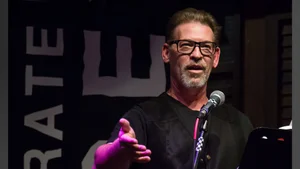
Don Hall is a writer, storyteller, and creative mercenary whose wildly varied career—from homeless busker and Chicago public school teacher to theater producer, jazz musician, radio executive, and front-of-house manager at some of Chicago's most iconic venues—has given him an endless supply of stories and an abiding distrust of certainty.
He is the author of Belief Is a Thermonuclear Warhead, co-editor of The Literate Ape, and publisher of the Substack The Attention of Fools, where he writes about culture, politics, creativity, and the glorious absurdity of being human.