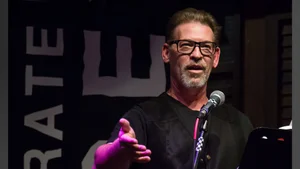
As I restart my path away from the place I’ve called home for over half my life, I revisit some of those moments and stories that made me. This story took place in the very beginning of my Chicago odyssey.
∞∞∞
The Big Fish swims happily through the Little Pond and, because he is a fish, he has no concept of how small the pond really is. In his world, he is the apex predator. He is the fastest, the strongest, and the most talented creature that has ever finned its way through those muddy waters. He has no way of knowing there are larger ponds, lakes, rivers, and oceans where fish like him are so ordinary they barely warrant a second glance.
Then life scoops him out of his comfortable little puddle and drops him into deeper water. His inflated self-image doesn't simply deflate; it explodes with the sound of an ego shattering like a Hummel figurine thrown against a brick wall.
In 1989, I was that fish.
At the University of Arkansas, I was as hot as asphalt in August. I had just finished a three-month tour with a young jazz musician whose career was about to take off, and for several years I had been the trumpet player around campus. If someone wanted to know who could play, my name inevitably entered the conversation. I wasn't delusional; I was genuinely good. Unfortunately, I mistook being the best player in one small pond for being ready to conquer an ocean.
So I threw everything I owned into my pickup truck and drove to Chicago.
There wasn't a shred of doubt in my mind that the city was about to discover its next great trumpet player. Chicago had no idea who was coming.
Reality, however, had other plans.
I arrived with almost no money, no job, no apartment, and not a single contact. For a while I lived in my truck, earning just enough money to eat by busking on street corners. During the day I worked on getting my Illinois teaching certificate, and at night I chased jazz. I haunted open mics at the Get Me High Lounge, the Blackstone, Buddy Guy's, and eventually the Green Mill.
The open-mic scene in early-nineties Chicago bore little resemblance to anything I'd known in Arkansas. The Get Me High was gloriously divey. You showed up after midnight, stood near the stage with your horn case, and waited for the house band to nod you up. There was rarely much of an audience—just eight or ten musicians quietly judging one another over cheap beer and well whiskey.
The Green Mill was another world entirely. Dark, elegant, smoky, and haunted, it felt as though the ghosts of every jazz legend who had ever played Chicago had simply refused to leave. You paid your three-dollar cover, signed your name on a clipboard, and waited while civilians packed the room and hopeful musicians clustered beside the stage pretending not to be nervous.
That night, the house band was the Von Freeman Quintet.
If you know Chicago jazz, you know Von Freeman. He had played with Dizzy Gillespie, Charlie Parker, and Sun Ra. He was one of the founding fathers of the Chicago tenor tradition and possessed that effortless cool that can't be imitated. Fedora tipped low. Sunglasses indoors. He hardly spoke, leaving most conversations to his bassist while he let the tenor saxophone do the talking.
At twenty-three, I had one quality that was either admirable or deeply unhealthy: I never got nervous.
Classical music could make me sweat because Haydn and Hummel demanded perfection, but jazz never did. My philosophy came straight from Miles Davis: if you crack a note, play it two more times and suddenly it's intentional. Jazz forgives confidence.
So when my stomach started tying itself into knots as I waited for my name to be called, I barely recognized the feeling.
An alto player got up and played "A Foggy Day" beautifully. A couple of trumpet players acquitted themselves well. A clarinet player swung hard. I ordered two gin and tonics hoping they would calm me down, but they merely made me dizzy. Besides, I kept reassuring myself that once Von Freeman heard me play, he'd understand exactly who I was dealing with. Maybe he'd even offer me a gig.
I was that magnificently full of myself.
Finally the bassist looked over.
"Hall?"
Something inside me locked.
I still can't explain it. Suddenly every reckless decision I'd made over the previous six months arrived all at once. Leaving Arkansas. Living in my truck. Eating because strangers dropped dollars into my trumpet case. It all balanced on the next six minutes.
I honestly can't remember the tune. It was probably a standard, and probably one I'd played hundreds of times before. What I do remember is that the music I heard in my head bore absolutely no resemblance to what came out of the bell of my trumpet. Somewhere between my brain, my lungs, my lips, and my fingers, the connection failed.
The Miles Davis trick only works if the wrong note is surrounded by right ones.
I had somehow skipped directly to playing only the wrong ones.
I wasn't improvising anymore; I was drowning. Every chorus felt like treading water in a bottomless lake at midnight, and with every measure I sank a little farther. For the first time since arriving in Chicago, I understood exactly how alone I was. There would be no professor telling me everyone has bad nights, no friends buying me a beer afterward, and no familiar faces reminding me tomorrow would be better.
There were only strangers.
The tune finally staggered to an end. I smiled weakly toward Von Freeman, but he wasn't even looking at me. As I shuffled offstage toward the men's room, he broke his silence for the first time all evening.
"That guy sucks."
There was no anger in his voice, no cruelty, and no dramatic flourish. It was simply an observational statement delivered with the emotional investment of someone commenting on tomorrow's weather. Somehow, that made it hurt even more.
Because he was right.
I packed up my trumpet, sat near the front door drinking gin and tonics I'd paid for with money earned busking on Michigan Avenue, and waited for the Green Mill to close. Then I walked back to my truck, crawled into the bed beneath my sleeping bag, and cried myself to sleep.
Looking back now, I don't think Von Freeman humiliated me. He liberated me.
Until that night, I believed talent was a destination. You arrived, became "the guy," and that identity belonged to you forever. Chicago taught me something entirely different. Talent is merely admission to the race. Every room has another room behind it, every pond empties into a larger body of water, and every musician eventually meets someone who makes him realize he's been confusing potential with accomplishment.
Pride wants to be discovered.
Craft wants to improve.
Over the next year I licked my wounds, earned my Illinois teaching certificate, found an apartment, and, most importantly, played. I played restaurants, weddings, jam sessions, rehearsals, clubs, dives, and anywhere else that would have me. Somewhere along the way I stopped worrying about being the best player in the room and started concentrating on becoming a better player than I'd been the day before.
When Von Freeman returned to the Green Mill the following year, I signed up again.
This time I wasn't hoping to become Clifford Brown. I simply wanted to survive the tune.
A different bassist called my name.
"What do you want to play?"
"All the Things You Are."
We played it. I thanked the band and started to walk off the stage when Von shook his head.
"Stick around."
I played five more tunes before the band finally took a break.
At the bar, Von wandered over beside me and nodded to the bartender that my next drink was on him. He asked where I'd been working, and I listed a few gigs before reminding him we'd met the previous year.
"You told the room I sucked."
He thought about it for a moment.
"Huh."
Then he smiled.
"Well," he said with a little wink, "you got better."
It remains one of the greatest compliments I've ever received.
The Big Fish always dreams of becoming the biggest fish in the pond. Age eventually teaches him something far more valuable: there is always another pond, another lake, another ocean, and another musician who can show you how much farther you have to go. The goal isn't to become the biggest fish. It's to become a better one every time you're lucky enough to swim.
∞∞∞
Don Hall is a writer, storyteller, and creative mercenary whose wildly varied career—from homeless busker and Chicago public school teacher to theater producer, jazz musician, radio executive, and front-of-house manager at some of Chicago's most iconic venues—has given him an endless supply of stories and an abiding distrust of certainty.
He is the author of Belief Is a Thermonuclear Warhead, co-editor of The Literate Ape, and publisher of the Substack The Attention of Fools, where he writes about culture, politics, creativity, and the glorious absurdity of being human.