Familial Reflection on Suicide
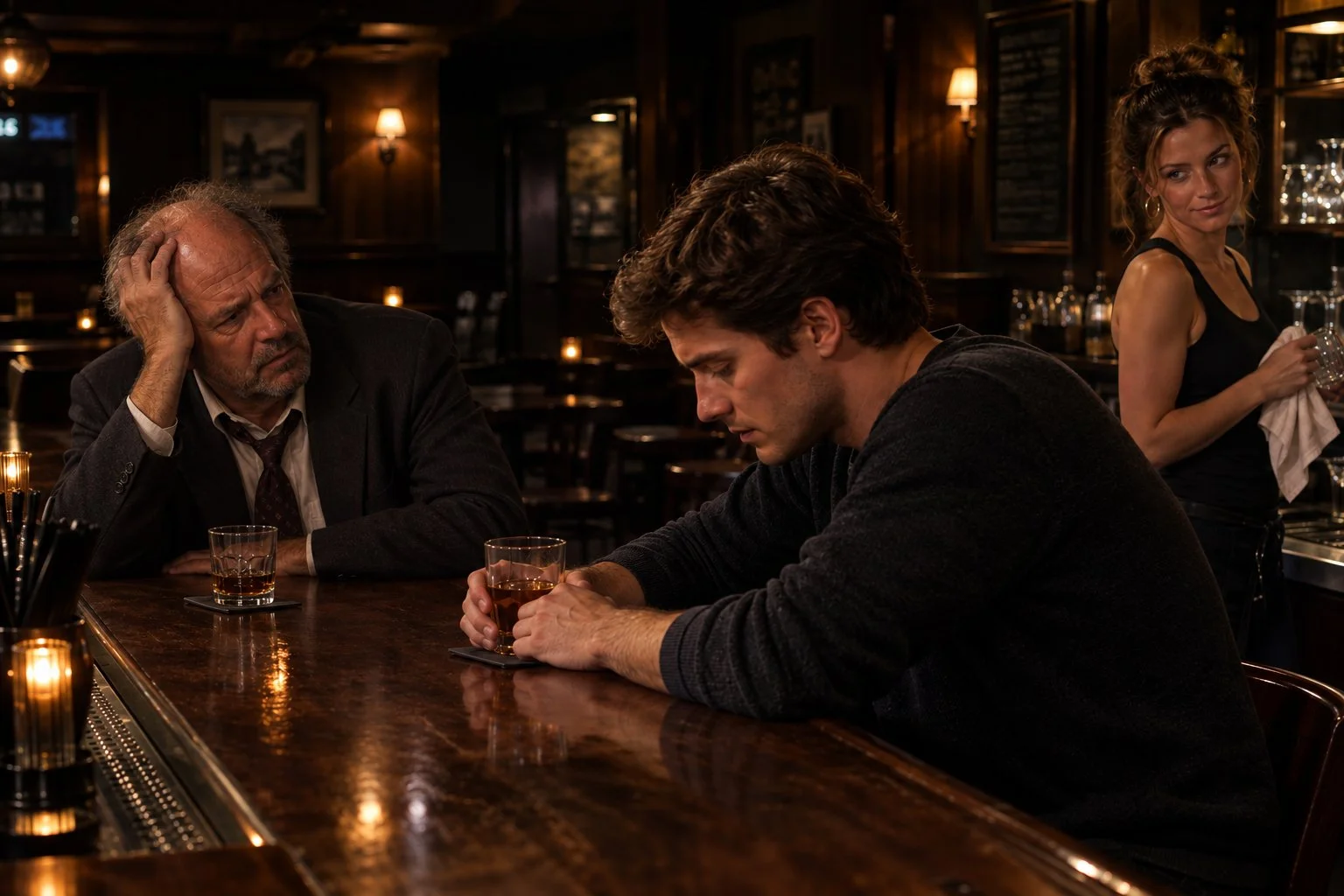
I think my dad had a hard time with retirement. In the five months since stepping away he’d grown increasingly interested in me. I couldn’t tell if it was out of boredom or guilt for not having been more involved in my life up to that point. And though I never felt abandoned by him, it was nice—albeit strange—to get to spend some time with him.
He requested that we get together for a scotch every Thursday night at seven o’clock. He chose a bar downtown in an old hotel that wasn’t far from his former law firm’s office. I figured he chose that place because it was where his old pals preferred to drink after a long day, or to celebrate a trial or settlement victory. I asked him about this and he denied it. He said that any attorney at that firm who had time to drink at a bar wasn’t working hard enough. He said that the good attorneys drank in their offices. Dad just happened to like the selection of scotch behind the bar.
It was tucked away but just off the hotel’s lobby, dimly lit by small candles on the top of the wide bar, a few lights in the low ceiling and a runner of lights set in the bar’s foot railing. It maintained its original art deco style with a black and white tiled floor and ornate hand carvings in the wood that made the bar and the shelves behind it. The most patrons I ever saw in there at one time, other than me and Dad was nine. And they were just there waiting for their tenth to join them so they could catch the train back to the airport. It was like we had our own private watering hole.
Usually our talks would take getting through the first glass before we got in to anything of any real substance. Mostly, I droned on about my miserable job or the wedding planning or whatever was new with Casey or Ali. Dad would talk about my mom as if she was an old friend he hadn’t talked to in a while instead of the fact that she died twelve years earlier. And even then, we didn’t talk about her much. It was too hard for both of us. Even into the second glass with the scotch taking its effect, the conversations were referential, polite. Distant.
Casey’s suicide changed that. The mystery of it seemed to excite my dad.
“Still no word about why he did it?” Dad asked me the first time we got together since Casey died.
“Not a one. I’ve been wracking my brain over it.”
“Have you asked his wife about it?”
“I don’t think I can do that.”
“Why not? She was the closest one to him.”
“Was she? Ali and I were pretty close to him.”
“Of course. She was his wife. That’s a special bond.”
“I just don’t think now is the time.”
“Bah. Maybe he was a pussy.”
“Come on, Dad.”
“I’m sorry, Andrew. I am sorry about Casey. I know he was a good friend of yours and I really liked the boy. Had a lovely looking wife. It’s a damn shame. But suicide? Bah.”
“You ever think about suicide?”
“Every year at tax season.”
“I’m serious.”
“So am I. What self-respecting person with money wouldn’t? Suicide or an IRS agent killing spree. Hey, maybe he was having some tax trouble.”
“I don’t think so.”
“It’s worth looking into.”
“Okay, Dad. But come on, you ever actually think about it?
“No. What reason would I have to kill myself? My children disappointing me? I’ve long gotten over that.” He clinked my glass as he said that to signal that he was only joking. “Any disappointments I’ve had I quickly got over. Suicide is a weakling’s way out. You’re admitting to being a failure because you give up every chance to ever have the upper hand.”
“But Casey was nothing like that.”
“Well, shit, Andrew, how do you really know that? Because he went and killed himself now didn’t he? Bah. So no. I’ve never thought about committing suicide. Hell, think of what people would say about me.”
“They’d probably call you a pussy.”
“Exactly. And I’ll be goddamned if someone’s going to call me a pussy.”
“So you’ve lived a good life. I mean, you’re happy with your life thus far. You can look around you, look at all the things you’ve seen and done and you’re good with it all?”
“I am.”
“But what if you weren’t. What if you looked around and all you saw was everything you didn’t want. Or even worse, you saw the things you thought you wanted but then realized too late that you actually didn’t want those things at all. What then?”
“Why the hell would anyone fill his life with things he didn’t want? Sounds pretty stupid to me.”
“You didn’t know it until it was too late.”
“Too late for what?”
“I don’t know. Too late to replace them or fix them or just do—be—something different.”
“I can’t imagine a situation where there’s no way to influence a change or make a better situation. Figure out what you want, make it happen. Like a fucking man.”
“I’m guessing you don’t know anybody who committed suicide.”
“Not personally, no. Well, just Casey. I did have a case, years ago. Big shipping company. The kind that deals with massive cargo ships full of whatever we just ordered from China. The company had been a client for years, long before I got there. Paid us an incredible retainer. After I made partner, I was assigned to the client. For the first few years things were quiet. Just had to wine and dine the CEO and his wife when they would come into town once a year from Corpus Christi. But then I get a call from the client’s in-house legal team. There’s a problem. A labor dispute. I suggest we contact the unions as soon as possible to see what can be sorted out. I also make plans to fly down there and get all of the details before talking to the unions. I suggest that no one at the company talk to anyone else until I have wrapped my head around everything. Their in-house attorney tells me it’s not that kind of labor dispute. I ask, ‘What are you talking about?’ He says, it’s best if I get down there as soon as possible.
“I book the earliest flight I can, which was the next morning. I was at the airport waiting for boarding to begin, reading the Journal when my cell phone rang. You remember that big cell phone, the one about as long as your forearm? That rings, and at first I didn’t answer it because I had no goddamn idea what was making all of that noise. I’d only had the thing a week and no one had ever called me on it. The ringing stopped and I went back to reading the paper. But then it started ringing again. I looked around to pinpoint whatever was making all of the noise and realized that everyone at the gate had done the same thing. And they were all looking at me. I dug into my briefcase and answered the thing. It was the shipping company’s CEO. He was hysterical. I couldn’t understand much of what he said because either he cried like a sobbing, stuttering little kid or the service on that piece of shit phone was fucking terrible. Anyway, I knew he was upset and tried to calm him down. I told him that I would call him right back from a payphone. He started screaming, ‘No! No!’ And then, and this part I had no trouble making out, he said, ‘Just don’t let them take my company from me.’ Then the line went dead.
“We boarded, I flew down there, sat next to a gorgeous young woman, and when I arrived, I was greeted by the company limousine. The attorney who had called me the day before met me in the lobby of the corporate offices. He told me that the CEO was found dead in his home about thirty minutes before I got there. He hung himself with the belt from his bathrobe. His wife found him, eyes bugged out, face blue, tongue hanging from his mouth wearing his bathrobe, which was wide open on account of the belt was preoccupied.”
“Jesus.”
“But get this. He hung himself from these wooden rafters, which were in the kitchen. He was swinging right above the kitchen table where he and his wife would have breakfast every day before he went off to work. He put one of the table’s chairs on top of the table to stand on while tying the belt around his neck. She came running downstairs after hearing the sound of the chair being kicked out from under her husband, off the table, and onto the floor. She probably got to him mere seconds after he died.
“So as she’s standing there in shock looking at her dead husband swinging from the rafters above their breakfast table, his bodily functions give in and he pisses and shits all over the table, on the floor and on his wife.”
“Oh my God! That’s horrible!”
“It’s something. I was probably one of the last people the guy spoke to.”
“So what happened then?”
“After the attorney gave me the play-by-play, I told him what the CEO said to me back in the airport. He sort of shrugged his shoulders and said, ‘There’s nothing to worry about now.’ We went upstairs to the big conference room, had a quick meeting with the attorney and the vice president of the company, they took me to lunch and put me back on a plane to Chicago. The vice president assumed the role left vacant by the CEO and that was that. Nothing more came from any of it. They still pay us—um, the firm, I mean—that insane retainer.”
“You said you didn’t personally know anyone who committed suicide.”
“I don’t.”
“You knew that guy.”
“Bah. He was a client. I had a few dinners and drinks with the guy. It was all business. He wasn’t a friend or anything.”
“And you never wanted to know his motive? Never wanted to get to the bottom of what was clearly some shady shit happening at that company?”
“Wasn’t my business. I did what I was paid to do. No sense in trying to understand why some people do crazy shit. I could have spent my entire life doing that. Your mother, for one. I don’t know…” He paused and took a long swig of his scotch then composed himself. “Some of those clients… Holy shit.”
We sat quiet for a few minutes while I absorbed what my dad just told me and debated whether he was a callous prick for not being affected by the story or if he was right to not get emotionally involved. Dad, I think, spent those few minutes basking in the afterglow of having relived a thrilling adventure in law.
I could no longer stand to hear myself admit that I had spent thirty-six years following suit, being a sheep or a lemming. Well, not a lemming. Lemmings end up throwing themselves off a cliff. So I wasn’t a lemming quite yet. But being a lemming was looking far more attractive to me than being a sheep.
I broke the silence when I said to him, “Think of it this way, Dad. We’re all just waiting for something to kill us. It’s only a matter of time before some kind of cancer lands in our body and eats away at us. It seems like a rational thing to do: end it quickly before you’re stuck in a bed rotting away. Cheaper, too. No chemo, no drugs—”
“If you get cancer, I’ll buy you a damn gun. How’s that sound? I’m not doing the cancer thing again.” he said.
“You’re missing the point. I’m talking about doing it before it gets any worse. That had to have been what that CEO was thinking. Something terrible was about to go down and he didn’t want to be around to face the fallout.”
“I hope these aren’t the conversations you have with your friends. Because I’m considering taking that knife over there and slitting my wrists just so I don’t have to listen to you.”
“Now you see what I mean.”
“For Christ’s sake, Andrew, knock it off. How’s that daughter-in-law of mine?”
“Let’s not call her that just yet. But she’s fine. Sort of. She’s in wedding planning mode, which is starting to take its toll on her. You know, when I met Lindsay five years ago, she hated all of this wedding stuff. Thirty-year-old Lindsay would kick thirty-five-year-old Lindsay’s ass.”
“Do you know why I married your mother?”
“She hated Carter?”
“Close. She was pregnant with your brother. But do you know why that didn’t terrify me?”
“She loved Reagan?”
“Because your mother let me be me. She knew that my work came first and understood that she and you boys were the beneficiaries of that priority. Your mother let me do what I wanted to do when and how I wanted to do it. Does Lindsay do that for you?”
“I don’t know. A little bit, I guess. Things are pretty balanced. Except when it comes to this wedding. I just don’t want—”
“That needs to change. Have an opinion, boy! Take a stand on something! Put your foot down. Tell me, why did you get engaged?”
“Honestly?”
“No, lie to me.”
“Honestly, because. We’ve been together for five years. It’s what people—”
I stopped myself from finishing the thought. I couldn’t keep explaining away my life like that. It was the truth, but I could no longer stand to hear myself admit that I had spent thirty-six years following suit, being a sheep or a lemming. Well, not a lemming. Lemmings end up throwing themselves off a cliff. So I wasn’t a lemming quite yet. But being a lemming was looking far more attractive to me than being a sheep.
“Should I call off the wedding?” I asked my father.
He slammed his glass down. “Jesus Christ! No. You can’t walk away from a commitment like this. She’s your goddamned fiancé. You love her, don’t you?”
“Yeah. I mean, I think so.”
“You think so?”
“Of course I do,” I corrected myself for the record.
“Then why call it off. Just get married. Let her plan whatever she wants and just be there to support her in every decision she makes.”
“What happened to taking a stand?”
“That applies everywhere else in the relationship excluding the engagement period. Give the woman a wide berth there. The wedding isn’t about you. It’s about her.”
“That’s what I’m afraid of.”
As soon as those words left my mouth, I prepared for my father to launch into a scolding about how being afraid of something like that made me a pussy and that since I was a pussy, I might as well kill myself because that’s what pussies do. Instead, the bartender, Beth, redirected things.
“You boys playing nice?” she asked us.
Beth was a brunette with big, green eyes, and a wide, bright smile. She worked Thursday nights and may have been part of the draw for Dad. I liked having her around, too. In addition to being gorgeous, she was friendly and funny. She was everything two men with certain desires could want in a bartender.
“I swear, Beth, you get prettier every week,” Dad said, causing me to cringe. Like always.
“Sure do, Gary. Flattery is not going to get you a round on the house. But I assume you want another.”
“This first one has treated us nicely, so yes, how about it,” Dad said.
“Same thing?”
“Rack ‘em up!” he said. Maybe he skipped lunch that day because the scotch seemed to be affecting Dad much more that it was me.
“Hang on,” I said. “Let’s try something different this time around.”
Beth quickly directed her professionally flirty eyes my way. Her body followed. “Andy, my man. Feeling adventurous tonight.”
“I just hate to see all that good whisky go to waste.” I squinted my eyes in the low light trying to get a better look at the labels on the bottles. “What’s that one there? Balvenie? Yeah. Let’s do that. Two Balvenie ten years on the rocks. Easy rocks, please, Beth.
She turned to grab the bottle. As she reached up for it, her tight, black tank top lifted away from the waistline of her tight, black pants. Dad nudged me and gestured with his eyes to the now exposed small of Beth’s back. It was a good view, but I gave dad a disappointing look. “Be cool, Dad. This isn’t the eighties.”
“How are you boys doing tonight?” she asked returning to the bar with the bottle in hand. “I missed you last week.”
“Blame him,” said my dad.
“We’re good, Beth.”
She served the drinks.
“He’s miserable,” Dad said.
“Miserable is the wrong word. I’m great.” I, of course, was lying. But I didn’t need the cute bartender to know that.
“That’s great. So, work is going better? Have you set a wedding date?”
“Okay, I’m somewhere between miserable and great. How’s that?”
“His friend killed himself.”
“Dad!”
“Ohmygod! Andy, I’m so sorry. When?”
“Little more than a week ago. Last Tuesday.”
“Oh wow. This wasn’t that person I read about? The political consultant guy?”
“Yeah. That’s him. Public relations. He was the president of a huge PR firm that focused on politicians and campaigns.
“He was your friend?”
“Best friend. Since college.”
“Oh, Andy.”
“Do you know why? Like, why he did it?”
“Nope. That’s part of what makes this all so strange.”
“Could have been something you did,” Dad chimed in.
“There it is,” I said.
“Gary!” scolded Beth.
“What? There’s a responsible party for everything that happens. I’m only presenting a reasonable idea.”
“Andy, you can’t blame yourself,” Beth said.
“I’m not.”
“Good. Don’t. You shouldn’t do that to yourself.”
“I’m not.”
“Suicide is so… it’s such a difficult thing to process. Especially when it happens to someone close to us.”
She was beginning to annoy me. “Okay.”
“How are we to know what another person is feeling or thinking at that moment… that moment of impact?”
“Right. No idea.”
“The journey of life can be ominous.”
“Jesus. Okay, Beth, I got it.”
“Well, if you need someone to talk to. I just hope you’re not drowning your sorrows.” She lightly tapped my glass with her fingernail.
“Are you kidding,” Dad said. “He’s got a team of psychoanalysts keeping his sorrows afloat.”
“Well, if you need someone else to talk to.”
“I’ll keep that in mind.”
“Tell you what, this round is on the house.”
“Is that all it takes to get a round in this place? Andy, how many more of your friends can you get to off themselves?”
“Watch it, Gary, or I’ll cut you off,” Beth said.
“Let’s talk about something else,” I said to Dad.
“Okay, fine. You pick the topic.”
I thought for a moment. “So, you never once thought about committing suicide?” I couldn’t help myself.
This story was adapted from the forthcoming novel, My Six-Year-Old Therapist.
David Himmel is the author of the books Hope Idiotic, The Last DJ, and A Camp Story. An award-winning journalist, he has contributed to several news outlets including POLITICO and The Atlantic. Leader of his two sons and their dog, he's a sailor who does not spend enough time on his boat. Subscribe to his Substack, The Autopsy .