Places Without an Audience
The first thing Jeremy Hoffman learned about disappearing was that nobody really disappeared anymore.
You could die, get lost in the Chihuahuan Desert, walk into Lake Michigan in February with bricks in your pockets and enough bourbon in your blood to convince yourself the water was warm, but you could not vanish cleanly because there was always a photograph, a tagged location, an old interview, or some asshole from high school who remembered you with suspicious clarity.
For the first three weeks after leaving Chicago, Jeremy Googled himself every morning even though he knew this was stupid and, more importantly, knew it was making him worse. He would wake around five-thirty in Room 117 of the Desert Rose Motor Lodge outside Amarillo, stare at the popcorn ceiling until he remembered where he was, then reach for his phone and type the same combinations into the search bar: “Jeremy Hoffman Abuse,” “Jeremy Hoffman Chicago,” “Jeremy Hoffman Monster,” and, after a while, the one that frightened him most, “Jeremy Hoffman WHERE IS HE NOW?”
The articles became less frequent, which should have comforted him but somehow did not. Being hated was terrible, but being forgotten turned out to contain its own small humiliation, and by November the Internet had moved on to a restaurateur who had thrown a chair at an employee and a Northwestern professor who apparently had a second family in Milwaukee. Jeremy Hoffman, briefly the most hated man in Chicago theater, had become old news.
He stopped Googling himself, lasted three days, and then did it again.
After that, he began deleting things.
Facebook went first, followed by Instagram, Threads, X, LinkedIn, an old Tumblr account he had forgotten existed, and finally his website. JeremyHoffman.com had once contained forty-three production photographs, seven reviews, a biography written in the third person, and a calendar of upcoming appearances. At the top of the biography was a sentence he had approved years earlier without embarrassment: Jeremy Hoffman is an award-winning Chicago actor, director, and educator whose work has been described as ferocious, transcendent, and dangerously alive.
He stared at that sentence for a long time before deleting the site.
Dangerously alive.
For fuck’s sake.
Seven months earlier, Jeremy had been King Lear. Not at the Goodman, not Steppenwolf, not Chicago Shakespeare, because Jeremy belonged to the other Chicago, the storefront Chicago above laundromats and beside liquor stores, where fifty folding chairs and a lighting grid made from plumbing pipe could become Elsinore if everybody agreed hard enough. He had been famous there, although not famous-famous. Maybe he’d been public radio famous. Nobody stopped him at O’Hare and TMZ had never waited outside his apartment, but put Jeremy Hoffman in Simon’s Tavern after eleven on a Monday night and people knew who he was. Actors knew him, directors knew him, critics knew him, and bartenders knew him because actors had tabs.
He had three Jeff Awards sitting on a shelf in his apartment and another four nominations scattered through his biography. Over thirty years he had performed Shakespeare, Shepard, Mamet, Albee, Beckett, Pinter, and Chekhov, had played Hickey in The Iceman Cometh at thirty-nine and George in Who’s Afraid of Virginia Woolf? at forty-six, and at fifty-three had played Lear in a ninety-nine-seat theater on Belmont Avenue and made people cry. The Reader called him a volcanic Chicago treasure, while the Tribune described the performance as the culmination of three decades of fearless work, and Jeremy saved both quotes because actors who claimed reviews did not matter were like dogs pretending they did not understand the word treat.
Three weeks after Lear closed, the Reader published another article about him.
The headline was The Cost of Jeremy Hoffman.
He read it sitting at his kitchen table with coffee in one hand and his phone in the other while his girlfriend, Claire, slept upstairs. At first he thought it might be a retrospective or one of those long theater profiles the Reader occasionally ran when an actor had finally become too old to be considered emerging, but then he saw the photograph: himself in black and white, smoking outside the Athena Theatre during tech for Buried Child six years earlier. He remembered the cigarette, remembered who had taken the picture, remembered complaining that the photographer had caught him from his bad side.
He remembered almost everything.
The article began with a woman named Megan, whom Jeremy had dated in 2004 for eight months, maybe nine. Megan said he had controlled what she wore, and Jeremy immediately said aloud, “No, I didn’t,” although nobody was there to hear him. He kept reading. She said he screamed during arguments, which was true, and that he once punched a wall beside her head, which was also true except that the wall had been across the room rather than beside her head.
Was that better?
It felt better, but only for a second, because even in the quiet of his kitchen Jeremy understood that this was the sort of distinction that sounded reasonable only to the person who had punched the wall.
The second woman was Holly, whom he had dated in 2011. She said Jeremy had humiliated her in front of other actors after she disagreed with one of his directing choices, and he remembered that because she had been wrong about the scene and because, even now, some diseased little part of him wanted the record to reflect that. She also said he had threatened to destroy her reputation, which Jeremy did not remember doing.
Then he reached the quote.
He told me, “People listen to me in this town. They don’t listen to you.”
Jeremy put the phone down and stared at the coffee cup between his hands because, suddenly, he remembered saying it.
Fuck.
He picked the phone up again.
There were five women in all, each of them a former girlfriend. Some had worked with him and some had not, none accused him of rape or of physically striking them, there were no police reports, and there were no photographs of bruises or restraining orders or criminal charges. Instead there were stories, dozens of them, and in some ways those were harder for Jeremy to argue with because stories contained context, memory, humiliation, and all the ugly connective tissue that an accusation stripped down to a single sentence could avoid.
There were accounts of screaming, doors slammed hard enough to crack frames, phones thrown, jealous interrogations, punishing silences, public humiliations, and arguments that lasted until the other person was too exhausted to continue.
One woman said Jeremy had driven ninety miles an hour down Lake Shore Drive during a fight while she begged him to slow down, and he remembered doing that. Another said he had locked her outside their apartment at two in the morning, which he remembered differently because she had thrown a glass at him first, although even as that defense formed in his head he could hear how useless it sounded. A third described him calling her “a mediocre fucking actress” after she got a role he believed she was not ready for.
He did not remember saying that at all. Which did not mean he had not said it. That thought frightened him more than anything else in the article.
Jeremy read all six thousand words, then read them again, and by the time Claire came downstairs wearing his Northwestern sweatshirt he had already begun dividing his own history into categories: true, false, distorted, technically true, missing context, not how I remember it, and, worst of all, possible.
Claire stopped at the bottom of the stairs. “What are you doing up?”
Jeremy looked at her and discovered that there was no version of the next few minutes he had rehearsed, no language stored away for this particular disaster, so he simply handed her the phone.
He watched her face while she read, and over the next several days this would become a habit, studying people for the precise second when they decided who he was. Claire scrolled without speaking until she reached the bottom of the article, then set the phone on the table and looked at him with an expression that was not yet anger.
“Are these things true?”
“No.”
The answer came too fast, and Jeremy heard it at exactly the same moment Claire did.
“None of them?”
“That’s not what I mean.”
“What do you mean?”
He rubbed both hands over his face. “I mean it’s complicated.”
Claire laughed once, although nothing was funny. “That’s a really shitty answer.”
“I know.”
She stared at him. Jeremy had performed naked onstage, forgotten lines in front of hundreds of people, taken catastrophic reviews, even been booed once during a disastrous production of The Merchant of Venice, but nothing had ever made him feel as exposed as Claire looking at him across his own kitchen.
“Did you punch a wall?”
“Yes.”
“Did you lock Anna outside?”
“She threw a glass at me.”
“That’s not what I asked.”
“Yes.”
“Did you call Holly a cunt?”
Jeremy said nothing.
Claire closed her eyes. “Jesus wept.”
“It was fifteen years ago.”
When she opened them, there it was: the look. Jeremy would eventually see versions of it thousands of times, mostly from people he had never met, but Claire was the first.
She went upstairs, packed a bag, and left before nine.
Fifteen minutes after the door missed her ass on the way out, the Athena Theatre called an emergency board meeting. At ten, Jeremy’s agent called. At ten-thirty his phone became unusable, and at eleven someone painted RAPIST across the Athena’s front doors even though no woman in the article had accused him of rape.
By noon there were thirty people outside the theater. By three there were seventy-five. Someone brought a bullhorn, someone else brought a papier-mâché head of Jeremy with devil horns, and his face began appearing on Instagram graphics with captions that included BLACKLIST JEREMY HOFFMAN, BELIEVE WOMEN, and NO STAGE FOR ABUSERS.
Jeremy watched all of it from his apartment, curtains half-closed, while the city he had spent thirty years trying to make notice him finally gave him its complete attention.
For most of his life, he had believed the worst thing that could happen to an actor was having no audience.
He was beginning to understand that he had been wrong.
The Athena board suspended him that night, using the word temporarily in an email drafted by an attorney whose name Jeremy had never heard before. Temporarily turned out to mean forty-eight hours, after which the board announced that it had accepted his resignation as Artistic Director, despite the inconvenient detail that Jeremy had not actually submitted one. When he pointed this out, the board president explained that the language had been chosen for legal reasons, which struck Jeremy as a remarkable sentence because, for twenty-two years, he had believed he was one of the people who owned the language of that theater.
His lawyer advised him to issue a statement, so Jeremy wrote nine pages. It contained timelines, context, corrections, apologies, denials, qualifications, examples, explanations, and two paragraphs about how memory functions under emotional stress. His lawyer read it and told him he sounded insane.
They reduced it to four paragraphs, then Jeremy reduced it again because every sentence seemed to become more incriminating the longer he looked at it.
“I am deeply troubled by the accounts published this week. While I dispute several characterizations, I recognize that my behavior in past relationships has caused pain. I am taking time to listen, reflect, and consider how I have failed people I cared about.”
The response was immediate.
CONSIDER? HOW ABOUT ADMIT?
Classic narcissist apology.
“Caused pain” = passive voice bullshit.
Name what you did, coward.
So he tried naming things. He admitted that he had screamed, thrown objects, punched a wall, driven recklessly during an argument, and used his standing in the theater community to win personal fights that should never have involved the theater community at all.
That was worse.
Now the headline became “Hoffman Admits Abusive Behavior,” and people who had not read the original article began quoting his own statement as evidence that he had confessed to things he had never been accused of doing.
He deleted the statement.
That was worse too.
Everything was worse.
Friends stopped calling first, which hurt, and then acquaintances began calling, which somehow hurt more. Some wanted gossip, some wanted to hear his side, some wanted to congratulate themselves for checking on him, and a remarkable number wanted to reassure Jeremy that they supported him privately while making it clear that public support would be professionally inconvenient.
His friend Peter called on the fourth night. They had known one another for twenty-seven years, had acted together six times, directed one another twice, and once spent a drunken Christmas Eve eating Chinese food on Jeremy’s floor after both their relationships collapsed within the same week.
“I know you, man,” Peter said.
Jeremy sat on the edge of his bed. “Then say that.”
Silence.
“Say what?”
“That you know me.”
“I do know you.”
“Publicly.”
Another silence.
Jeremy laughed, though there was nothing even remotely funny in it. “Holt shit, Peter.”
“I have a company.”
“So did I.”
“You know what I mean.”
“No. Tell me what you mean.”
Peter sighed. “I mean I have people depending on me.”
“So did I.”
“Jeremy—”
“Say what you mean.”
Peter did not.
Jeremy hung up.
Fifteen minutes later, Peter texted him.
I love you, brother.
Jeremy stared at the message until the words became meaningless, then threw his phone against the wall hard enough to crack the screen. The irony was not lost on him.
The Athena lasted another six weeks.
Protesters showed up for performances even when Jeremy was no longer involved, and two audience members had to be escorted out of a production of The Seagull after they stood during the second act and began shouting the names of Jeremy’s former girlfriends. Someone smashed three windows, someone else painted ABUSE LIVES HERE across the brick facade, two ensemble members resigned, then six, and a playwright withdrew the rights to a world premiere scheduled for the fall because she said she could not ethically allow her work to be produced by an institution complicit in violence.
The phrase struck Jeremy oddly. “Institution complicit in violence.” He had helped build the Athena from a rented room above a flooring warehouse where the actors had to carry scenery up two flights of stairs because the freight elevator only worked when the landlord kicked it. He had painted walls, hung lights, plunged toilets, built seating platforms, emptied mousetraps, slept on the lobby floor during tech, and once spent an entire January hauling space heaters from his apartment because the furnace failed during Endgame. It had never occurred to him that the thing they built would someday become an institution.
Ticket sales collapsed anyway, and when the landlord announced that he would not renew the lease, the Athena Theatre Ensemble released a statement announcing that after twenty-six seasons it would cease operations.
Jeremy read the announcement alone in his apartment.
That night he drank an entire bottle of bourbon and sat on the living room floor surrounded by three decades of programs, reviews, headshots, and photographs. There he was at twenty-seven, thin and furious, playing Tom in The Glass Menagerie. At thirty-four he was Stanley Kowalski, shirtless and still convinced fifty was an unimaginable age. At forty he was Hickey, at forty-eight George, and at fifty-three Lear, white-bearded and mad beneath a fake storm created by a nineteen-year-old lighting intern with two strobe lights and a sheet of aluminum.
Each photograph contained people who no longer spoke to him.
He began throwing them away.
At three in the morning he carried two garbage bags downstairs, and as he stepped onto the sidewalk, a young woman came around the corner walking a small white dog. She recognized him immediately. Jeremy knew because she stopped, tightened the leash, and gave him the expression people now reserved for him.
“Oh.”
That was all she said.
Not monster. Not bastard. Not even his name.
Just oh.
She pulled the dog closer and crossed the street.
Jeremy carried the garbage to the alley, then returned upstairs and began packing.
By morning, he had decided he needed somewhere nobody cared about theater, someplace where the name Chekhov was more likely to be mistaken for a rifle than a playwright. He bought a paper map from Walgreens because using Google Maps suddenly felt like leaving footprints, spread it across his kitchen table, and stared at the enormous middle of the country as though America itself were offering witness protection.
He closed his eyes and put one finger down.
Texas.
Of course it was Texas.
He drove south and west for three days, staying off interstates when he could and listening to AM radio because every podcast he used to enjoy eventually mentioned Chicago, theater, abuse, cancellation, accountability, or some adjacent word that made his shoulders tighten. Outside St. Louis he deleted his voicemail greeting. In Oklahoma he turned off location services. Somewhere north of Amarillo he realized that nobody knew exactly where he was, and for the first time in months he felt something that resembled relief.
Marlow, Texas, had a population of 1,804 according to the weather-beaten sign at the edge of town, though Jeremy suspected the sign was optimistic. There was one traffic light, one Dairy Queen, three churches, a feed store, a hardware store, a high school football stadium large enough to suggest misplaced municipal priorities, and a convenience store on Highway 67 called LAST CHANCE GAS & GROCERY.
Jeremy liked the name immediately.
He rented a one-bedroom house for six hundred dollars a month from a seventy-six-year-old man named Boone Kessler, who showed him the place without requesting references, credit history, proof of employment, or any of the other documents Jeremy had spent thirty years accumulating.
“You smoke?” Boone asked.
“No.”
“Pets?”
“No.”
“You gonna cook meth?”
Jeremy stared at him.
“No.”
Boone nodded. “Then we’re good.”
He handed over the key.
Jeremy liked Boone because Boone owned a flip phone and appeared to regard the Internet as something the government had invented to make pornography easier to tax.
The next morning, Jeremy applied for a job at Last Chance. The manager was a woman named Jolene Vargas, which nearly sent him back through the door before the interview began. She was perhaps forty-five, with a gray streak running through black hair, heavy eyeliner, and a faded Dallas Cowboys tattoo on her forearm. She read his application while chewing gum and occasionally glancing at him with an expression that suggested she had seen every species of failure come through that office and expected nothing particularly original from him.
“You were a theater director?” she asked.
“Yes.”
“In Chicago?”
“Yes.”
She looked at him over the application. “Why the hell you wanna work here?”
Jeremy had practiced several versions of this answer during the drive west, most involving family, burnout, lifestyle changes, and an invented desire to reconnect with simpler work, but standing beneath a fluorescent light while Jolene waited, every one of them sounded ridiculous.
“Change of pace.”
Jolene stared at him for a moment longer, then looked back at the form.
“You steal?”
“No.”
“You high right now?”
“No.”
“You show up when you’re scheduled?”
“Yes.”
She opened a drawer, pulled out a red polo shirt, and threw it across the desk.
“Congratulations. You’re overqualified.”
That was the entire interview.
Jeremy sat in his car afterward for nearly fifteen minutes with both hands wrapped around the steering wheel because they were shaking.
Last Chance sold gasoline, cigarettes, beer, lottery tickets, bait, coffee, breakfast burritos, windshield fluid, condoms, ammunition, aspirin, sunglasses, canned chili, and something in a plastic pouch labeled PICKLED HOT MAMA that Jeremy decided he would investigate only if his life became even more desperate.
The work was astonishingly simple. People came in, bought things, complained about gasoline prices, talked about weather, argued over lottery numbers, and left. There were no production meetings, no first rehearsals, no casting negotiations, no season planning, no fundraisers, no board retreats, no critics, no post-show talkbacks, and nobody ever asked what the beef jerky was trying to say about America.
Jeremy loved it.
He hated that he loved it.
The regulars learned his name quickly. Roy bought Marlboro Reds every morning at six-ten. Sheriff Polk stopped around seven for black coffee and powdered donuts. A rancher named Mrs. Haggerty came in every Friday for six scratch-off tickets and insisted on calling Jeremy “Chicago,” even after he told her his actual name for the fourth time.
Nobody asked why he was there, and Jeremy slowly realized that rural Texas operated according to an etiquette Chicago had never understood: everyone assumed everybody else was running from something, but unless the sheriff was involved, it was impolite to ask what.
The problem was women.
Jeremy had never been afraid of women before. He had loved women, desired them, fought with them, worked with them, directed them, mentored them, slept beside them, cheated on one of them when he was thirty-two and spent six years feeling entitled to forgiveness. He had made women laugh, made women furious, made women cry, and spent most of his adult life believing that whatever else could be said about him, women understood him.
Now every interaction felt like carrying nitroglycerin down a staircase.
If a woman said good morning, Jeremy immediately questioned his response. Too warm and he was flirting. Too cold and he was hostile. If someone asked him for help reaching a product on a shelf, he became acutely aware of where his hands were. If he made a joke and she laughed, he worried the joke had been inappropriate. If she did not laugh, he assumed it had been.
One afternoon, a woman in her thirties bought three scratch-off tickets and asked Jeremy which one he thought was lucky.
“I don’t know.”
She smiled. “Just pick one.”
He selected Lucky Sevens.
She scratched it at the counter and lost ten dollars.
Jeremy said, “I’m sorry.”
The woman laughed. “You didn’t print the damn thing.”
He knew that intellectually. His body did not.
His body had learned that every interaction could someday become testimony, every sentence could be remembered differently, every joke could acquire a second meaning after the fact, and every careless gesture might someday be presented to strangers who would decide whether it proved something about him.
So Jeremy became careful. Then more careful. Eventually he became nearly silent.
Jolene noticed.
“You scared of me?” she asked one morning while Jeremy stocked bottles in the cooler.
“What?”
“You heard me.”
“No.”
“Bullshit.”
She leaned against the cooler door while Jeremy continued arranging Gatorade by flavor because it gave him something to do with his hands.
“You married?”
“No.”
“Divorced?”
“No.”
“Girlfriend?”
“No.”
“Boyfriend?”
“No.”
“You kill somebody?”
Jeremy turned and looked at her.
Jolene shrugged. “We get all kinds.”
“I didn’t kill anybody.”
“Good.”
She walked away as though the subject had been settled.
Jeremy watched her disappear into the office and wondered whether she had Googled him.
That night, for the first time in three months, he searched his name again. There was nothing new, only the old stories, archived outrage, and a theater blog post titled WHAT JEREMY HOFFMAN TEACHES US ABOUT POWER, written by someone Jeremy had never met.
He closed the laptop, then opened it again and found the original Reader article.
Reading it in Texas was different. Not less painful and certainly not less serious, but smaller somehow, as though geographical distance had changed the scale of the object without changing its weight. There was Megan, Holly, Anna, Rachel, Beth, five women describing five versions of him, and Jeremy found himself doing what he had done from the beginning: testing each allegation for accuracy, searching for factual weaknesses, disputing adjectives, correcting timelines, and mentally offering context no one had requested.
Then, for the first time, he wondered whether the details mattered as much as he wanted them to.
Maybe Holly had exaggerated a sentence. Maybe Anna remembered the apartment argument differently. Maybe Megan had been standing six feet from the wall rather than two.
What if the portrait was accurate anyway? A mosaic did not require every tile to be perfect.
Jeremy shut the computer and sat in the dark while insects screamed into the Texas night.
In January, a girl started coming into Last Chance most afternoons around four. She looked seventeen, maybe eighteen, although Jeremy had become terrible at guessing ages, and her name was Casey because it was embroidered on a navy jacket beneath the words MARLOW HIGH DRAMA CLUB.
The first time Jeremy noticed the lettering, he nearly laughed.
Of course. There was no escaping theater. Not even here.
Casey bought a Dr Pepper and sunflower seeds, dropped a handful of coins on the counter, and studied Jeremy while he counted them.
“You new?”
“Six months.”
“That’s new here.”
She nodded toward his nametag. “Jeremy.”
“That’s what it says.”
“You always this friendly?”
“Pretty much.”
She smiled. “Cool.”
Then she left.
She returned the next day and the day after that, and on Thursday she set a photocopied script on the counter while digging through her backpack for money.
Jeremy looked down.
Our Town.
He hated Our Town. He loved Our Town. Every theater person did both.
“You doing that at school?” he asked.
Casey looked at the script. “Trying.”
“Who’s directing?”
“Mr. Tate.”
“English teacher?”
“Football coach.”
Jeremy nodded because of course he was.
“He ever directed anything before?”
“He directed traffic after homecoming.”
Jeremy laughed before he could stop himself.
Casey grinned. “See? You are human.”
He handed her change. “Debatable.”
She scooped up the script and left.
Two weeks later she came in carrying it again, but this time she opened it on the counter.
“Can I ask you something?”
Jeremy’s stomach tightened automatically. “Sure.”
“What does this mean?”
She pointed to Emily’s final monologue.
Jeremy looked away. “I don’t know.”
“You didn’t even read it.”
“I don’t know plays.”
“Bullshit.”
He stared at her.
Casey pointed at his face. “See? That. You know.”
“What?”
“That judgy face.”
“I don’t have a judgy face.”
“You have the most judgy face I’ve ever seen.”
Jeremy considered telling her to leave, but instead he looked at the page.
He knew the scene by heart. He had directed Our Town in 1998 and played the Stage Manager seventeen years later, and reading even a few lines brought the entire play back to him: the ladders, the milk bottles, the empty stage, the terrible simplicity of people understanding life only when it was too late to participate in it.
“She’s realizing nobody pays attention,” he said.
Casey frowned. “To what?”
“Anything.”
“That’s depressing.”
“No.”
“It sounds depressing.”
“It’s the opposite.”
She waited.
Jeremy tapped the script with one finger. “Everybody thinks life is the big things. Weddings, funerals, getting the job, losing the job, winning something, getting your heart broken. Wilder is saying that isn’t life.”
“What is?”
The old machinery began moving before Jeremy realized he had switched it on. His voice changed slightly, his attention sharpened, and for the first time in months he was not thinking about Chicago, the article, or whether he was saying the wrong thing.
“The eggs you ate for breakfast. The way your mother says your name when she’s annoyed. The smell of your house when you walk in after being away. Sitting in a gas station talking to some miserable old bastard you’ll forget five minutes after you leave.”
“I’m not gonna forget you.”
Jeremy went still.
Casey did not notice. She was reading.
“So Emily understands that?”
“Too late.”
Casey looked up. “That’s fucked up.”
“That’s Our Town.”
She laughed and Jeremy laughed with her, and then the front door opened.
A woman walked in.
Jeremy stepped away from Casey so abruptly that she looked at him.
“What?”
“Nothing.”
“You okay?”
“Fine.”
The woman bought cigarettes. Jeremy spoke only when necessary and kept both hands visibly on the counter, and after she left Casey studied him with open curiosity.
“You’re weird.”
“Correct.”
She gathered her things, then stopped at the door.
“Auditions are Monday.”
“Good luck.”
“You should come.”
“No.”
“Why?”
“I have to work.”
“They’re at seven.”
“No.”
“You could help.”
“No.”
“Why?”
Jeremy looked at her and considered all the real answers. Because theaters had cameras now. Because parents had Facebook. Because teachers Googled volunteers. Because there were five women in Chicago who would probably be sick if they learned he was advising a teenage girl. Because he did not know what redemption looked like and suspected anyone who claimed to know was selling something.
Because he still did not know whether he was dangerous.
“I don’t do theater anymore.”
Casey shrugged. “Looks like theater still does you.”
She left.
Jeremy stood behind the counter for several seconds, then muttered, “Little shit.”
From the office Jolene called, “I heard that.”
He did not go to the audition, although he thought about it so relentlessly that staying home became its own form of attendance. At seven-fifteen he washed dishes. At seven-thirty he reorganized his sock drawer. At eight he sat on his porch with a beer and stared upward at a Texas sky so full of stars it looked theatrical.
Chicago gave you six stars on a clear night and expected gratitude. Texas dumped the entire universe on your head.
Jeremy thought about the final performance of Lear and the standing ovation that lasted four minutes. He remembered because actors always counted, even when they claimed not to. Two hundred people had risen at once, and Jeremy had stood beneath the lights accepting their applause with the private conviction that he had earned every second.
Three weeks later, strangers demanded that he never stand on a stage again.
Sitting beneath the Texas sky, Jeremy considered for the first time that perhaps applause and condemnation were cousins. Both required an audience, and both gave strangers enormous authority over the meaning of your life.
His phone buzzed. Unknown number.
You should have come. It was a fucking disaster. —Casey
Jeremy stared at the message.
He typed Language, deleted it, typed How did you get my number?, deleted that too, and finally sent:
How bad?
Three dots appeared.
Coach Tate cast George because he can throw a football.
Jeremy smiled despite himself.
Tragic.
The reply came almost immediately.
Can you help us?
He did not answer.
The next morning Casey arrived at six.
“You didn’t answer.”
“I was sleeping.”
“No you weren’t.”
“How would you know?”
“Old people don’t sleep.”
“I’m fifty-four.”
“Exactly.”
Jeremy poured coffee while she leaned against the counter.
“Just one rehearsal,” she said.
“No.”
“Why?”
“No.”
“That’s not a reason.”
“It becomes one when you’re older.”
“Coach Tate thinks Emily’s speech should have music under it.”
Jeremy grimaced.
Casey pointed. “See!”
“See what?”
“You hate that.”
“I don’t care.”
“You physically reacted.”
“I have acid reflux.”
“He wants Coldplay.”
“Jesus Christ.”
“Come fix it.”
Jeremy looked at her. “No.”
Casey studied him more carefully this time, and something in her expression changed from annoyance to understanding.
“You really are scared.”
Jeremy said nothing.
“Of what?”
“Go to school.”
“Of theater?”
“Casey.”
“Of people?”
“School.”
“Of me?”
Jeremy’s voice sharpened before he could stop it.
“Go.”
Casey flinched. Barely.
It was almost nothing, but Jeremy saw it, and suddenly he was back in every rehearsal room where people had gone quiet because he had decided they should, every apartment where he had discovered that volume could end an argument even when it could not win one.
Casey picked up her backpack.
“Fine.”
She left.
Jeremy stood motionless behind the counter, feeling sick. Jolene emerged from the office. “You want to tell me what the hell that was?”
“No.”
“Good. Didn’t want to hear it.”
She poured herself coffee. After a moment she said, “You know she thinks you’re the smartest person she’s ever met.”
Jeremy laughed. “Then she needs to meet more people.”
“Probably.”
Jolene took a sip. “She also thinks you’re scared.”
“Did she tell you that?”
“No. I have eyes.”
Jeremy rubbed his face. Jolene watched him. “You running from a woman?”
Jeremy gave a dry laugh. “Five.”
She raised an eyebrow. “Overachiever.”
That surprised a laugh out of him, and then, for reasons he would never understand, Jeremy began telling her the truth. Not all of it, but enough.
He told her about Chicago, the Reader article, the Athena, the protests, the accusations, and the former girlfriends. He told her about the things he disputed and the things he could not dispute, the incidents he remembered differently and the ones he wished he remembered differently. He told her he had never hit anyone, had never forced sex on anyone, but had yelled, intimidated, humiliated, and manipulated people he claimed to love.
Jolene listened without interrupting. When he finished, she took out her phone.
Jeremy immediately tensed. “What are you doing?”
“Googling you.”
“Jesus.”
“You told me your name.”
She typed, read, scrolled, opened the Reader article, read more, then opened a second piece.
Jeremy stood waiting to find out who he was now. After several minutes Jolene put down the phone.
“Well.”
“What?”
“That’s a mess.”
“Yes.”
“You hit any of them?”
“No.”
“Rape anybody?”
“No.”
“Threaten them?”
Jeremy hesitated. “I said things.”
“That’s not what I asked.”
“No.”
Jolene studied him for a moment.
“You’re kind of an asshole.”
Jeremy nodded. “I know.”
“No, I mean right now.”
He looked at her. “What?”
“You think those are the only two options.”
“What options?”
“Monster or innocent.”
Jeremy did not answer.
Jolene picked up her coffee. “Maybe you were just an asshole.”
She started toward the office.
“That’s your wisdom?”
“Costs extra if you want wisdom.”
Three nights later, Jeremy went to rehearsal.
He parked across from Marlow High School and sat in the car for ten minutes, then fifteen, watching students go through the auditorium doors. He nearly left twice, but eventually embarrassment at his own fear became stronger than the fear itself.
The auditorium seated four hundred and smelled exactly like every high school auditorium Jeremy had ever entered: dust, curtains, floor wax, adolescent sweat, and decades of paint layered over old paint. The lighting instruments looked older than the students, and Coach Tate stood in the aisle with a clipboard, broad enough through the shoulders to make Jeremy believe every word about football.
“You Jeremy?”
“Yes.”
“Casey says you know theater.”
“A little.”
Coach Tate looked relieved. “Thank Christ.”
That was the audition. Jeremy took a seat in the back and promised himself he would only watch. For twenty minutes he succeeded.
Then George entered from the wrong side and Jeremy twitched. Emily rushed through a scene and Jeremy gripped the armrest. Mrs. Gibbs could barely be heard. The Stage Manager played every line like he was announcing casualties.
Jeremy said nothing.
Then Coach Tate started the Coldplay. Jeremy stood.
“No.”
Everyone turned. The room went silent. The silence felt good. That frightened him almost as much as anything.
Coach Tate frowned. “Why?”
“No music.”
“Why not?”
“Because Wilder already wrote the music.”
The students stared at him. Jeremy walked down the aisle, climbed the steps, and stood onstage for the first time in nine months.
There was no smell like a theater because every theater in the world somehow smelled like every theater that had existed before it. For half a second Jeremy closed his eyes, and when he opened them Casey was watching him from center stage.
“Again,” he said. She began the final monologue.
“Stop.”
Casey stopped. Jeremy felt the room tighten, the way rooms had tightened around him for decades, and he forced himself to lower his voice.
“You’re trying to make us sad.”
“Isn’t it sad?”
“Yes, which means you don’t have to help.”
She nodded.
“Again.”
She started.
“Slower.”
Again.
“Don’t perform it.”
Again.
“Look at your mother.”
The girl playing Mrs. Webb sat at the kitchen table. Casey looked toward her.
“Really look.”
She did. Something changed.
Jeremy saw it first because he had spent thirty years learning to recognize the instant when an actor stopped demonstrating emotion and began allowing it to happen. Casey spoke the next lines simply, almost conversationally, and that made them devastating.
When she finished, nobody moved. Coach Tate wiped his nose.
“Goddamn.”
Jeremy smiled. Then he noticed someone standing in the auditorium doorway.
A woman. Forties. Watching him. Every muscle in Jeremy’s body tightened.
She walked down the aisle.
Casey brightened. “Mom.”
Jeremy felt cold. The woman stepped onto the stage and looked first at Casey, then at him.
“You Jeremy?”
“Yes.”
“I’m Laura.”
She extended her hand. Jeremy stared at it for half a second too long, then shook.
“Casey won’t shut up about you.”
“She’s talented.”
“I know.”
Laura studied him, and Jeremy saw something forming behind her expression.
“You from Chicago?”
He glanced at Casey.
She shrugged. “I might’ve mentioned it.”
Laura smiled. “I lived in Evanston for five years.”
There it was. The universe tightening.
“I should go.”
Casey frowned. “What?”
“I have work early.”
“You just got here.”
“Sorry.”
He left before anyone could stop him.
At home, Jeremy opened his laptop and stared at the blank search field because he knew exactly what would happen next. Laura would search his name, maybe that night, maybe the next morning, and she would find everything.
Jeremy Hoffman Chicago theater.
The article. The protests. The Athena. The photographs.
Then Coach Tate would know, the principal would know, the superintendent would know, parents would know, Facebook would know, and eventually someone in Chicago would discover it.
He could already imagine the headline.
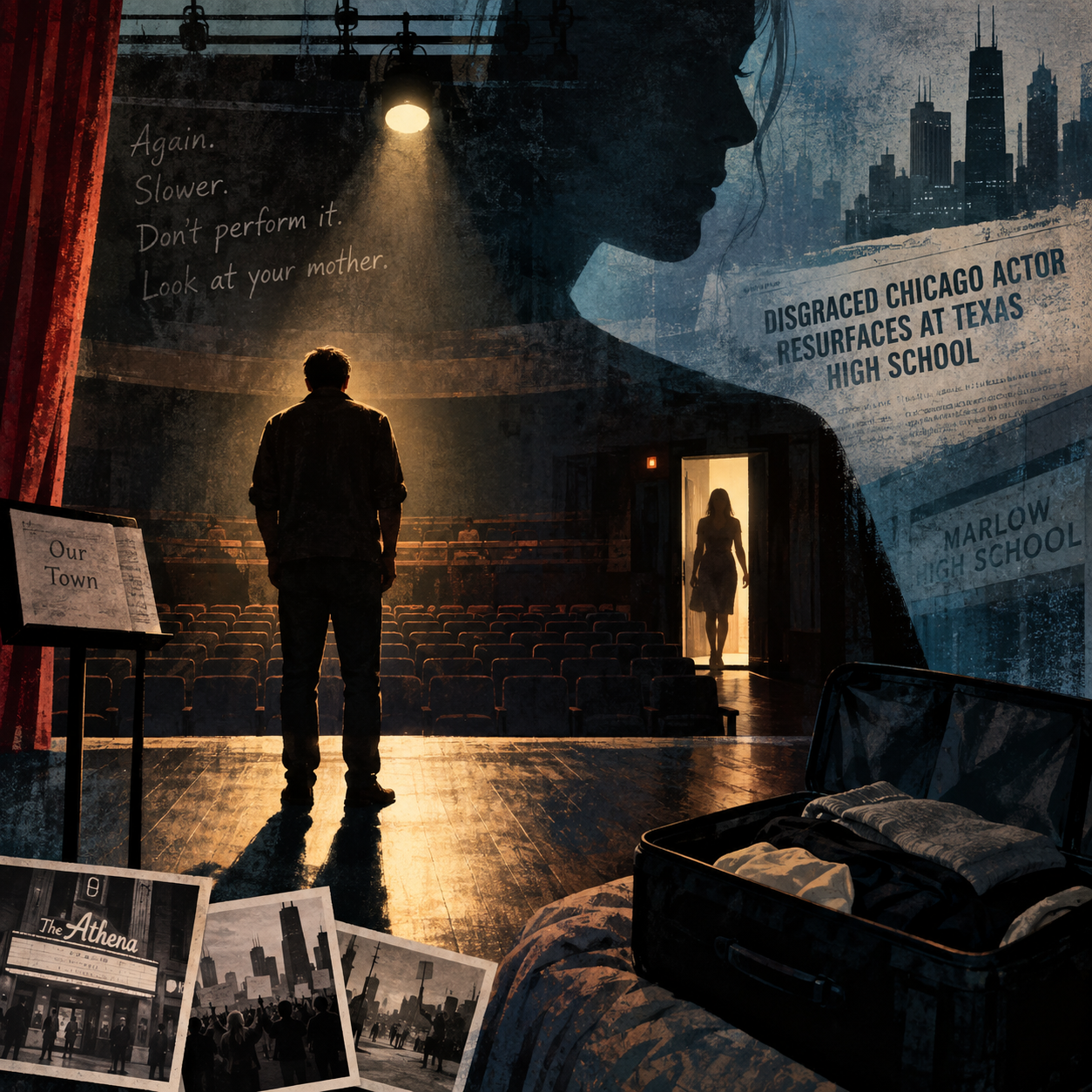
DISGRACED CHICAGO ACTOR RESURFACES AT TEXAS HIGH SCHOOL.
Jeremy began packing. He had become good at it. One suitcase, one duffel, laptop, clothes, toiletries, nothing sentimental. Disappearing was easiest when you owned nothing that objected to being abandoned.
At eleven-thirty someone knocked on the door. Jeremy looked through the curtain.
Jolene.
He opened it.
“What?”
She held up her phone. “Fan mail.”
On the screen was the Reader article. Jeremy closed his eyes.
“Somebody posted this in the Marlow Community Facebook group.”
“Already?”
“This town has eighteen hundred people and one traffic light. Information is our recreational drug.”
“Who posted it?”
“Does it matter?”
“No.”
Jolene stepped inside and noticed the suitcase on the couch.
“Running?”
“Leaving.”
“Same verb.”
“I can’t stay.”
“Why?”
Jeremy laughed. “Because tomorrow everybody knows.”
“So?”
He stared at her.
“So?”
“Yeah.”
“You saw what happened in Chicago.”
“This ain’t Chicago.”
“That’s supposed to reassure me?”
“A little.”
“My theater closed.”
“I know.”
“My friends stopped talking to me.”
“I know.”
“People smashed windows.”
“I know.”
“I couldn’t walk outside.”
Jolene folded her arms. “You’re not listening.”
“To what?”
“This ain’t Chicago.”
Jeremy looked at the suitcase.
“What happens tomorrow?”
“Tomorrow Roy buys cigarettes, Sheriff Polk buys donuts, Mrs. Haggerty loses twenty bucks on scratch-offs, and you stand behind the counter looking like somebody shit in your cereal.”
“You don’t know that.”
“No.”
Jolene nodded toward the suitcase.
“Neither do you.”
Jeremy sat down.
For the first time in months, he felt not tired but exhausted, and there was a difference. Tired could be solved by sleep. Exhausted meant there was nowhere left to go.
“What if they hate me?”
“Some will.”
“What if they want me gone?”
“Some might.”
“What if Casey’s mother—”
“Laura already commented.”
Jeremy looked up. “What?”
Jolene handed him the phone.
The post featured a photograph of Jeremy as Lear and a link to the Reader article.
IS THIS THE MAN WORKING AT LAST CHANCE AND NOW HELPING WITH OUR CHILDREN AT MHS???
There were thirty-seven comments. Some expressed shock. Some anger. Some confusion. One person called Jeremy a predator. Another pointed out that none of the allegations involved sexual misconduct. Someone responded that abuse was abuse.
Then Laura.
Yes, that’s him. I met him tonight. I have read the article. Casey is my daughter. I will be speaking with her before she works with him again.
Jeremy swallowed.
Below it was another comment posted twenty minutes later.
I spoke with my daughter. She says Mr. Hoffman has never touched her, contacted her privately beyond discussing the play, or behaved inappropriately toward her. She says he has treated her seriously as an artist. I still have concerns and intend to speak directly with him.
Jeremy handed the phone back.
“That doesn’t sound good.”
“It doesn’t sound bad.”
“It sounds like she wants to interrogate me.”
“Probably.”
“I can’t do that.”
“Then leave.”
Jeremy looked at her.
Jolene shrugged. “Seriously. Leave. There’s always another Marlow. Another gas station. Another shitty little house. You can spend the next thirty years finding towns where nobody knows your name.”
Jeremy stared at the suitcase.
“Or?”
“Or unpack.”
The next morning, Jeremy parked outside Last Chance at ten minutes to six and sat behind the wheel until ten after six.
Then he went inside.
Jolene said nothing.
At six-thirty Roy came through the door.
Jeremy waited.
Roy put Marlboro Reds on the counter.
“Morning.”
“Morning.”
Roy looked at him longer than usual. Jeremy felt his stomach tighten.
“Twenty on pump three.”
Jeremy rang it up.
Roy paid and started toward the door, then stopped.
“Never cared for Shakespeare.”
Jeremy blinked. “Okay.”
“Too many words.”
“Fair.”
Roy left.
At six-forty-six Sheriff Polk came in for coffee and powdered donuts. He looked Jeremy over, then asked, “You famous?”
“Not anymore.”
“Good.”
He paid and left.
Mrs. Haggerty bought scratch-offs at seven-fifteen.
At eight, a woman Jeremy did not recognize entered, stared at him without speaking, and walked out without buying anything. Around nine someone drove past the store and gave him the finger. At ten-thirty, Casey came in with her mother.
Jeremy stopped breathing.
Laura approached the counter while Casey stayed near the door.
“Can we talk?”
Jeremy glanced toward the office. Jolene disappeared inside.
Coward.
He came around the counter. Laura crossed her arms. “I read everything.”
Jeremy nodded. “Okay.”
“Are the women lying?”
There it was. The question Jeremy had spent nearly a year trying to answer. He looked at Casey, then back at Laura.
“No.”
Laura seemed surprised. “All of it is true?”
“No.”
“Then what are you saying?”
Jeremy took a breath.
“I’m saying I think some things happened differently than they remember them. Some things happened exactly the way they remember them. Some things I don’t remember at all, and there are things I wish I could tell you weren’t true.”
Laura waited. Jeremy continued.
“I yelled. I threw things. I said things designed to hurt people because I knew exactly what would hurt them. I was jealous. I could be controlling. I could make a room miserable until everyone in it surrendered just so the argument would stop.”
Casey stared at him. Jeremy hated that. He continued anyway.
“I never hit anyone. I never sexually assaulted anyone. I don’t believe I ever threatened anyone with violence. But I was cruel.”
Laura’s face gave him nothing.
“Why?”
Jeremy laughed softly. “I’ve spent nine months trying to answer that.”
“And?”
“I liked winning.”
“Arguments?”
“Everything.”
Laura nodded slightly.
“Do you think you’re dangerous?”
That question. The question beneath all the others. Jeremy looked at Casey.
“I don’t know.”
Casey’s face changed. Laura saw it.
Jeremy said, “Which is why I shouldn’t work with your daughter.”
Casey started to object, but Laura raised one hand.
“You haven’t done anything to her,” Laura said.
“That’s not the point.”
“Then what is?”
Jeremy looked at her.
“I don’t want her defending me.”
Nobody spoke.
“I don’t want Casey becoming part of some argument about whether I’m good or bad. I don’t want her deciding those women are liars because I’ve been kind to her. Both things can be true.”
Laura studied him for a long time. Finally she said, “That’s the first intelligent thing I’ve heard anyone say about that article.”
Jeremy almost laughed. Laura turned toward the door. Casey did not move.
“Mom?”
“Come on.”
“But the play—”
“We’ll talk about it.”
Casey looked at Jeremy. He wanted to say something meaningful, something theatrical, something worthy of a final scene. Instead he nodded.
She left.
Jeremy returned behind the counter. Jolene emerged from the office.
“You survived.”
“Fuck you.”
“That’s the spirit.”
Jeremy did not return to the school. Coach Tate removed the Coldplay anyway. The production opened without him. Casey sent Jeremy one photograph after closing night: the entire cast crowded together onstage, smiling beneath a hand-painted sign that read GROVER’S CORNERS.
There was no message.
Jeremy did not respond.
Winter became spring, the Facebook controversy faded, and the people of Marlow eventually discovered newer things to discuss. They still knew who Jeremy was, but knowing turned out to be different from caring, and Jeremy discovered that most people possessed limited reserves of outrage and preferred to spend them on property taxes, football, road construction, and whichever family had allowed their cattle to wander onto Highway 67.
He remained at Last Chance. He planted tomatoes behind his rental house. They died. He tried again. Those died too. Boone told him he was watering them wrong. Jeremy told Boone to fuck off. Boone laughed and showed him how to water them.
Jeremy started running in the mornings and lost twenty pounds. His beard turned mostly gray. He stopped searching his name, then stopped thinking about whether he had stopped searching it, which felt like greater progress.
He still thought about Chicago.
Sometimes he dreamed about the Athena, but in the dreams the theater was always empty and the set belonged to a production he could not remember directing. He would stand under the ghost light trying to figure out what show was supposed to happen next, and each time he woke before he found the answer.
Then one afternoon in April, a package arrived at Last Chance. There was no return address.
Jolene dropped it on the counter.
“Fan mail.”
“Fuck off.”
Jeremy opened the package. Inside was a script. No title. No author’s name. Just pages held together with a black binder clip. A handwritten note sat on top.
Mr. Hoffman—
Casey said you used to direct new plays. I wrote this. She thinks you might understand it. You don’t know me. That’s probably better.
—M
Jeremy stared at the pages.
“What’s that?” Jolene asked.
“Nothing.”
He put the script beneath the counter and ignored it for three days.
On the fourth night he took it home. He made coffee, sat at the kitchen table, and opened to the first page.
The play began at a gas station. A man stood behind a counter. He had once been someone else. Jeremy stopped reading.
Outside, thunder rolled across the Texas plains, and when he looked toward the window he could see his reflection in the glass: older, thinner, gray around the mouth, nobody he quite recognized.
For most of his life, Jeremy had believed identity worked like casting. You decided what role you wanted, persuaded enough people that you belonged in it, then spent years performing it until the distinction between yourself and the part became irrelevant.
Actor.
Director.
Artistic Director.
Mentor.
Boyfriend.
Monster.
Victim.
Exile.
The problem was that every one of those names required somebody watching.
He returned to the table and looked again at the script.
For months he had been trying to become invisible because invisibility seemed safer than being misunderstood. He had assumed the opposite of performance was disappearance, but perhaps he had been wrong about that too. Perhaps the opposite of performance was simply doing something without knowing whether anyone would applaud.
Jeremy turned the page. Then another. Outside, rain began hitting the windows, slow at first and then hard enough to erase the highway beyond the house. He kept reading.
When he reached the end, it was nearly two in the morning. The play was bad. Parts of it were very bad.
There were speeches no human being would ever say, scenes that arrived too late, scenes that went on too long, characters who existed only to explain the plot, and a thirty-page second act that appeared to have been written under the influence of Tennessee Williams and cough syrup.
Jeremy loved it.
He reached for a pencil. Then stopped. For nearly a minute he stared at the blank margin beside the first page. He could already hear what he would have said ten years earlier.
Cut this.
Earn this.
You’re forcing the emotion.
This character doesn’t want anything.
Stop explaining.
Start later.
End sooner.
He could hear the impatience in his old voice and the absolute conviction that the room improved whenever he entered it.
Jeremy put down the pencil. Then he picked it up again.
In the margin beside the opening line, he wrote:
What if the man wants to stay?
He looked at the sentence. It was not a command. It was not an answer. It was only a question. For now, that seemed like enough.
Jeremy turned to page two and kept going.
∞∞∞
Don Hall is a writer, storyteller, and creative mercenary whose wildly varied career—from homeless busker and Chicago public school teacher to theater producer, jazz musician, radio executive, and front-of-house manager at some of Chicago's most iconic venues—has given him an endless supply of stories and an abiding distrust of certainty.
He is the author of Belief Is a Thermonuclear Warhead, co-editor of The Literate Ape, and publisher of the Substack The Attention of Fools, where he writes about culture, politics, creativity, and the glorious absurdity of being human.