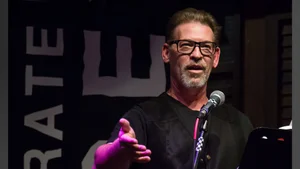
Does the Costume Wear the Man?
Is a new job a reinvention? With the end of the Auditorium Theatre experiment, it’s time for another skin.
Reinvention comes to me like water to a catfish. Growing up the perpetual new kid in school created a pattern that is bedrock in my life. Who I am hasn’t changed but who I am to the world has multiple times.
I’m really fucking good at it.
The positives are that I am able to land on my feet with little regard to the impossibility of the task and can bounce back with gusto. On the other side, there comes a point in a person’s life when reinvention stops looking like courage and starts looking like witness protection.
At first, reinvention is noble. American, even. We love the mythology of it. Burn the old life down. Move west. Change careers. Lose weight. Stop drinking. Start drinking better liquor. Buy black t-shirts. Become a “creative.” Start using phrases like “intentional living” while eating twelve-dollar almonds from a resealable pouch that looks like medical equipment.
We applaud transformation because it gives us hope that identity is not a prison but a series of costume changes. Clark Kent steps into a phone booth and emerges as Superman. David Bowie kills Ziggy Stardust and invents the Thin White Duke. Madonna changed personas so many times she became less a woman than an airport terminal through which trends passed.
The pervasive attempt to redefine gender identity as choice rather than birth tracks in this call for reinvention. The unhappy child tries on the goth thing. Wears all black. Heavy eye makeup. A nose ring with a chain attached to a belly button ring. The despair continues so the child tries on the “queer” or “non-binary” label and gains acceptance in a niche group. But still the dissatisfaction. How about the transgender dress up?
I applaud anyone for trying to find their true identity, the core of who they are. The transgender movement is about as American as the discovery of the road by the Beat Poets, so calm down, rightwingers. But eventually the question arrives like a repo man at 3:00am:
How many times can a person reinvent themselves before there’s no original left underneath the paint?
At what point does adaptation become fabrication?
At what point are you no longer evolving but simply fleeing the scene of earlier crimes against yourself?
Because some people (meaning people like me) reinvent themselves the way normal people change smoke detector batteries. Not occasionally. Constantly. They become human Etch A Sketches, shaking themselves violently every few years until the previous drawing disappears. The teacher becomes the theater producer. The theater producer becomes the NPR events guy. The NPR events guy becomes a casino manager.
And every version insists this one is the real me.
Sure it is.
The modern world practically demands this shape-shifting. Stability has become suspicious. If you remain the same person for too long, people start looking at you the way villagers looked at someone who survived the plague in a medieval painting. What’s wrong with him? Why hasn’t he pivoted? Why doesn’t he have a brand refresh?
LinkedIn alone feels like a digital psychiatric ward where everyone is announcing identity updates with terrifying enthusiasm.
“I’m thrilled to announce…”
No human being has ever been thrilled that many times.
Nobody is genuinely ecstatic to become Senior Vice President of Synergistic Logistics Solutions or Chief Narrative Officer at a company that manufactures biodegradable phone chargers. That’s not joy. That’s hostage footage with emojis.
Social media has accelerated reinvention into something resembling spiritual fast fashion. A person can now become an entirely different human between breakfast and dinner. By noon they’re a socialist. By 2:00pm they’re a Viking. By sunset they’ve posted a photo of themselves staring moodily into the middle distance beside a caption about wolves, boundaries, and “protecting my energy.”
The internet has created an economy where identity itself is content. Every new self is another season of the show.
Season One: Divorced gym rat.
Season Two: Stoic whiskey philosopher.
Season Three: Amateur mushroom mystic with suspiciously expensive scarves.
Season Four: “I’ve decided to leave the city and focus on what matters.”
Which apparently means goats.
Always goats.
At the very least, I’ve never been inspired to raise goats.
The trouble is that genuine reinvention requires destruction. Real change is violent. It kills things. Old assumptions. Old delusions. Old appetites. Sometimes entire friend groups evaporate because the new version of you no longer fits inside the ecosystem where the old one survived.
But fake reinvention? Fake reinvention is cosmetic taxidermy.
It’s painting racing stripes on a broken refrigerator and calling it a Ferrari.
America is full of these taxidermied souls wandering around like mall Santas after closing time. They have assembled themselves from inspirational quotes, podcast fragments, TED Talks, therapy jargon, and the emotional nutritional value of gas station sushi.
You meet them at bars and they introduce themselves using recovery language, startup terminology, and astrology all in the same sentence.
“I’m a recovering people-pleaser entering my entrepreneur era because as a Sagittarius I really value disruption.”
That sentence should legally qualify someone for observation.
For all my verbiage, often to an excess that rivals my late Grandma Betty, in person and in written form, my multiple reinventions are most often accompanied by less talk, more action. Moving on from something that just doesn’t work for me starts with a sense that I’m an elephant chained to a spot with the idea that the chain and the spot represent stability and security. Then I remember that those two things have never been benchmarks of my upbringing. Once I see the chain, I look for another spot and (hopefully) one without a chain.
The older I get, the stranger reinvention becomes because age introduces archaeology into the process. Young people can reinvent themselves because they haven’t accumulated enough evidence yet. At twenty-three you can move to Chicago in a Bronco, start teaching public school, and insist your old self is dead.
At sixty, however, your previous selves follow you around like unpaid interns.
These ghosts of former lives remember things.
They remember the divorces. The empty bank accounts. The motivational seminar phase. The girlfriend with the sternum tattoo. The “playwright years.” The brief obsession with Ayn Rand. The six years you tried to become the kind of man who wears multiple bracelets.
Aging turns reinvention into a haunted house attraction where every former version of yourself jumps out holding receipts.
Still I continue because modern life punishes consistency. To remain unchanged now feels economically dangerous. Corporations reinvent quarterly. Cities reinvent neighborhoods by sanding all personality off them and replacing it with luxury dog bakeries. Even music reinvents itself every seven minutes until songs sound less like songs and more like pharmaceutical side effects.
We are living inside a cultural casino where the slot machines whisper:
Maybe the next version of you will finally feel right. Perhaps the next gig will be as close to perfect as possible. Could the new gig, the new self, last longer than a year and a half?
So I keep pulling the lever.
New haircut.
New ideology.
New romantic status.
New city.
New business cards.
New tattoos explaining old damage. Like, twelve of them.
The self becomes less an identity than a series of emergency renovations performed during an electrical fire. And beneath all of it lurks the terrifying suspicion that maybe there never was an authentic self to begin with.
That possibility horrifies people because Western culture worships authenticity while simultaneously making it impossible. Be yourself, we’re told, inside an economy specifically designed to monetize performance.
That’s like telling someone to remain dry while throwing them into the Atlantic Ocean wearing a meat suit.
Human beings are naturally fictional creatures. We narrate ourselves constantly. We edit memories. We recast motives. We convert humiliations into “chapters.” We turn disasters into origin stories because otherwise we’d have to admit most of life is random chaos wearing a nametag. In my case, some would call it Don Lore.
Memory itself is a dishonest archivist.
You are partly composed of stories you told yourself in order to survive previous versions of reality.
That’s why reinvention is seductive. It offers narrative control. It says the old life wasn’t failure—it was merely Act One. The divorce becomes “growth.” Getting fired becomes “redirection.” Nervous breakdowns become “healing journeys.”
Americans especially adore this because we are descendants of grifters, pilgrims, carnival barkers, bankrupt dreamers, and men who changed their names after accidentally shooting somebody near a riverboat casino. This country was practically founded by people trying to escape earlier versions of themselves.
The frontier itself was one giant national reinvention project. Move west and become somebody else. A rancher. A preacher. A gunslinger. A man who claims expertise in “snake oil distribution technologies.”
No one checked credentials because everyone smelled equally suspicious.
And now the digital frontier has resurrected that instinct. Online, a person can reinvent themselves overnight with the click of a button and the emotional courage of a counterfeit twenty-dollar bill.
Delete photos.
Change bio.
New aesthetic.
New politics.
New face courtesy of fillers, filters, and lighting dimmer than a David Fincher interrogation scene.
The internet allows people to become ghosts haunting their own former identities.
Real reinvention is humiliating.
It requires admitting that previous versions of yourself were not misunderstood masterpieces but partially assembled disasters. It means acknowledging your own bullshit without the protective haze of irony.
Most people would rather swallow a lit road flare.
Ego wants continuity. Ego wants to believe every previous decision was part of an elegant master plan rather than a drunken scavenger hunt through emotional potholes. But maturity often arrives when a person realizes identity is less marble statue and more ongoing negotiation with entropy.
You are not one fixed thing.
You are a committee meeting held inside failing infrastructure.
Some versions of you deserve burial.
Some deserve forgiveness.
Some deserve to be laughed at until milk comes out of humanity’s nose.
The danger comes when reinvention becomes compulsive performance. When a person changes so often they become impossible to emotionally locate. They become like a Netflix series that changes writers every season until nobody remembers what the original premise was.
At that point, relationships become impossible because intimacy requires continuity. Love depends partly on recognition.
Not perfection.
Recognition.
The feeling that beneath all the weather and aging and damage, there remains some identifiable core.
Without that core, a person becomes socially uncanny. Not mysterious. Not dynamic. Fictional.
Like talking to an AI trained exclusively on self-help books, whiskey ads, and divorce podcasts.
Perhaps that’s the answer.
A person becomes fictional not when they reinvent themselves many times, but when every reinvention is optimized for audience reaction rather than private truth.
When identity becomes branding.
When every change feels focus-grouped.
When the soul starts sounding like marketing copy.
The fictional person is not the one who evolves. The fictional person is the one who performs evolution constantly because they cannot tolerate stillness long enough to discover who remains when the music stops.
Because eventually the costumes pile up.
The motivational speaker jacket.
The punk leather jacket.
The expensive minimalist sweater signaling “quiet luxury” to other damaged LinkedIn ghouls.
The spiritual beads.
The gym transformation photos.
The carefully cultivated eccentricity.
And somewhere under that mountain of theatrical wardrobe sits a frightened little creature wondering if anyone would still love them without the special effects.
That’s the real horror beneath endless reinvention.
Not that a person becomes fake.
But that they become unreachable.
Even to themselves.
Especially to themselves.
Like an actor trapped in method performance so long he forgets where the script ends.
Still, there’s something weirdly beautiful about the attempt. Humans are the only creatures arrogant enough to repeatedly declare bankruptcy on their own identity and reopen under new management.
A lobster molts.
A snake sheds skin.
A human being announces a healing journey and starts a SubStack.
Buried inside every reinvention is hope. Delusional hope, maybe, but hope nonetheless. The stubborn belief that tomorrow’s self might finally align with the person glimpsed occasionally in private moments between panic and distraction.
And maybe fiction isn’t always the enemy.
After all, stories are how human beings survive unbearable realities. We create narratives because existence without narrative is just a credit score and blood pressure.
The trick is knowing the difference between authorship and fraudulence.
Between growth and cosplay.
Between transformation and disappearance.
So how many times can a person reinvent themselves before they become fictional?
Probably one fewer than the number of times they reinvent themselves to impress strangers.
And one more than the number required to save their own life.