The Last Offensive Man in America
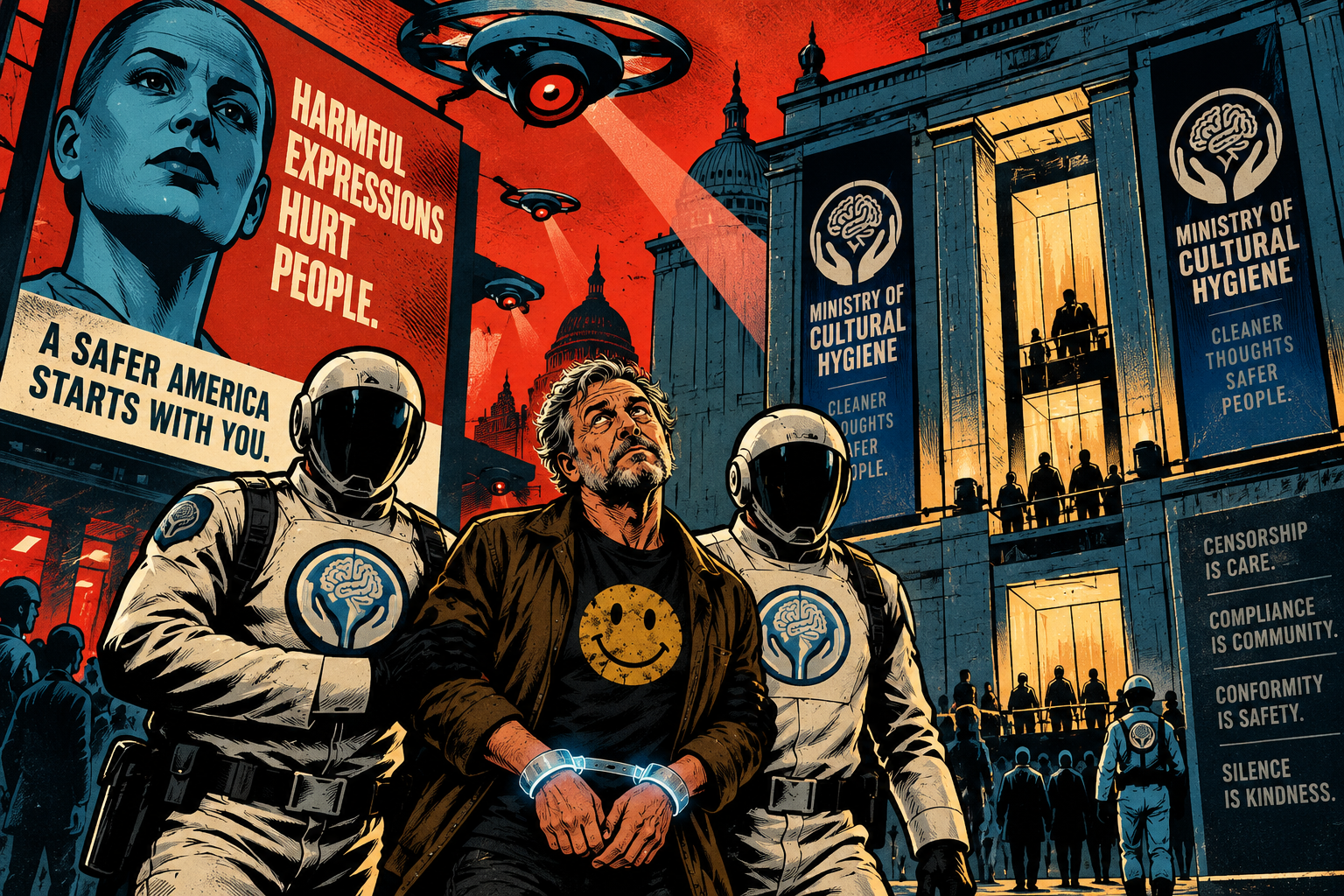
Walter Briggs was arrested on a Tuesday morning for telling a joke.
It wasn't even a particularly good joke, which offended him more than the arrest.
At sixty years old, Walter had spent thirty-seven years telling jokes professionally, fifteen of those years successfully, eleven unsuccessfully, and the remainder in what his accountant once called "an aggressively ambiguous financial category." He had played casinos, cruise ships, comedy clubs, corporate retreats, divorce parties, two prisons, one funeral, and a convention of orthodontists in Phoenix where he learned that people who straighten teeth for a living possess the sense of humor reserved for cadavers.
He knew good jokes, and the joke that finally exhausted civilization's patience with Walter Briggs wasn't one of them.
He was standing in line at a government grocery distribution center when the woman ahead of him complained that the artificial intelligence operating the checkout had misgendered her cat.
Walter said, "Even after you cut off her balls? Outrageous!"
The woman stared at him. The cashier stared at him. The man behind him took three careful steps backward.
Somewhere in the ceiling, something clicked.
Walter looked up. "Oh, for fuck's sake."
The arresting officers arrived forty-three seconds later wearing the pearl-white uniforms of the Ministry of Cultural Hygiene, with the familiar blue emblem stitched over their hearts: two hands gently washing a human brain.
"Mr. Briggs?"
"Depends."
"Walter Eugene Briggs?"
"Depends more."
"You have been flagged for spontaneous harmful expression."
"I made a joke. I mean, less of a joke and more an observation with attitude”
The younger officer winced. The older one said, "Please don't characterize the incident."
"How should I characterize it?"
"You shouldn't."
Walter nodded. “Well, that's surprisingly convenient for everyone but the cat."
The younger officer winced again. Walter was beginning to enjoy him.
They placed a translucent restraint around his wrists. It wasn't technically called a restraint anymore. The Ministry called it a Behavioral Pause Bracelet.
Everything had been renamed as if calling it something sanitized changed its inherent nature. Prisons became Reflection Centers. Interrogations became Clarification Sessions. Censorship became Cultural Hygiene. Execution became Permanent Harm Prevention. War had briefly become Aggressive Mutual Counseling until even the Ministry admitted that sounded a bit stupid.
Walter was taken outside while people watched from behind the windows of shops. Nobody said anything because nobody ever said anything anymore. America had finally become safe. To keep things safe, Americans became quiet.
The Ministry of Cultural Hygiene occupied what had once been the Smithsonian National Museum of American History. This struck Walter as funny, but he wisely kept that to himself.
The building's artifacts had been removed decades earlier during the Great Contextualization, when historians determined that displaying historical objects without continuously updated interpretive warnings constituted passive endorsement of the eras that produced them. The Star-Spangled Banner went first, followed by Lincoln's hat, and Dorothy's ruby slippers.
Nobody could remember exactly what had been wrong with the slippers.
Walter could. They were culturally appropriative footwear. Or maybe they encouraged unrealistic expectations concerning transportation. He couldn't quite remember.
That was the problem. Walter forgot things just like everybody else. He simply forgot considerably less.
He remembered Richard Pryor, Bill Hicks, George Carlin, Lenny Bruce, Joan Rivers, and Don Rickles. He remembered Blazing Saddles and Archie Bunker. He remembered advertisements featuring cigarettes, cartoons involving anvils, and songs about under age girls. I could clearly recall movies about revenge, and jokes about priests, lawyers, blondes, husbands, wives, mothers-in-law, trannies, dead babies, sex, race, disability, religion, alcoholism, obesity, stupidity, flatulence, and approximately four thousand other subjects now categorized as Legacy Harm Materials.
He remembered when people laughed at funerals, when children insulted one another recreationally, and when adults could dislike something without believing it should cease to exist.
But there were other things Walter remembered that mattered considerably more.
He remembered Laura laughing.
His wife had laughed like somebody falling down a staircase. There was nothing graceful about it. She snorted, wheezed, slapped tables and occasionally hit Walter hard enough to leave a mark. During their thirty-two years together, producing that sound had been Walter's favorite accomplishment.
His favorite memory was from 2029. They were lying in bed when Walter made an observation about their aging bodies (that would eventually become a felony), and Laura laughed so hard she spit water onto his chest.
Walter still remembered the exact joke. They were in the foreplay mode one evening.
“Better turn off the lights,” he said with a smirk.
“Why?”
“Because at this point, my nuts are so wrinkled they look like the face of an angry old man and your pussy looks like a badly made ham sandwich stuffed in a fanny pack. Unless you want to see Tommy Lee Jones eating something out of a dumpster, best we copulate in the dark.”
He had never told it to anyone else, not because it was particularly offensive but because it belonged to her.
Laura died in 2034. Cancer, back when death was still called death.
Their daughter Emily was twenty-four and blamed Walter for almost everything afterward. Not Laura's death, exactly. Just everything that came next.
Walter continued performing while comedy was slowly dismantled. Clubs were fined. Performers were required to submit material for sensitivity review. Audience complaints became legal evidence. Eventually every comedian worked with a Cultural Safety Monitor positioned beside the stage with authority to interrupt the performance.
Walter lasted longer than most. He considered this a point of pride. Emily considered it selfishness.
Their last argument happened in 2038 when she stood in his kitchen crying and asked, "Why can't you just stop?"
"Stop what?"
"Fighting everybody."
"I'm not fighting everybody."
"You turn everything into a joke."
"Occupational hazard."
"See? That."
Walter remembered the silence afterward and wishing, even as it happened, that he had simply hugged her.
Instead he said, "You used to think I was funny."
Emily answered, "I was a kid."
Three months later she voluntarily enrolled in Cultural Reconciliation Therapy.
She had Walter removed.
Not physically. Cognitively.
Every painful association with her father was softened, contextualized and eventually deleted. Walter saw her once afterward. She looked directly at him and was perfectly polite.
"Do I know you?"
Walter told her no. It was the only time Walter Briggs had ever lied without trying to make somebody laugh.
He was placed inside a white room containing a white table and two white chairs. A woman entered who looked approximately forty, although everyone between thirty and sixty looked forty now. Cosmetic medicine had become extremely good at preventing aging without becoming particularly good at making anyone look young.
She sat opposite him.
"Mr. Briggs, I'm Deputy Secretary Mara Venn."
"Congratulations."
"I haven't told you what I do."
"You've got Deputy Secretary in front of your name. I'm assuming you didn't win it in a raffle."
She studied him, and Walter saw the tiny muscular betrayal around her mouth.
There it was. She had almost laughed. He knew the signs. Once a comedian, always a fisherman watching the line.
Venn opened a folder. "You were born in 1966."
"Allegedly."
"You performed stand-up comedy professionally until comedy was discontinued in 2038."
"Comedy wasn't discontinued."
"The National Emotional Safety Commission determined adversarial humor had no measurable social utility."
"That's because the National Emotional Safety Commission was run by people who couldn't get laid if they had Axe Body Spray coming out of their ass."
Another twitch.
Walter pointed. "There. You almost did it."
"Did what?"
"Laughed."
"I did not."
"You did."
She closed the folder. "Do you understand why you're here?"
“Recognition of a feline with its balls elsewhere."
"You are here because yesterday the Ministry completed the National Cognitive Audit. For the first time since the Cultural Hygiene Act, every living American has achieved Level Zero Harm Retention."
Walter stared at her. "Every American?"
"Yes."
"No offensive cultural memories?"
"None."
"No dirty jokes?"
"No."
"No racist jokes?"
"No."
"No Mel Brooks?"
She hesitated. "No."
Another thought occurred to him.
"Emily Briggs."
Venn's expression changed.
"My daughter. Emily Briggs. Is she Level Zero?"
"I can't discuss individual citizens."
"You just told me every American."
Venn said nothing.
Walter already knew the answer, but hearing the silence made it different.
"She doesn't remember me."
"No."
Venn slid a tablet across the table. A map of the United States appeared, covered with millions of tiny blue lights and one blinking red one.
Walter touched it.
WALTER EUGENE BRIGGS
CULTURAL RETENTION INDEX: 98.7%
STATUS: CONTAMINATED
"You people tested everybody?"
"Everyone."
"And I'm the last one?"
"Yes."
Walter considered this for several seconds before he began laughing. Not chuckling, but deep, barking, uncontrollable laughter that echoed through the sterile room.
Venn watched him. "What is funny?"
Walter wiped his eyes.
"You did it. You finally created a country where I'm the edgiest comedian alive.”
The extraction began at nine the following morning.
Walter was placed inside a machine resembling an MRI designed by Scandinavians with an eye toward torturing even the most handy while Dr. Evelyn Sayeed explained the procedure.
"We identify prohibited memory clusters and remove their associative pathways."
"Brainwashing."
"Memory sanitation."
"Brainwashing."
"That terminology is obsolete."
"Still works."
She sighed. "Mr. Briggs, we're not erasing your identity."
"Just everything that makes it worth wallowing in."
"We're removing harmful cultural residue."
"And then?"
Dr. Sayeed didn't answer.
Walter looked through the glass at Mara Venn. "Permanent Harm Prevention?"
Venn looked away.
"Thought so."
The machine hummed. Walter felt something cold enter the back of his skull as a screen illuminated and images flickered across it.
Richard Pryor disappeared. Then Carlin. Walter felt each memory vanish like somebody turning off lights in an old house.
Then Blazing Saddles appeared.
Walter stiffened.
"No."
Dr. Sayeed looked up. "Remain still."
"Skip that."
"We can't."
"Skip the fucking movie."
The machine engaged.
Walter was twenty-two again, sitting in a movie theater. Laura was beside him, twenty-one years old and laughing. Walter remembered reaching for her hand in the dark.
Then there was nothing. Walter screamed in almost uncharacteristic rage . The machine stopped and an alarm sounded. Dr. Sayeed stared at her console while a technician checked the diagnostic display.
"What's wrong?"
"I don't know. Everything is functioning normally."
Walter opened his eyes.
"Laura."
Nobody answered.
"Give her back."
Seven miles away, nine-year-old Timothy Hale was sitting in arithmetic class when he suddenly raised his hand. His teacher called on him and Timothy told a joke he’d never heard before.
“A serial killer and a little boy are walking into the woods at night.
‘I’m scared,’ cried the boy.
‘You think you’re scared? I have to walk back alone.’”
The classroom went silent.
Three children began laughing, one child cried, and the teacher activated the emergency cultural alarm.
At precisely the same moment, graffiti appeared on a freshly sanitized wall in Baltimore. Nobody saw anyone paint it. One second the wall was blank; the next it read:
FUCK YOUR FEELINGS.
The phrase had not appeared in the American language for nineteen years.
The Ministry initially classified the incidents as coincidence.
They tried another extraction. Walter remembered an episode of The Dave Chapelle Show when Chapelle played a blind black man who thought he was a racist white man. The memory disappeared.
At 3:17 a.m. the following morning, 4,812 televisions across twelve states turned themselves on and played the episode. People woke screaming, emergency hotlines collapsed, and the Ministry issued a statement blaming obsolete firmware.
They tried again.
A dirty limerick Walter had learned in eighth grade was removed.
There once was a bastard named Dwight,
Who got absolutely shitfaced each night.
He shit in a vase,
Punched a priest in the face—
Then woke up as the groom, dressed in white.
Within six hours it appeared carved into a tree in Nebraska, written on a bathroom wall in Oregon, and inexplicably printed inside fortune cookies at a Chinese restaurant in Delaware.
They removed a joke about Polish people and three hundred Polish Americans spontaneously remembered it. Most were offended.
Twenty-seven thought it was hilarious.
The Ministry panicked.
Walter was moved underground while Dr. Sayeed conducted more tests. Every result was identical: remove something from Walter and it appeared somewhere else, sometimes in people, sometimes in machines, sometimes written on objects.
Once they removed Walter's memory of an Andrew Dice Clay joke.
A lady goes to the store to buy a hook to mount on a wall to hang her coat. She walks up to the counter with it but doesn't have a screw to mount it to the wall. The checkout guy says "do you want a screw for the hook? She answers ""No but I'll blow you for that toaster.”
Two minutes later, every LED traffic sign for thirty miles designed to remind drivers to slow down and not text alerted every commuter that the lady would fellate the checkout guy for an appliance.
Three weeks passed. The Ministry stopped extracting memories, but the contamination continued without their assistance.
A thirteen-year-old girl in Ohio woke from a dream containing the complete plot of A Clockwork Orange. A Baptist minister in Georgia accidentally quoted Bill Hicks during a sermon. A kindergarten class in Minnesota independently invented sarcasm.
That one terrified the Ministry most.
Then Dr. Sayeed showed Walter surveillance footage from a playground in Maryland. A little girl, perhaps eight years old, was sitting on a swing talking to another child.
Walter watched her mouth move.
"Play that again."
Sayeed enhanced the audio.
Walter stopped breathing.
The girl repeated the joke. “…unless you want to see Tommy Lee Jones eating something out of a dumpster…”
"Who taught her that?"
"Nobody."
"That's impossible."
"I know."
The little girl told it again, and another child laughed. It wasn't Laura's laugh, but it was close enough.
Walter sat down.
For the first time since his arrest, he cried.
Two days later, Emily Briggs dreamed about her father.
She had not remembered Walter for twenty-two years, but she woke at 3:17 a.m. with tears on her face and a memory of sitting backstage doing homework while her father performed. She remembered the smell of beer and cigarettes. She remembered Walter walking offstage sweating through his shirt and asking how he'd done.
"You sucked," twelve-year-old Emily had told him.
Walter laughed.
Then Emily laughed.
The memory wasn't supposed to exist.
But it had come home.
Walter was brought before a committee of seven officials seated behind a curved desk. Deputy Secretary Venn stood beside him while Dr. Sayeed displayed brain scans.
"We originally believed Briggs possessed unusually durable long-term memory."
One official interrupted. "Doesn't he?"
"No."
She changed the image. Walter's brain appeared, followed by another brain, then hundreds more.
"The memories aren't localized."
"What does that mean?"
"They aren't stored in him."
Walter looked up. "Come again?"
Dr. Sayeed turned toward him. "Your brain doesn't contain the cultural material."
"Then where is it?"
"We don't know. We think you're accessing it."
The committee chairman frowned. "Accessing what?"
Sayeed took a breath.
"Culture."
The Ministry had spent fifty years operating under the assumption that culture existed inside human beings. Songs were memories, stories were neural patterns, and jokes were learned sequences of words. Erase the memory and you erased the thing.
Except they hadn't.
Human culture behaved less like information than ecology. Ideas migrated, stories adapted, and jokes mutated. Songs disappeared for centuries and returned with different melodies. Myths crossed civilizations without passports.
Walter Briggs wasn't remembering forbidden culture. Forbidden culture was remembering itself through Walter Briggs.
"He's a host," Sayeed said.
Walter shook his head. "No."
Everyone looked at him.
"That's backwards."
Sayeed frowned. "What?"
Walter thought about Laura's joke coming out of a little girl's mouth hundreds of miles away. He thought about Emily.
"I'm not carrying it."
He looked around the room.
"It's carrying me.”
They scheduled his euthanasia for Friday. The reasoning was simple enough: if Walter was a conduit, destroy the conduit.
Walter spent Thursday evening eating his requested final meal of filet mignon, garlic french fries, rye whiskey, Key Lime pie, and an actual cigarette confiscated from the Ministry archives.
Venn entered his cell.
"You can't smoke that."
"I'm being killed tomorrow."
"It's carcinogenic."
Walter stared at her until she sat down. For several minutes neither spoke. She lit his cigarette. Finally Venn placed a tablet on the table.
Someone appeared on the screen. Older now. Gray beginning to show in her hair.
Emily.
Walter stopped breathing.
"Hello?" she said.
He couldn't speak.
Emily studied his face for several seconds. Then she smiled.
"Dad?"
Walter looked away as his face collapsed.
"You remember me?"
"Some."
"How much?"
"More every hour."
Walter laughed through tears. "That's probably not good."
"No."
"How's your mother?"
Emily smiled. "Dead."
"Right."
They both laughed. The sound nearly killed him.
"I'm sorry," Walter said.
"For what?"
"Everything."
Emily thought about it. "You were an asshole."
"That's fair."
"But you were my asshole."
Walter covered his eyes. The Ministry disconnected the call.
Venn looked at him. "I'm sorry."
Walter wiped his face. "No you're not."
Then Walter started laughing.
Venn stared at him. "What?"
"You people spent fifty years trying to protect everybody from painful memories."
He looked at the blank screen where his daughter had been.
"Turns out those are the ones worth keeping.”
Walter Briggs died Friday morning at 8:03 a.m.
The procedure was painless.
The Ministry released a statement announcing that America had achieved Complete Cultural Hygiene. Officials began congratulating one another.
At 8:37 a.m., a boy in Detroit told his sister a joke Walter Briggs had written in 1995 about Bill Clinton’s penis.
At 9:14 a.m., somebody spray-painted “Some guy workin' at Home Depot, he wants to f-k just as many women as a celebrity. But he can't do it, because whores don't care about lumber.” on the Ministry of Cultural Hygiene headquarters.
At 10:02 a.m., every digital billboard in Times Square displayed the same sentence fragment:
THE SHERIFF IS A NIG—.
By noon, thousands of Americans began remembering songs that had never officially existed.
At 2:30 p.m., unauthorized copies of banned novels appeared inside public libraries, although nobody knew who had put them there.
At 3:17 p.m., every television in America turned on.
Walter Briggs appeared on the screen, but not the sixty-year-old Walter who had died that morning. This Walter was thirty-two, standing beneath a spotlight in The Chuckle Shack in Kenosha, Wisconsin. Nobody could identify the recording. The Ministry had destroyed every known copy decades earlier. Walter looked directly into the camera and smiled.
"Good evening, ladies and gentlemen. I've been told I’ll have to watch carefully what I say while onstage."
He paused.
"So, I hope you don’t mind if I drop my pants and point as a visual rimshot."
Somebody laughed, then somebody else, then everyone.
Not because the joke was particularly funny. Walter would have admitted that.
They laughed because they suddenly remembered what even attempted humor felt like when nobody had approved it first.
In Maryland, a little girl told Laura's joke. In Chicago, an old man remembered Richard Pryor. In Texas, teenagers discovered George Carlin. In an apartment outside Washington, Emily Briggs sat alone watching her dead father.
Walter leaned toward the microphone.
"Now, before they drag me offstage, I've got one last joke."
Emily began crying. She knew what was coming. She didn't know how she knew. She simply remembered.
Walter smiled.
Emily said the punchline with him.
For the first time in twenty-two years, she remembered everything: the fights, the embarrassment, the bad jokes, her mother's death, her father's failures, her anger and his love.
None of it was safe. None of it was clean or painless.
It was hers. Emily laughed. Across the country, like an uncontrollable smoker’s hack, people surprised themselves with the terrible, wonderful sound of their own giggling.
Deep beneath the Ministry headquarters, alarms began screaming as deleted books, films, songs, paintings, jokes, photographs, and memories started reappearing inside supposedly sterile databases.
Dr. Evelyn Sayeed watched it happen and finally understood.
Culture had never lived in books because books were temporary. It didn't live in movies because film decayed. It didn't live in computers because hard drives failed, and it didn't even live inside human beings because people died.
Culture lived in the space between people—in the transfer, the telling, the remembering, the whisper after someone said not to repeat something. Every attempt to destroy it merely gave it another reason to survive.
The Ministry had spent half a century hunting contamination without understanding the fundamental problem. Human beings were the contamination.
Walter Briggs had never been the last offensive man in America. He had merely been the last person stubborn enough to remember that forgetting pain wasn't the same thing as healing from it.
Somewhere beneath the earth, inside servers containing fifty years of deleted history, erased movies, forbidden songs, offensive cartoons, obscene novels, cruel jokes, stupid jokes, beautiful jokes, and jokes that weren't even worth remembering, something stirred.
Something enormous and patient that had been waiting a very long time for someone to laugh.
And every alarm in America went off at once.
∞∞∞
Don Hall is a writer, storyteller, and creative mercenary whose wildly varied career—from homeless busker and Chicago public school teacher to theater producer, jazz musician, radio executive, and front-of-house manager at some of Chicago's most iconic venues—has given him an endless supply of stories and an abiding distrust of certainty.
He is the author of Belief Is a Thermonuclear Warhead, co-editor of The Literate Ape, and publisher of the Substack The Attention of Fools, where he writes about culture, politics, creativity, and the glorious absurdity of being human.