I Believe… [The Book]
Well, here we are.
The third in a series. Finally out into the world for reading. You can purchase it for ten bucks right here. If you do, please take a moment and give it a review (even if you think I’m completely full of shit).
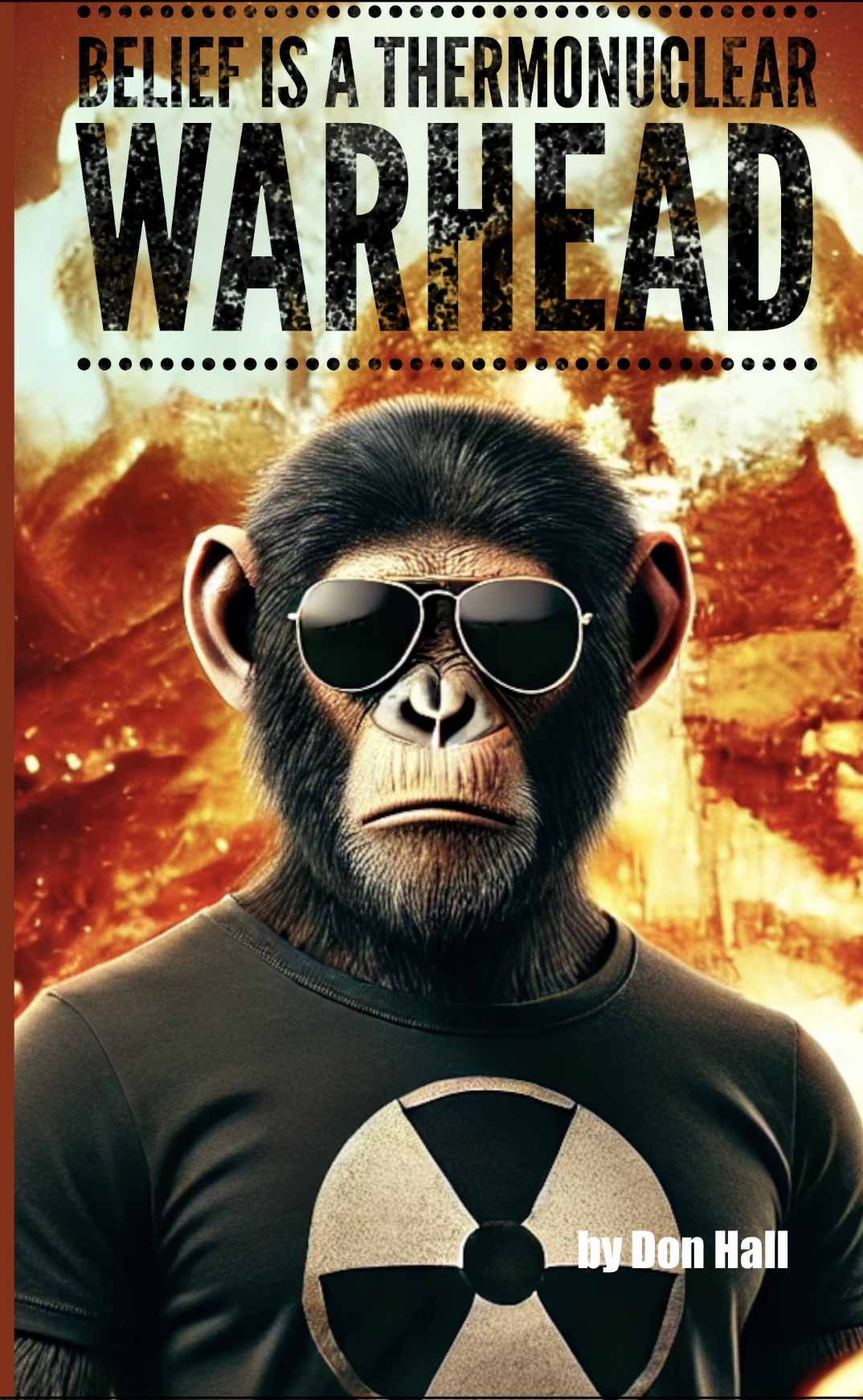
Here’s a taste. The introduction to what I describe as the perfect toilet tome.
The Wretched Gospel of Certainty: How Belief Burns the World
It started with a sketch show in the late 90’s. Joe Janes and I were writing a two-hander, directed by Matt Elwell for his Second City Training Center Director’s class. Joe wrote things. Funny things. I suggested horrible, shocking ideas that I thought were funny. One of us landed on a dueling set up beliefs where I would state a provocative thing I believed loosely and Joe would follow it up something funny. It worked and was fun.
Later, as LiterateApe.com became a thing, I decided to channel the late Paul Harvey and write a weekly column of five such beliefs—things both specific and general, comic and heartfelt, in the moment and more abstract, which I believed wholeheartedly at the time of writing.
A few years later, I culled together hundreds of them, added some essays inspired by a few of the beliefs, and published Belief is a Sledgehammer.
Rinse and repeat. Another couple of years writing five things every week, a purging of those that were either blatantly repetitive or dull, and a few more essays. The second book is Belief is a Bulldozer.
Here is the third tome and I cannot guarantee it will be the last in the series because I just keep writing them. Things I believe. About everything. From cheese to sex, the ownership of dogs to Apple devices, the philosophies of society and culture. One of those things I believe is that belief is dangerous and has been one of the most destructive concepts in history.
The problem with belief in conception and practice is that it gives no fucks about reality. Reality is a thin, wobbly raft on a black sea, and belief is the crazed sailor who torches it because he’s convinced there’s a better boat just beneath the waves. It’s a chemical reaction, a funky trip, a fever dream that grips the brain like an iron vice and never lets go.
Men kill for belief. They throw themselves screaming into the abyss, convinced that the weightless free fall is flight. They strap bombs to their chests, march into war, elect tyrants, burn witches, lynch strangers, all in the name of an idea that can’t be touched, smelled, or measured. Belief is a virus, and once it takes root, it spreads faster than an OnlyFans model with a mortgage due.
The worst part? The host loves it. They welcome the fever, embrace the delirium, and call it enlightenment.
This is not an attack on faith alone—though history is littered with the charred remains of those who got in the way of the righteous. No, this is bigger. Belief is a weapon no matter what brand it carries.
Religious, political, ideological—it doesn’t matter. Once a man is sure he is right, he is capable of anything. There is no force more dangerous than a mind on rails, no horror greater than an absolute truth.
The qualities of true believers defy ignorance or education. Zealots simply ignore any piece of information or counter to their views, they spin this new knowledge as proof that they are correct in their blind fealty, so reasoning with them is almost self defeating.
Let’s get something straight: belief doesn’t need to be true to be dangerous. In fact, the best beliefs are the ones that can’t be proven. That way, they can’t be disproven either. They are immune to evidence, immune to argument, immune to doubt. And if something is immune to doubt, it is immune to reason.
History is one long horror show of belief gone bad. The Crusades? A thousand-mile meat grinder fueled by divine conviction. The Spanish Inquisition? A bureaucratic torture factory that ran on the certainty of God’s will. The Salem Witch Trials? A paranoid frenzy of murder sparked by the unshakable faith that the Devil walked among us.
And it’s not just religion. The 20th century saw its fair share of secular dogma doing the same bloody work. Stalin’s purges, Hitler’s genocidal fantasies, Mao’s Great Leap Forward—each a catastrophic experiment in what happens when you hand absolute power to a man with an unshakable belief in his own righteousness.
The Nazi rallies in Nuremberg were not just exercises in propaganda. They were revivals, churches of hysteria, collective madness wrapped in banners and torches. People surrendered themselves to a cause so completely that they became mere vessels of ideology. And once a man ceases to question, he ceases to be a man at all. He becomes a machine, a tool, a weapon.
The Soviet Union had its own religion, though it called itself something else. Marxism-Leninism. The infallible dogma. A vision so perfect that millions had to die to bring it into existence. When belief takes hold, the cost of dissent is blood. Denounce the party, reject the revolution, question the plan, and you’re an enemy of progress. The gulags were full of believers who had simply believed the wrong thing at the wrong time.
The psychology of belief is not complicated. People want certainty. They crave meaning. The world is a chaotic, terrifying mess, and belief offers a way out. It tells them that there is an order to things, that there is a right and a wrong, that they are on the side of good. It transforms the mundane into the mythic. Suddenly, the fight isn’t just about politics, or religion, or economics—it’s about the very fabric of existence.
Once a person believes, truly believes, they stop asking questions. Doubt is weakness, and weakness is the enemy. They surround themselves with fellow believers, reinforcing their own convictions until reality itself bends to fit the narrative. And if reality refuses to comply? Then reality must be wrong.
This is how men justify atrocities. The suicide bomber doesn’t see himself as a murderer—he sees himself as a martyr. The torturer doesn’t see himself as a monster—he sees himself as a purifier. The tyrant doesn’t see himself as a villain—he sees himself as a savior.
The fanatic is never the villain of his own story. He is always the hero, standing on the frontlines of the eternal battle between light and darkness. And if he has to kill for the cause, so be it. If he has to burn the world to save it, then he will strike the match with a steady hand.
The old gods may be dead, but belief is alive and well. It just wears different clothes. The modern world is filled with zealots, each screaming their gospel into the void.
Politics has become a religion, complete with heretics, saints, and holy wars. The internet is a battlefield of ideological crusades, where reason is drowned in the bloodlust of certainty. People are radicalized not in smoky backrooms or secret meetings, but in broad daylight, through glowing screens and endless echo chambers.
Social media has turned belief into an arms race. The more extreme the conviction, the more attention it gets. Moderation is cowardice. Doubt is betrayal. You are either with us or against us. And so the machine grinds on, churning out armies of fanatics, each more convinced than the last.
Conspiracy theories are just another brand of madness. The earth is flat. The moon landing was faked. The government is run by lizard people. It doesn’t matter how absurd the claim—once belief takes hold, reality becomes irrelevant. The more outlandish the theory, the stronger the faith. Because if you’re willing to believe the impossible, you’re willing to do anything.
Is there a cure for belief? Probably not. The human brain is wired for it. We are pattern-seeking, meaning-hungry creatures, desperate to impose order on the chaos of existence. But there is a difference between seeking meaning and surrendering to madness.
The only real defense is suspicion. Doubt is the antidote to fanaticism. Incredulity forces us to question, to reconsider, to step back from the brink. It is the only thing standing between civilization and the abyss.
But skepticism is hard. It is uncomfortable. It requires humility. It means admitting that you might be wrong. And in a world where everyone is screaming for certainty, humility is a rare and dangerous thing.
Maybe that’s why the world is the way it is. Maybe we’re just not built for doubt. Maybe belief will always win in the end.
Or maybe not.
Maybe the real battle isn’t between good and evil, or right and wrong, or progress and tradition. Maybe the real battle is between certainty and doubt. Between the madmen and the skeptics. Between the burning zealots and the weary, questioning few.
And if that’s the case, then the only thing left to do is pick a side.
Just remember: the moment you start believing too much in anything, you’ve already lost.