The Last Trick
The first rule of close-up magic is that nobody cares how hard it is.
You can spend eight months learning to bottom-deal a playing card without moving your wrist, practicing until the tendons in your fingers feel like piano wire and the cards start appearing in your dreams, and somebody watching you will still say, My uncle does this thing where he pulls his thumb apart.
You can spend years learning the Hofzinser Cull, the Elmsley Count, the Classic Pass, moves with names that sound like obscure European war crimes, and somebody at the table will interrupt you halfway through to ask whether you can make his wife disappear.
People always laugh when they say that, and it is always the wife too, never the husband, never the mortgage, never the pancreatic cancer eating somebody’s father from the inside out.
Just the wife.
Everybody laughs because apparently marriage is the longest-running comedy franchise in America, and because nothing makes people happier than pretending the person they chose to spend their life with is the primary obstacle to enjoying it.
This was my profession, although profession is probably too generous a word for something that mostly involved interrupting strangers while they were chewing.
I wasn’t a magician in the David Copperfield sense, where buildings vanish and women in evening gowns float above stages while orchestras swell beneath them, and I wasn’t a magician in the David Blaine sense either, where a skinny lunatic stares into a camera while doing something that looks medically inadvisable.
I was a guy who knew card tricks and owned three black shirts.
There is a difference.
My name is Martin Bell, although almost nobody knew it before everything happened, which turns out to matter because anonymity feels worthless right up until millions of people know exactly who you are.
Before the miracle, before the lawsuits and churches and death threats and congressional hearings, I performed six nights a week at a restaurant on Hollywood Boulevard called Cinema Planet, which was not Planet Hollywood and had apparently spent enough money proving this distinction to attorneys that management mentioned it during employee orientation.
Inside Cinema Planet, you could eat something called the Terminator Burger beneath a fiberglass motorcycle supposedly used during the filming of Terminator 2, although the laminated plaque mounted beneath it said:
AUTHENTIC SCREEN-USED MOTORCYCLE
and then, in much smaller letters:
ORIGIN UNVERIFIED
Everything in Los Angeles has two signs.
The first sign tells you the dream, while the second sign, usually printed in six-point Helvetica somewhere near the bottom, tells you what you actually bought.
Cinema Planet employed three Elvis impersonators, four aspiring actors, two bartenders who spent their breaks recording a podcast about movies they hated, and me.
My job was table magic, which meant approaching strangers while they were trying to eat mozzarella sticks and saying, “Mind if I show you something impossible?”
Usually the customer would look at me with a french fry halfway to his mouth, trying to determine whether refusing would somehow make him an asshole.
Sometimes he said yes, sometimes he said no, and sometimes he asked whether I was his waiter.
The trick that got the best response was called Chicago Opener, an elegant little routine where a selected card mysteriously changes color and another selected card somehow becomes the same impossible card, and if you perform it correctly there is a moment, maybe two seconds long, when the person watching forgets that the world obeys rules.
That moment took me three years to perfect.
It earned me about seven dollars in tips on a good night.
The worst night I ever had, a twelve-year-old boy explained the method to his parents while I was still performing the trick because he had seen a tutorial on YouTube and apparently nothing makes a child happier than murdering mystery in front of adults.
YouTube killed magic, not completely, obviously, but enough that by the time I was thirty-eight, people had become suspicious of amazement itself, as though being fooled for thirty seconds meant you had somehow failed an intelligence test.
TikTok arrived, which reduced the acceptable duration of wonder to roughly the amount of time it takes someone to swipe toward a video of a woman making lasagna inside a toilet.
So this was my life: birthday parties on weekends, Cinema Planet at night, occasional corporate events when somebody in human resources decided that a man doing card tricks would somehow improve quarterly morale, and every few months a wedding where I would roam between tables while intoxicated relatives tried to grab the deck out of my hands.
My mother told people I worked in entertainment. My father, before he died, told people I dealt cards.
Both statements were technically correct.
Here is another rule of magic: if someone asks you how the trick works, never tell them. People believe they want the secret, but they almost never do because the secret is invariably smaller and uglier than the miracle. A double lift, a false shuffle, a duplicate card, a magnet hidden beneath the table, thread so thin you cannot see it unless the light catches exactly right, or a mirror positioned at the correct angle.
That’s it.
Nobody really wants to discover that the impossible thing they just witnessed was accomplished with dental floss and misdirection. They want permission to believe they were fooled by something worthy of fooling them.
That is the entire business. You protect the lie from the truth because the truth is usually cheap.
The call came on a Tuesday afternoon, which was my day off, while I was sitting on the floor of my studio apartment practicing a one-handed shuffle and eating generic cereal straight from the box because milk goes bad and cereal does not, which at the time qualified as financial planning.
My phone buzzed.
It was a text from Rob.
Emily died.
Two words, no punctuation.
I read them twice because there are certain combinations of ordinary words the brain refuses to process when they suddenly mean something enormous.
Emily died.
Subject and verb.
End of universe.
Rob and I had known each other since community college, where we both took Introduction to Theatre because somebody told us we’d get laid, which turned out to be true. Well, it was true for Rob. I wasn’t swarthy or ambitious enough for most of the girls in the department. I had sex but usually with the woman who then later discovered she was a lesbian after all.
Rob became a lighting technician.
I became a magician.
This is what happens when ambition meets California.
Emily had been his girlfriend for four years, and I knew her well enough to know that she had red hair, one crooked front tooth, an allergy to shellfish, and a habit of starting to laugh halfway through telling a joke because she always found herself funnier than the rest of us did. She worked at an animal shelter in Burbank, and once I watched her cry for twenty minutes because somebody had abandoned a twelve-year-old beagle in a grocery-store parking lot.
The beagle got adopted. Emily didn’t get saved.
Later there would be other words: overdose, fentanyl, accidental, toxicology, history of substance abuse. This is what happens after somebody dies, because the person slowly gets translated into paperwork until the unimaginable becomes administrative.
But that afternoon there were only two words that mattered.
Emily died.
I called Rob, and when he answered on the eighth ring I said all the things people say when language has failed but silence feels crueler.
Jesus, man.
I’m so sorry.
I can’t believe it.
He didn’t say much, and I could hear him breathing into the phone as though breathing itself had become manual labor.
I asked the question everybody asks.
“Is there anything I can do?”
This sentence is almost always a lie, although usually not an intentional one, because what people actually mean when they ask whether there is anything they can do is whether there is some small, socially acceptable task that will allow them to stop feeling helpless.
Bring food, walk the dog, drive someone to the airport, pick up relatives, carry folding chairs, or sit quietly in the kitchen while somebody cries into a beer.
Nobody means anything cosmic.
Rob was quiet for a long time, then he said, “Yeah.”
I waited.
“You could do a card trick that brings her back to life.”
He laughed once, a short barking noise with absolutely nothing funny in it, because grief sometimes comes out of the body wearing the wrong clothes.
I said, “I’ll work on it.”
“Thanks.”
That should have been the end, followed by the funeral, the casseroles, the awkward conversations and the slow return of everyone except the person whose absence had caused all of it. Instead, three weeks later, at 2:17 in the morning, sitting beneath the fluorescent light in my three-hundred-and-eleven-square-foot apartment, I accidentally discovered how to do exactly what Rob had asked.
That was the trick that ruined everything.
I had been working on a restoration routine I jokingly called Lazarus, which should have been enough of a warning, although magicians are superstitious only about things that have already gone wrong.
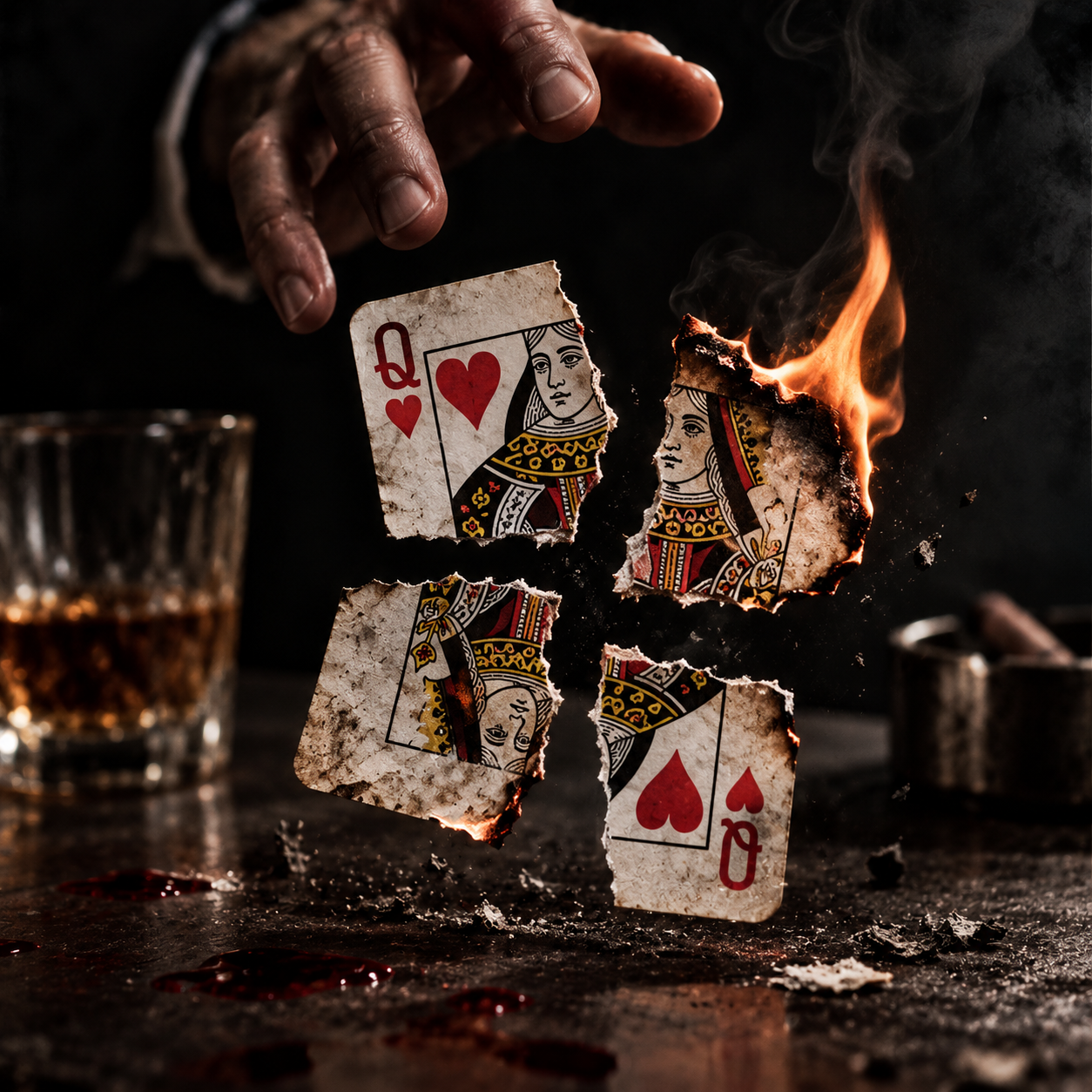
The effect was simple enough: a spectator chooses the Queen of Hearts, the card gets torn into four pieces, one piece gets burned, the remaining pieces go into the card box, and then, with enough theatrical hesitation to suggest that something delicate is happening, the Queen appears again completely restored.
There are a dozen ways to accomplish the effect, all of them involving some combination of duplicate cards, concealed pieces, switches, false transfers and the basic human tendency to look exactly where you want them to look if you give them a reason.
Mine wasn’t working.
The switch felt clumsy, the duplicate flashed from certain angles, the gimmick made the card box bulge, and I had spent almost two weeks making a three-minute trick worse with every improvement. Every magician owns a drawer full of miracles that look like garbage.
That night I had maybe six thousand playing cards scattered around the apartment, including Red Bikes, Blue Bikes, Bees, Tally-Hos, novelty decks, marked decks, stripper decks, invisible decks, Svengali decks and a deck printed with naked women that somebody had given me at a convention in Reno. A whole forest turned into fifty-two-card rectangles so men like me could convince strangers that reality had briefly malfunctioned.
At around three in the morning, something changed.
There was no thunder, no glowing doorway, no mysterious wind blowing through the apartment, and no choir of angels politely alerting me that physics had submitted its resignation.
The deck simply felt heavier.
Not much heavier, maybe half an ounce if I had been forced to quantify it, but enough that my fingers noticed before the rest of me did.
I stopped, counted the deck and got fifty-two. I started again. Shuffle, cut, force the Queen of Hearts, tear it into four pieces, put three pieces into the box, hold the fourth over the flame of a cheap vanilla candle and let it curl into black ash.
That was when the smell arrived.
It wasn’t smoke.
It was flowers, but not fresh flowers, because these were the heavy wet flowers you smell at funerals after they have spent three days drinking old water beside a coffin. Lilies, maybe. Something sweet going rotten.
I checked the candle, then the trash, then the hallway, because even when the laws of nature start behaving strangely, the human brain first assumes that somebody nearby has thrown out an arrangement from a funeral.
The deck became heavier again.
I put the cards down and opened the box. The Queen of Hearts was inside. Whole. Not apparently whole, not convincingly restored and not repaired well enough to fool an audience sitting six feet away.
Whole.
I checked the duplicate I had concealed in my pocket, and it was still there. I checked the torn pieces.
Gone.
I checked the ash from the burned quarter.
Gone.
Then, because I was a magician and therefore professionally incapable of accepting an impossible event without trying to expose it as a cheap method, I performed the routine again.
Same result.
I changed decks.
Same result.
I changed the force, changed the shuffle, changed the order of the tear and even used a card other than the Queen.
Nothing.
When I returned to the Queen of Hearts, the smell came back and the card restored. I repeated the trick seventeen times. At 4:13 a.m., I called Rob.
He answered immediately and sounded terrified because when somebody who recently attended your girlfriend’s funeral calls before dawn, you assume the universe has more bad news.
“What happened?”
“Nothing happened.”
“Martin, it’s four in the morning.”
“I know.”
“Are you okay?”
I looked at the Queen of Hearts sitting on my table.
“Do you still have Emily’s ashes?”
There was a long silence.
“What?”
“Her ashes. Do you have them?”
“Why?”
“I need to try something.”
“Try what?”
I looked around the apartment at the decks and torn cards and the little gray remains of experiments that should not have worked.
“I don’t know yet.”
There are decisions you make because they seem crazy, and there are decisions you make because refusing to make them would somehow seem crazier.
An hour later I was sitting on the floor of Rob’s apartment with Emily’s urn between us. It was blue ceramic, about the size of a large coffee can, and for reasons I still cannot explain that bothered me more than almost anything else about the evening. A human being should not fit inside an object you could imagine buying at Pottery Barn.
Rob looked terrible because grief had reduced him to basic functions: three weeks of beard, yellow eyes, gray sweatpants, bare feet, and the careful movements of someone whose body is present while the rest of him has wandered someplace much darker.
I explained what had happened in my apartment, although “explained” is probably the wrong word because all I really did was describe events that made no sense and then reassure him several times that I understood how insane I sounded.
When I finished, he stared at me.
“What do you think is going to happen?”
“Probably nothing.”
That was a lie.
I had brought the Queen of Hearts, a new deck of Red Bikes and Emily’s old driver’s license, although I had no idea whether any of them mattered except the card.
People assume magicians understand magic, but we understand tricks, and those are not the same thing.
I spread the cards across the carpet and told Rob to touch one. He gave me a look suggesting that, even in the middle of grief, he could still recognize ridiculous theater.
“Seriously?”
“Touch one.”
He touched a card.
Queen of Hearts.
I had forced it, of course, because whatever supernatural lunacy I was attempting, I wasn’t going to trust fifty-two-to-one odds. I tore the card into quarters, put three pieces into the box and burned the fourth over the candle. The funeral-flower smell filled the room almost immediately.
Rob noticed it.
“What the fuck is that?”
“I don’t know.”
The deck grew heavy in my hands, but this time it kept getting heavier until the sensation had nothing to do with physical weight anymore. It felt like holding a telephone when you already know the call is going to change your life.
Weight without mass.
I looked at Emily’s photograph.
“Emily Carter.”
Nothing happened.
I snapped my fingers because apparently even when violating mortality, I still had professional standards.
The bedroom door opened. Emily walked out. Rob screamed.
Not shouted and not gasped, because this was a full animal scream, the kind that erupts before dignity or language can get involved. Emily was naked, confused and apparently irritated, and the first words spoken by a human being who had returned from death were not about God, light, darkness or eternity.
“Why the fuck am I naked?”
Rob crawled backward until he hit the couch.
Emily looked at him.
“What happened to your face?”
She saw the urn on the floor.
The first thing Emily wanted was water, the second thing she wanted was clothing, and the third was an explanation for why Rob was sobbing so hard he could barely form words.
We told her. She didn’t believe us.
Rob showed her the death certificate and she said it was fake, then I showed her photographs from the funeral and she threw up into a wastebasket. Alive people do this. They vomit, complain that their feet are cold, ask for sweatpants and need to use the bathroom. Miracles become disappointingly biological when you stand close enough.
Emily remembered taking a pill, lying down and then nothing. Not darkness exactly, because darkness is something you experience. Nothing. No tunnel, no floating over her body, no dead relatives waiting in soft focus, no white light and no supernatural customer-service representative explaining what happens next.
She described it as falling asleep without dreaming and then opening her eyes in Rob’s bedroom.
This answer disappointed almost everyone later, especially the religious people.
Rob held her for twenty minutes, maybe longer, while both of them cried hard enough that I started feeling like an intruder, and I was considering leaving when they began arguing.
“You called my mother?”
“I thought you were dead.”
“You went through my phone?”
“You were dead.”
“You called Megan?”
“You were fucking dead!”
“I told you never to call Megan!”
Three hours after the first resurrection in recorded human history, the resurrected woman and her boyfriend were fighting about boundaries.
That should have been my warning. Instead, I could think only one thing.
It works.
For the first week, we told nobody, while Emily stayed hidden inside Rob’s apartment eating Thai food, watching television, sleeping fourteen hours a day and occasionally standing naked in front of the bathroom mirror to inspect herself as if death might have left a watermark.
She felt exactly the same.
Doctors later confirmed this once doctors became involved, because there was no brain damage, no fentanyl in her bloodstream, no organ failure and no evidence that her heart had ever stopped. Her body seemed to have been restored to roughly twelve hours before her death, not younger and not immortal, but simply healthy and alive.
This would become the most important fact in human history.
At the time, the more immediate issue was that Emily no longer legally existed.
Her driver’s license had been canceled, her bank accounts had been frozen, her health insurance terminated, her apartment lease transferred and her job at the shelter filled by someone else. There was no bureaucratic box marked DECEASED BUT IMPROVED.
The first person Rob told was his sister, who told her husband, who told a coworker, who had a six-year-old daughter named Madison. Madison had died from leukemia eleven months earlier. They came to my apartment on a Sunday morning carrying her school photograph in a silver frame.
Missing front tooth, pink sweater, hair brushed too carefully.
I said no.
The father cried and I still said no, then he offered ten thousand dollars and I told him to leave because the idea of taking money made the whole thing feel somehow worse. The mother never cried. She simply put Madison’s photograph on my folding table and stared at me.
“You brought Emily back.”
I said nothing.
“So you can bring Madison back.”
“I don’t know.”
“You know enough to try.”
That word.
Try.
Human civilization has been built almost entirely around that word because trying is what we do when knowledge fails us. Try medicine, try surgery, try prayer, try diplomacy, try war, try hitting it with a hammer, try rebooting it, try again.
I tried.
Madison came back.
She was wearing nothing, of course, although within a few weeks we would learn to keep robes and blankets nearby, and she looked exactly as she had before the leukemia entered its final stage. The mother fainted. The father pissed himself. I wish I were making that up.
Later, when the story became part of the mythology, people said he dropped to his knees in worship, which sounded better in documentaries. He pissed himself. Miracles are always improved in post-production.
By Thursday, there were six people outside my apartment.
By Saturday, there were twenty.
By Monday morning, eighty-four.
They brought photographs, urns, lockets, baby teeth, wedding rings, letters, dog tags, newspaper clippings, death certificates, prosthetic limbs and once an entire guitar because the widow said her husband had loved it more than anything except her.
I discovered quickly that none of those things mattered. All I needed was the name of the dead person and someone who genuinely remembered them.The cards somehow handled the rest.
Always the Queen of Hearts.
The sequence mattered, although I never understood why: force the card, tear it, burn one piece, place the others inside the box, speak the name, snap my fingers. Return.
At first I tried to understand what I was doing, but eventually the questions became too large and the results too consistent. When the laws of nature start taking requests, methodology begins to feel petty.
The first month I brought back thirty-two people.
Then eighty.
Then two hundred.
The dead arrived naked every time, and by the second month I had purchased thirty white bathrobes from Costco because this is how miracles become logistics. You begin by overthrowing mortality. You end up buying towels in bulk.
The city became involved, followed by the state and the federal government, which sent representatives from several agencies whose acronyms I was expected to recognize. The government first asked me to stop, then asked me to continue, then asked me to continue under supervision.
Scientists examined the cards and found regular paper, regular ink and ordinary United States Playing Card Company stock. They examined me and found regular blood, regular organs, a regular brain and slightly elevated cholesterol.
They filmed the trick at ten thousand frames per second and saw nothing unusual. They used thermal cameras, radiation detectors, electromagnetic monitors, spectrometers and equipment whose names were longer than the explanations the technicians gave me.
Nothing.
A priest came, a rabbi, an imam and two Buddhist monks who spent most of the afternoon watching quietly and looking as though the rest of us were making something unnecessarily complicated. Everybody had a theory. God, quantum mechanics, collective consciousness, simulation theory, unknown energy, extraterrestrial technology, psychokinesis or some undiscovered interaction between memory and matter.
The scientists hated the religious explanations, the religious people hated the scientific explanations, and nobody hated me.
Yet.
At first, I was a miracle.
TIME put me on the cover holding the Queen of Hearts beneath the headline THE MAN WHO DEFEATED DEATH. They airbrushed my acne scars.
CNN called it the Resurrection Event, Fox called it the Lazarus Miracle, MSNBC called it the Ethical Crisis of Post-Mortality, and the internet, proving once again that it could simplify anything, called me Card Jesus. I preferred that. Short, catchy, good branding.
People tattooed the Queen of Hearts on their shoulders and forearms, while one woman put my face over her heart, which was deeply unsettling because even my mother did not have a framed picture of me in her house.
Churches appeared almost immediately: the Church of the Second Deal, the Fellowship of the Queen, House of Return and at least three organizations using the word Lazarus. People prayed using decks of cards like rosaries. A company sold consecrated playing cards for thirty-nine ninety-five plus shipping.
I never made a dime from any of it.
This bothered people because if I had charged money, they could have understood me. Money explains motive. Free makes people suspicious. A billionaire offered me fifty million dollars to keep him on what he called priority resurrection status. I asked what that meant.
“If I die, you bring me back first.”
“No.”
“One hundred million.”
“No.”
“Two hundred.”
“No.”
He leaned across the table and studied me as though trying to identify a defect.
“What do you want?”
That became the question everyone asked. Money, women, power, fame, a building with my name on it, a foundation, a private island, immunity from taxes, a seat at the United Nations. Nobody believed I wanted none of it.
This is America. Wanting nothing is considered psychosis.
The truth was that I wanted to stop, but stopping became impossible almost as soon as the first crowd formed because how do you look at three hundred people standing outside your apartment, each carrying some version of the worst day of their life, and tell them you need a break? How do you tell the woman who drove from Maine with her husband’s ashes buckled into the passenger seat that your hands hurt? How do you tell the father holding the photograph of his dead son that you would like Sunday off?
Tired is not a moral argument.
So I kept going. Queen of Hearts, tear, burn, box, name, snap, return. Again and again.
Soldiers came back, children, grandmothers, drug addicts, murder victims, suicides, cancer patients, people dead for a week, a month, a year, a decade. The longest gap I ever crossed was for a man named Hector Ruiz, who died in 1963. His daughter was eighty-two years old when she asked me to bring him back.
Hector returned at thirty-nine.
For almost a minute they simply stared at each other, while Hector tried to reconcile the elderly woman in front of him with the little girl he remembered.
Finally he said, “Mija?”
She collapsed into his arms.
The video got more than four billion views and became evidence, depending on who was talking, that humanity was beautiful, that God was real, that science had conquered death or that society had crossed a line from which it could never return. Nobody filmed them six weeks later when Hector moved out because he could not adjust to having a daughter who was older than his own mother had been when he died. Nobody filmed him trying to absorb Kennedy, Vietnam, the moon landing, Watergate, AIDS, personal computers, 9/11, smartphones, social media, streaming television, DoorDash and gender-reveal parties.
Hector lasted nine months, then he walked into traffic.
His daughter asked me to bring him back again. I refused.
That was when we discovered the next problem, because until that point nobody had thought to ask how many times resurrection applied. Could I bring someone back twice?
Yes.
I learned this after a thirteen-year-old boy named Caleb, resurrected after drowning, died eight months later in a car accident. His parents begged me to try. Caleb returned again. Same thirteen-year-old, same scar on his chin, same laugh and the same irritation that his parents had gone through his room after his first death.
The networks called it DOUBLE RESURRECTION.
The phrase changed everything.
Until then, people had still believed death existed and I merely possessed some extraordinary ability to reverse it once. After Caleb, death became an inconvenience. People stopped wearing seatbelts. Motorcycle sales increased. Extreme sports companies discovered what amounted to the greatest marketing opportunity in history.
Life insurance markets collapsed while funeral homes reinvented themselves as transition centers. Hospitals developed post-resurrection release forms and politicians began arguing over whether revival should be covered by Medicare. The military wanted guaranteed access, as did police departments, foreign governments and corporations whose executives suddenly considered death a productivity issue.
A senator introduced the Resurrection Equity Act while another senator called resurrection an unconstitutional interference with natural law. A televangelist announced that anyone returned through playing cards was possessed by demons, then called me privately when his wife died of an aneurysm.
I brought her back. He changed denominations.
People behaved differently because why wouldn’t they?
Serial killers discovered that victims could return and testify. This seemed good. Prisons requested resurrection for executed inmates because appeals were still pending. That seemed less clear.
Abortion activists appeared outside my hotel, both sides at once, with one group demanding I attempt to resurrect fetuses and the other demanding that I refuse. Neither could agree on what constituted a person, but both expected a card trick to settle philosophy.
I became the Supreme Court with a deck of Bikes.
Governments got involved in wars. One country asked me to resurrect three thousand soldiers. Another demanded that I first resurrect the civilians those soldiers had killed. Both called their position justice. Everybody wants the dead back until the dead belong to the enemy.
Here is another rule of magic: never repeat the same trick too many times because eventually the audience stops watching the effect and starts searching for the method. By then I had repeated mine more than twenty thousand times. People were no longer amazed.
They were impatient.
Crowds outside the secured buildings chanted BRING THEM BACK until the words stopped sounding like language. I could perform forty resurrections in a day if I worked steadily, maybe fifty if I skipped meals and let assistants handle everything except the cards.
Roughly sixty million people died every year. Someone did the math. Humans love mathematics when mathematics proves someone else is failing.
One network built a live counter estimating the number of people I had failed to save. It rolled upward every second. At my pace, assuming fifty resurrections every single day without vacations or illness, I could bring back roughly eighteen thousand people annually while tens of millions remained dead.
Suddenly every death on Earth had an identifiable bottleneck.
Me.
Families sued, churches sued, governments sued and activist groups sued on behalf of people who had been dead for centuries. A court ordered a randomized lottery system, then another court blocked it. One judge ruled resurrection was healthcare, another ruled it was religious expression and a third ruled it was neither because no existing statute had contemplated supernatural card manipulation.
For the first time in American history, Congress attempted to define a card trick. The bill was eleven hundred pages. I read none of it. I kept working. My fingers developed calluses, then tendonitis, then arthritis. Doctors gave me injections.
An engineering firm built a machine designed to tear the card for me, but the resurrection failed unless I handled every step personally. This made me more valuable and therefore less free.
The Secret Service eventually moved me to a secure facility in Nevada, officially for protection, although after a while I noticed that the fences were designed to keep people both out and in. Nobody used the word prisoner. Nobody had to.
My room was nicer than my apartment, with a king-size bed, a private kitchen, a gym and no windows. Three armed guards worked rotating shifts. Someone produced a schedule.
6:00 a.m., wake up.
6:30 a.m.,, breakfast.
7:00 a.m., first resurrection.
Noon, lunch.
12:30 p.m., restart.
7:00 p.m., dinner.
8:00 p.m., medical evaluation and rest.
Six days a week. On Sundays I got four hours outside inside a fenced recreation area. The Messiah gets Sundays off.
Millions of letters arrived. I read some.
Dear Mr. Bell, my wife Patricia died in 2018.
Dear Martin, my little brother was only seventeen.
Dear Card Jesus, please.
Dear Sir, you don’t know me.
A large percentage began with the same sentence.
I know you can’t save everyone, but—
There was always a but.
Everybody understood in theory that I could not resurrect everyone, while everybody believed in practice that I should resurrect theirs. This is the mathematics of grief. One dead stranger is unfortunate. One dead person you love is the end of the world.
I accidentally brought back murderers because families did not always mention the unpleasant portions of a person’s biography. One mother asked for her son, neglecting to mention that he had killed two people during a robbery before dying in a police chase. I resurrected him. The victims’ families protested, then realized I could bring back the victims too and demanded that I do so.
I did. The victims testified. The murderer went to prison. He killed himself.
His mother demanded that I resurrect him again. I refused. She called me a murderer.
This happened more often than you would think.
The first death threat came from a man whose wife I had not resurrected. The second came from a man whose wife I had. Apparently she returned and, within two months, left him. He blamed me.
“You ruined my life,” he said during a hearing through a pane of bulletproof glass, after being arrested outside the facility with a rifle.
“She was dead.”
“She was mine.”
There it was. Not alive. Mine.
People like to believe grief is entirely about loss, but resurrection revealed how much of it can also be about ownership. My wife, my husband, my child, my mother, my father, my friend. The possessive pronoun carries more weight than anybody wants to admit.
People did not always want their loved ones alive. They wanted them returned exactly as remembered. The resurrected had other ideas.
They left marriages, abandoned careers, converted to new religions, rejected old religions, became atheists, became evangelicals, spent recklessly, hoarded money, quit drinking, started drinking and occasionally decided that the life everyone else had missed so desperately was a life they themselves no longer wanted.
A woman who had drowned refused to take baths. A man resurrected after a mountain-climbing accident became obsessed with BASE jumping. A six-year-old girl brought back after drowning became fascinated with swimming and had to be dragged from pools. One woman refused to sleep because she was convinced death might return if she lost consciousness.
A pastor came back after cardiac arrest and told his congregation he had experienced absolutely nothing. They fired him.
That became another problem. People begged the returned to describe death, and almost all of them gave the same answer. There wasn’t anything to describe. No awareness, no waiting, no voices and no time.
The absence became known as the Blank.
For some people, the Blank was comforting because it made death sound like dreamless sleep. For others, it was catastrophic. Church attendance dropped, then increased, then fractured into denominations arguing over whether God intentionally erased the memory of the afterlife. New religions emerged while old religions rewrote pamphlets.
Scientists insisted the reports proved nothing.
Philosophers became television personalities.
Everybody found a way to monetize uncertainty.
Except me. I just tore cards.
After resurrection number 31,744, I looked at my hands and realized they were shaking badly enough that I could barely hold the deck. The next person was a nine-year-old boy named Brian who had died of a brain tumor. His parents stood on the other side of the observation glass while an assistant handed me the photograph.
I could bring him back. There was no cost.
That was the worst part. Nobody else died. No imbalance appeared in nature.
The resurrected did not become violent or soulless, their flesh did not decay and they did not return possessed by ancient demons. They were not copies. They were themselves.
If every resurrection had killed another person, I could have stopped. If the returned came back wrong, I could have stopped. If the sky cracked open, if blood ran down the walls, if monsters crawled through whatever door I had opened, I could have put down the cards and called it responsibility.
But nothing bad happened.
Which meant stopping required me to look at Brian’s parents and say that their son could be alive again, perfectly alive, and I simply did not want to do it today.
I performed the trick. Brian came back. I vomited into a trash can.
The following morning, the official waiting list passed four million.
Soon people were registering dead relatives not because they expected resurrection within their lifetime but because they wanted their children to inherit the application. Death had become a waiting list. The waiting list developed a black market because everything does.
Slots sold for millions.
Applications were forged. People bribed clerks, manipulated records, hired actors to impersonate relatives and occasionally murdered other applicants. One family maintained the priority position of a grandfather nobody living actually remembered by hiring an actor to claim emotional attachment.
The resurrection failed. Whatever the cards were doing, they knew.
That frightened me more than the miracle itself because it meant something beyond me was making distinctions.
Congress subpoenaed me. I sat beneath fluorescent lights while senators used five-minute speaking blocks to ask questions that humanity had failed to answer in five thousand years.
“Mr. Bell, do you believe every American has a right to resurrection?”
“I don’t know.”
“Should wealth influence access?”
“No.”
“Should convicted criminals qualify?”
“I don’t know.”
“Foreign nationals?”
“I don’t know.”
“Enemy combatants?”
“I don’t know.”
“Unborn children?”
“I don’t know.”
One senator, sounding almost embarrassed, asked about pets.
That one I knew.
“Yes.”
People laughed. I didn’t. Animals were easier.
The first animal I resurrected was my neighbor’s cat, years before Nevada, after someone hit him with a Toyota Corolla. His name was Barnie.
I found him in the street, carried him inside on a towel and tried the trick almost as an experiment. Barnie returned, stretched, licked his paw and ate half a can of tuna. He never asked why I had not brought him back sooner.
He never sued.
He never formed a church.
He never sold merchandise with my face on it.
The breaking point was a woman named Theresa Abbott, whose daughter Sophie had died in a car accident fourteen years earlier at the age of twenty-two. Theresa waited eighteen months for her slot. I performed the trick. Sophie returned.
She hugged her mother, Theresa collapsed against her and everyone in the room cried, including two security guards who had already watched hundreds of resurrections.
Three weeks later, Sophie killed herself. There was a note, although I never saw the whole thing. Only one sentence leaked.
I had already finished being alive.
Theresa returned to the facility and demanded that I bring Sophie back again.
I refused.
She screamed until security removed her. She came back the next day and the next, then began appearing outside the gates with photographs and signs until she finally got close enough during a transport to spit in my face.
“You don’t get to decide.”
That sentence stayed with me because everybody eventually said some version of it. Politicians, parents, priests, lawyers, scientists and strangers standing behind barricades.
You don’t get to decide.
Which was strange because apparently I did. That was the problem. I had accidentally become the only person alive who could decide who remained dead. I used to make seven dollars doing Chicago Opener while somebody ate a burger beneath a fake movie prop. Now presidents called me, popes called me, kings, dictators, celebrities and billionaires called me.
A movie star once offered to sleep with me if I resurrected her dog.
I resurrected the dog and declined the rest. The tabloids called me impotent.
Here is another rule of magic: audiences do not hate being fooled nearly as much as they hate realizing somebody else controls the exact moment when they understand the deception. Control was always the real miracle. Not life. Control.
Human beings had tolerated death reasonably well when nobody was in charge of it. Cancer, heart attacks, car crashes, war, infection, old age, bad luck, God, nature. Impersonal monsters.
Suddenly death acquired an employee. Every grave became my fault. Every funeral became a decision I had made. Every widow could look at me and know that I possessed the ability to reverse the worst thing that had ever happened to her.
The fact that I could not reverse it for everyone did not matter. What mattered was if I could reverse it for one meant I owed everyone.
This is what finally made me run. Not the threats, not the lawsuits, not governments and not the people who called me Satan, Christ or something in between. A seven-year-old girl made me run. Her father was dead.
She stood outside the Nevada facility holding a handmade sign.
MR. BELL PLEASE GIVE ME MY DADDY BACK.
She had drawn red hearts around the words. The photograph hit every network, somebody printed it on billboards and commentators spent three days asking whether I had a moral obligation to move her father ahead in the queue.
I saw one of the billboards through the window of a transport van. That night I performed fifty-three resurrections.
None were her father.
At 3:00 a.m, I asked one of my guards, a man named Walsh, whether he had children.
“Two.”
“If one of them died, would you ask me?”
He thought for a while.
“Yes.”
“What if ten million people were ahead of you?”
“I’d still ask.”
“What if I said no?”
Walsh looked at me for a long time.
He had guarded me for eleven months, brought me coffee when my hands hurt, played chess with me after dinner and told me about his daughter’s soccer team.
“I think I’d hate you.”
That was when I understood there was no exit where everybody forgave me. So I chose the exit where nobody could find me. Walsh helped. Maybe he felt guilty about what he had said, maybe he understood exactly what he had said, or maybe every prison guard carries some secret respect for escape.
Three months later, I was living under the name Michael Barnes in a one-room shack in the mountains of Idaho. There was a wood stove, propane for cooking, well water and a small solar panel that produced enough electricity to charge a lamp. No television, no phone, no internet and no mailbox.
The nearest town was thirty miles away. The realtor called the place rustic.
Remember the two signs? Rustic means mice. Secluded means the ambulance will not arrive in time. Mountain view means groceries are forty minutes away.
It was paid for by a hidden cryptocurrency account rigged by the son of an oligarch who had his only child resurrected. His son, a suicide, paid him back by bankrupting his father out of spite. The kid sent it to me before offing himself a second time. No one asked any questions because, even in Idaho, crypto is like magic.
My beard grew, my hair grew, I lost twenty pounds and for six months I never touched a deck of cards. Winter came.
One morning I found a rabbit beside the shed, stiff beneath a layer of snow, probably dead from exposure.
White fur, one black ear.
I stared at it for a long time before carrying it inside.
I still had one deck. Red Bikes. Of course.
I put the rabbit on the table and spread the cards.
Queen of Hearts. Tear, burn, box, name, snap.
The rabbit returned, kicked twice and rolled onto its feet beneath the chair. For a moment it sat there looking at me, nose twitching. I opened the door. It disappeared into the snow. There were no cameras, no screaming, no lawyers, no weeping families and no people asking what this meant for the future of civilization.
Nobody thanked me.
Perfect.
After that, I started paying attention during my walks. I found a squirrel killed by a hawk, a finch beneath a window, a fox caught in old wire and a field mouse frozen beside the woodpile. I brought them back. Not every day and not because I had created some rule.
Only when I found them.
Queen, tear, burn, box, snap, return.
The fox ran without looking back.
The finch shit on my table.
The squirrel bit my thumb.
This felt appropriate.
Sometimes I wonder what happened to everyone after I disappeared.
Emily and Rob.
Madison.
Brian.
Hector’s daughter.
Theresa.
The little girl with the sign.
Maybe the world thinks I died. Maybe the government kidnapped me, the CIA murdered me, aliens took me, I ascended to heaven or I discovered immortality and now live beneath Denver International Airport.
People probably have theories. People love theories because mystery is unbearable unless we can make it about ourselves. Sometimes airplanes cross the sky over the mountains, and I watch them until they disappear behind the ridge, then go back to chopping wood.
People used to ask why I never resurrected my own father.
He died when I was twenty-six. Heart attack.
I could bring him back. I never did.
Everyone assumed this meant we had a bad relationship, because people always look for injury when restraint would be more complicated.
We didn’t.
I loved my father.
That’s why.
He died.
He had a life with a beginning, a middle and an end, and maybe that sounds cruel coming from the man who could rewrite endings with a deck of cards, but I had learned what happens when everybody begins treating an ending as a clerical error.
I used to know less. That was better.
Yesterday I found a deer beside the creek. Young buck, neck broken after a fall on the rocks, with one brown eye open and already turning into the kind of object an eye becomes when nothing is looking through it anymore. I sat beside him for nearly an hour while snow came down around us in enormous soft flakes.
I carried him back on a sled. The ritual takes less than two minutes now. I haven’t gotten rusty.
That is the funny part because, after everything, after tens of thousands of resurrections, presidents, churches, lawsuits, death threats, congressional hearings and entire religions built around something I discovered while practicing alone in my underwear, I am finally a very good magician.
My hands no longer shake. The force is invisible, the tear is clean, the burn happens exactly at my fingertips and there is no wasted motion.
The buck stood inside my cabin, alive and steaming, his hooves skidding across the wooden floor while his nostrils flared at the smell of smoke. For a second, we looked at each other. He smashed directly through the screen door instead of using the opening.
I laughed for ten minutes.
Tonight I am sitting at the table while the wood stove ticks and snow presses against the windows. The Queen of Hearts is lying in front of me, whole again. Always whole again.
Somewhere outside, the animals I returned to the world are doing whatever animals do with miracles. Eating, running, hiding, mating, freezing and eventually dying again. They do not construct monuments. They do not ask what happens next, why them, why not someone else, whether their return was fair or what the resurrection means for the distribution of resources.
They do not call me savior.
They do not call me murderer.
They do not call me anything.
This is the closest thing to peace I have found.
I think sometimes about that first phone call with Rob, about hearing him breathe into the receiver while I asked the useless question everybody asks.
“Is there anything I can do?”
Then Rob saying:
“You could do a card trick that brings her back to life.”
I should have said no.
Not because Emily did not deserve to live. She did. Everyone does. That is the problem. Everyone deserves to live, and nobody gets to do it forever.
Maybe that is the one rule nobody wants to hear because there is no method behind it, no duplicate card, no hidden thread and no angle from which the illusion can be exposed.
Maybe death was never the trick. The trick was convincing ourselves that because something ends, it has been stolen from us.
The stove pops. Outside, something small moves underneath the snow.
Tomorrow I will walk the ridge, and there may be another bird, another mouse, another rabbit curled beneath a tree, or maybe there will be nothing at all. I have fifty-one cards left in the deck. The Queen of Hearts is on the table. I pick it up, turn it over and slide it somewhere into the middle.
I shuffle.
I shuffle until the cards become one soft mechanical sound in my hands and until I no longer know where the Queen is.
For the first time in years, I do not force the card.
I cut the deck. Turn over the top card. Seven of Clubs. Nothing happens.
Perfect.
∞∞∞
Don Hall is a writer, storyteller, and creative mercenary whose wildly varied career—from homeless busker and Chicago public school teacher to theater producer, jazz musician, radio executive, and front-of-house manager at some of Chicago's most iconic venues—has given him an endless supply of stories and an abiding distrust of certainty.
He is the author of Belief Is a Thermonuclear Warhead, co-editor of The Literate Ape, and publisher of the Substack The Attention of Fools, where he writes about culture, politics, creativity, and the glorious absurdity of being human.