Divorce, Rain, and Other Maintenance Issues
This was written as a Literate ApeCast challenge. The prompt was the Himmel Post-It Note “If it weren’t for being divorced, I’d have student loans.” Himmel wrote The UltimateDecision. Here’s mine.
“If it weren’t for being divorced, I’d have student loans.”
That’s the sentence I usually use whenever somebody asks how life’s been going, which admittedly isn’t often because once you cross fifty there’s this unspoken agreement among adults that nobody actually wants the honest answer anymore, they just want confirmation that your house hasn’t burned down, your liver still reports for work every morning, and you haven’t joined a cult unless it’s CrossFit, which somehow gets grandfathered into acceptable behavior.
But it’s true. Six months before my marriage dissolved in the spectacularly uncinematic fashion that most marriages actually dissolve—no dishes flying, no affairs revealed during Thanksgiving dinner, no rain-soaked screaming matches in the driveway, just lawyers, signatures, calendars, and two adults discovering they’d slowly become roommates who occasionally remembered they used to kiss—I had enrolled in graduate school to become a therapist because everyone I knew had spent years treating me like one anyway.
Apparently I’m a good listener.
I’ve never thought that was much of a compliment.
Calling somebody “a great listener” is a little like telling the designated driver he really knows how to watch other people have fun.
Every conversation ended the same way. Somebody would spend ninety minutes explaining why their boss was a narcissist, or why their father never hugged them, or why they couldn’t stop dating people who collected emotional red flags the way normal people collect refrigerator magnets, and then they’d lean back in their chair, sigh with tremendous satisfaction, pat me on the shoulder, and say, “Wow...I feel so much better.”
Fantastic.
One of us did.
So I figured maybe I should get licensed and at least make enough money to cover groceries while strangers emotionally redecorated my nervous system.
Instead, I got divorced.
The counseling program evaporated because tuition suddenly became impossible, my wife moved across town with half the furniture and all of the plants—which, if I’m being honest, was probably for the best because every plant I’ve ever owned has died with the kind of determination usually reserved for Civil War documentaries—and I inherited a three-bedroom house that felt roughly the size of Yellowstone National Park.
People always tell you the silence after divorce is difficult, but that’s not quite accurate because silence eventually becomes comfortable. It’s the sounds that survive which get you. The coffee maker still makes exactly the same gurgling noise it made when there were two people drinking it. The dryer still buzzes with the confidence of a machine convinced someone else will fold the towels. The floorboards continue creaking in the hallway at two in the morning, and your stupid animal brain keeps thinking, “She’s home,” before your rational brain walks in carrying paperwork and says, “No, idiot. That’s thermal expansion.”
It’s amazing how often physics has to rescue you from hope.
The first thing I noticed after she left was that houses don’t actually shrink when only one person lives in them, although they absolutely should because it’s wildly inefficient to vacuum three bedrooms when you spend ninety-eight percent of your life oscillating between the kitchen, the couch, and the bathroom like a Roomba with unresolved trauma. Entire rooms became archaeological sites dedicated to previous versions of myself. The guest room held camping gear purchased during the phase when we thought we were “outdoorsy,” which turned out to mean we enjoyed looking at photographs of mountains from hotels with reliable plumbing. The dining room contained a table capable of seating eight people despite the uncomfortable mathematical reality that I hadn’t hosted eight people simultaneously since Obama was president.
Loneliness has terrible spatial awareness.
It makes every empty chair look accusatory.
So I started getting rid of things, which felt healthy at first until I realized there is an almost religious difference between simplifying your life and attempting to erase evidence that another person once occupied it. You tell yourself you’re decluttering, but then you’re standing in your driveway holding an ice cream scoop for fifteen uninterrupted minutes because you can’t remember whether you actually like mint chocolate chip or whether she liked mint chocolate chip and somewhere over the years your personality quietly outsourced itself to compromise.
Nobody warns you about that part.
Everyone talks about losing the marriage.
Nobody mentions losing your opinions.
My elderly neighbor Frank wandered over while I was filling the dumpster, carrying two beers because men over seventy possess an almost supernatural ability to recognize emotional catastrophe from three houses away, and without asking a single invasive question he handed me one bottle, leaned against the fence, watched me throw away an exercise bike that had become a very expensive towel rack, and finally said, “Leave one thing.”
I looked at him.
“One thing?”
“Everybody throws out too much.”
Now, that sentence sounds like fortune-cookie nonsense until you reach an age where you’ve accumulated enough life to understand that old men don’t waste syllables. They edit. They’ve already delivered all the speeches nobody listened to, so eventually they compress entire philosophies into seven words and leave you to untangle them over the next decade.
I spent three days trying to decide what qualified as “one thing,” and eventually I found an old yellow umbrella tucked behind the water heater, bent in three places and advertising a roofing company that had apparently gone bankrupt sometime during the Bush administration, and I couldn’t remember where it came from or why I’d kept it, which somehow made it perfect because it existed completely outside the emotional blast radius of the marriage. It wasn’t ours. It was just...there.
Sometimes surviving requires one object that predates your narrative.
A few weeks later it rained with biblical enthusiasm, the sort of Midwestern storm that convinces squirrels to reconsider evolution, and I found myself stopped at a red light beside a young woman trying unsuccessfully to hide beneath a backpack while waiting for a bus that had clearly entered the witness protection program.
Now, modern society has complicated simple kindness because somewhere between the invention of smartphones and true-crime documentaries we collectively agreed that every interaction is potentially suspicious, so a middle-aged man offering a stranger a ride sounds less like compassion and more like the opening chapter of a Netflix series narrated by Keith Morrison.
I wasn’t offering a ride.
I held the umbrella out the window.
“That’s all I got.”
She blinked.
“You serious?”
“Painfully.”
She laughed.
Not politely.
Not performatively.
The kind of laugh that escapes before a person has time to decide whether they should have it.
She took the umbrella, thanked me, and I drove away feeling vaguely ridiculous, which, I’ve discovered, is usually a reliable indicator that you’ve done something worthwhile because meaningful acts rarely arrive wrapped in personal dignity.
Useful. Once a woman told me I looked '“youthful” and I thought she said “useful.” I preferred the second. At the time. Now “useful” feels different.
I must’ve read that word twenty times because nobody tells divorced people this either: you eventually stop wondering whether you’re lovable and start wondering whether you’re necessary. Love feels abstract after enough disappointment, but usefulness—that’s measurable. Somebody needed something. You happened to possess it. For five minutes your existence improved another person’s Thursday.
There’s tremendous peace in modest ambitions.
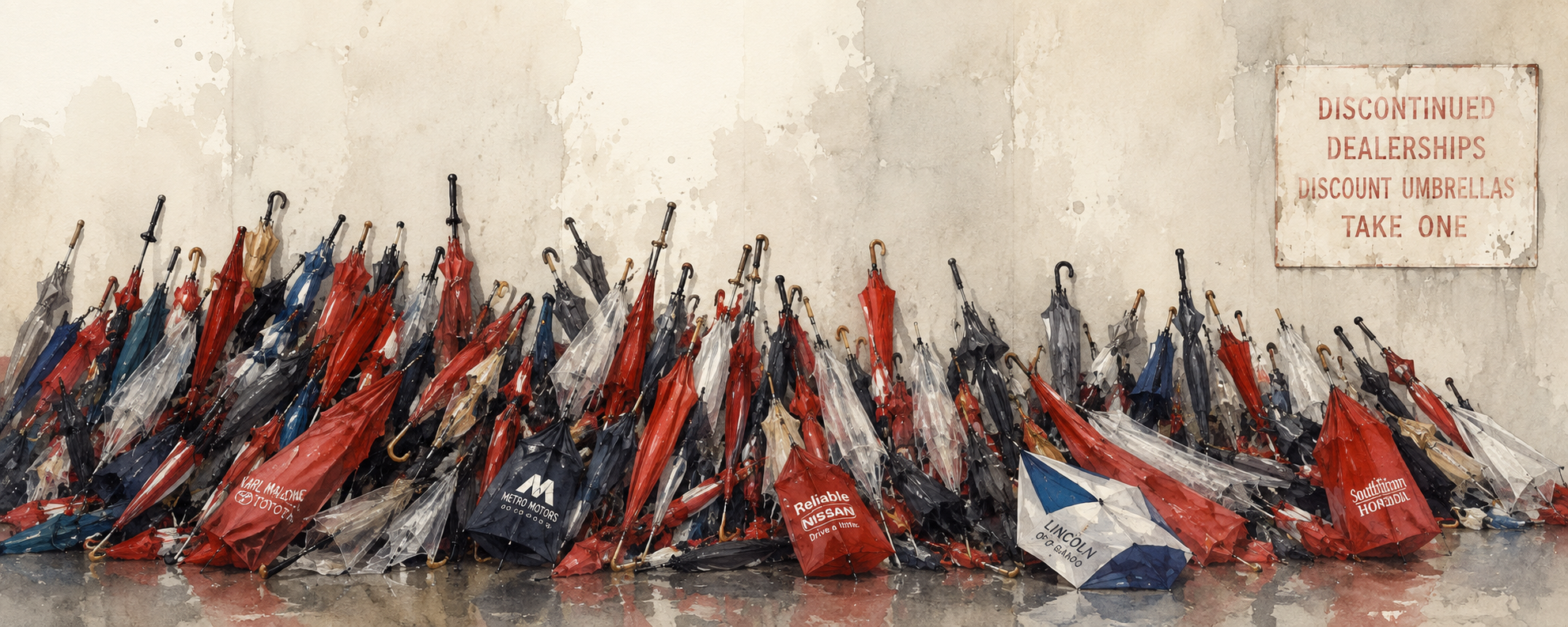
Frank died that winter, peacefully according to the obituary, although I’ve always suspected “peacefully” is simply what newspapers print whenever the actual story isn’t fit for breakfast reading, and because he had no children the neighbors helped clean out his garage, which is where I discovered enough umbrellas to protect a small nation.
Hundreds of them.
Golf umbrellas.
Tiny folding umbrellas.
Bright red ones.
Transparent ones.
Cheap promotional umbrellas from car dealerships that no longer existed.
I thought maybe he’d been collecting them the way some people collect stamps until another neighbor smiled and said, “Oh...Frank gave them away.”
“What?”
“Whenever it rained.”
Apparently that had been his thing for years. If somebody looked stranded, he handed them an umbrella. Sometimes they returned it. Usually they didn’t. Every so often another one would appear on his porch with a thank-you note tucked inside, and whenever that happened he’d simply place it back in the garage to wait for the next storm.
I inherited them, although “inherited” feels too formal for several hundred umbrellas that technically belonged to nobody in particular, and now I keep six or seven in the back seat of my truck because eventually traditions choose you whether you’re ready or not.
I think we’ve become obsessed with grand gestures because they’re easier to photograph than consistent ones. We imagine that changing the world requires wealth or influence or TED Talks, when in reality civilization survives because millions of ordinary people quietly perform microscopic acts of maintenance that never appear in history books. Somebody returns a shopping cart. Somebody shovels an elderly neighbor’s sidewalk. Somebody notices you’re carrying too many grocery bags and holds the door a second longer than etiquette technically requires.
The universe, as far as I can tell, is held together with embarrassingly small kindnesses.
I never became a therapist. Maybe I would’ve been good at it. Maybe I’d have burned out listening to people confuse discomfort with tragedy for eight hours a day.
Instead I became something considerably less official and probably more useful, because every storm reminds me that most people aren’t actually looking for someone to solve their lives. They’re looking for proof that they haven’t become invisible.
An umbrella doesn’t fix unemployment.
It doesn’t repair marriages. It doesn’t cure loneliness or erase grief or convince your father to finally admit he was proud of you. It just keeps you dry long enough to get where you’re already trying to go.
Maybe that’s all any of us are ever really doing for one another, keeping each other dry for another block.
Long enough to reach somewhere better.