One of the interesting pieces of information from the Free Press podcast The Witch Trials of JK Rowling is early on when Rowling, long before being branded a TERF and attacked en masse by the bizarre misogyny of the trans activists online, joins an early chat room for fans of her books.
She joins anonymously. She discovers that these young fans of her books that espouse the horrors of bullying and exclusionary behavior are bullies within their own ranks. If someone joins as a newbie and doesn't quite know the specifics of the books, they are shamed out of the chat room as posers or false fans. Ask the wrong question, get the order of the houses wrong, and the piranhas came out to tear bone from flesh in a digital sense.
"I got teased my entire school life. What they were picking on I don't even understand. It was my skin color. Then when I got older, it was about my breasts." — Rihanna
"Being teased for being ugly, having a big nose, being annoying.'Your laugh is funny, you're weird, why do you always sing, why are you so into theater, why do you do your make-up like that?'
"I used to be called a slut, be called this, be called that, I didn't even want to go to school sometimes." — Lady Gaga
Comedian Chris Rock calls being bullied "the defining moment of my life. . . it made me who I am." He told BET in 2014 that his experience as the only Black kid in his grade "for most of the time" contributed to the abuse. On Inside the Actor's Studio in 2007, Rock thanked the boys that “kicked my ass, spit in my face, and kicked me down the stairs” for making him the man he is today. He doesn't specifically thanks the kids who threw "water balloons with poo" at him, but that happened, too. He later turned his experiences into the sitcom Everybody Hates Chris, which he says is all true: "I got beat up just about every day. I got called [the word that can't even written out it's so reviled but starts with an 'n' so now you just said it in your head] every single day."
"I was bullied quite a lot when I was growing up in my Peking Opera School. I allowed myself to be bullied because I was scared and didn't know how to defend myself. I was bullied until I prevented a new student from being bullied. By standing up for him, I learned to stand up for myself." — Jackie Chan
What we fail to recognize (or admit) is that we are all bullies depending on the circumstances and our personal rationale of righteousness. To be human is to use whatever power you can gather to put down your perceived enemies. The more enemies you see, the greater potential you will unlock that bully superpower and reign hell upon as many of them as possible.
The reason Robert Louis Stevenson's Jekyll/Hyde tale (or Stan Lee's Hulk take on the same story) resonates is that each of us knows intuitively that we have that Hyde part of our brains. Like poverty, wherein it would only take two or three bad decisions to lead most of us to be living inside a box under an overpass, the inner cruelty within each one of us only takes two or three misfortunes to lead us into joining a mob to destroy someone we hate or, like Michael Douglas in Falling Down, find ourselves too far down the Hyde road to ever turn back.
When I was a kid the only thing worse than being bullied was tattling on the bully—seeking authority to deal with the problem. Appealing to a teacher was an admission of weakness.
Given that I was the perpetual new kid at every school I attended until eighth grade, there was always that kid for whom I felt a burning envy. It was the cool kid. The kid with a lot of friends who could hold court. The kid with a really cute girlfriend. The kid with newer clothes and better shoes.
When we landed in Peoria, AZ, there was a huge presence in our neighborhood of Cub Scouts. I used to troll around my neighborhood and beat up Cub Scouts regularly.
It wasn’t that I hated the Scouts. I admired them. I wanted to be them. They were a group to which I couldn’t belong because, in order to be a Cub Scout, your mom had to be able to buy you the required uniform. No uniform, no admission to the club. They would gather together in those uniforms and laugh and do activities together. They compared merit badges and were thrilled when someone received a new one.
At the time my mother was working several jobs and had had her only vehicle repossessed by her ex-husband. She wouldn’t allow us to refer to our tiny family of three as poor. We were broke but never poor, she would tell my sister and I. But the sting of exclusion due solely because of our brokeness felt bad. It felt unfair, unjust. This exclusion pissed me off in ways I was unprepared to understand.
So I used to walk around the neighborhood and start fights with Cub Scouts. Sometimes there were a couple together and my unbound rage would still pick the fight and I’d come home beaten but not deterred. More often than not, I’d encounter one of them blithely headed home or to school or to a Cub Scout meeting and just beat the living shit out of this blameless kid whose parents had the cash to shell out for something beyond my reach.
It was the poison of envy, the venomous result of jealousy, the baneful consequence of comparison.
I can only imagine what a horror it must be to be a chubby kid looking at countless pictures of bodies in better shape, lit for maximum appeal, on beaches, and in forests. Beautiful, thin people enjoying a hunk of cheese in Paris or a plate of pasta in Rome. As if advertising wasn't a noxious enough monster, social media is designed to foment envy.
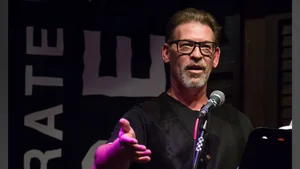
I've told the story of beating up Cub Scouts onstage and the resulting opinion is usually that I was a real cunt as a kid. That pummeling other kids because their parents had more money than my mother was the move of a true cocksucker, a jackass of nearly epic proportions. "Maybe you shouldn't tell that story," mentioned the producer of The Moth. "It makes you seem like such a bully."
He was right. It does.
Bullies exist for a myriad of reasons but our response to them is the lockstep of self improvement. Without those bullies, we don't learn in our bones to stand up for ourselves, to refine our sense of right and wrong, to build the emotional muscle to handle the pressure.
Why decide to improve yourself when you can go online and shit all over anyone with a Cub Scout uniform? Who has the time to drop a few pounds, get a haircut, learn something new, create something unique when you're spending five or six hours a day looking at people you deem better than you in comparison and deserving of some sort of punishment for no other reason than your butt-hurt feelings?
I was a bitter little asshole beating up those whom I suffered in comparison. I allowed, at eight years old, my station in life to determine a path of feeling that life was just so goddamned unfair that I would let my unrestrained anger at those I deemed culpable for the injustice run wild. At the time I was told by school counselors and my beleaguered mother that it was simply unacceptable that I take out my malevolence upon kids with (what I saw as) rich parents. I was told and ultimately taught to channel that anger into bettering my situation, taking responsibility for my station in life, and leaving the other kids alone.
I was taught that those who let poverty and deprivation define them would always feel maligned by life and that there would always be people who had more than I did. Learn to make the most of what you have rather than punish those with more. Poverty was not a liability but merely an obstacle to circumvent and that rage was like taking a hammer to a wall that couldn’t be broken, only climbed over.
As I grew older, I held onto these lessons yet I still had the anger.
By the time I got to seventh grade my sense of injustice became a bit more refined, though it still resembled a bludgeon rather than a scalpel. I found in my tendency to be a genuine smartass to a group of Latino kids who decided the band nerd with the big mouth was deserving of his own beat down. One fall day, when Victor Rodriguez (who was a small seventh grader but who held great influence on a grouping of much larger boys) was terrorizing a couple of other band kids, I crudely made fun of his size.
Later that day, two of his bigger comrades beat me in the hallway and, in a bizarre stereotype of a nerd versus bullies scenario, stuffed me in my locker. I cried for help for twenty minutes until a teacher let me out.
Thus began a months-long campaign between Victor and his allies to find opportunities to beat me up routinely. Every week I came home with another injury and every week my poor mother was furious. She went to the vice principal a number of times to complain but he was already so overloaded with similar situations, mine became just one more skirmish on the pile.
He often explained that Victor came from a broken home and that his mother was working several jobs. His brother was in prison and he was “acting out” as if this all comprised a solid excuse for he and his buddies pummeling me. My mother never explained that she was divorced, also working several jobs, and that I wasn’t beating anyone up (anymore...). I had, apparently, learned some sort of lesson from my days as the Cub Scout Bully and my mom was not in the habit of making excuses for me. She was raised by a man who told her “Even a good excuse is still just a fucking excuse.”
One day, Victor and his gang chased me home from school and I ran into the house. Mom was so angry, she chased the boys away in her nightgown, brandishing a chrome vacuum extender. After, she gave me the metal tube and told me to defend myself.
I kept it in my locker. It was more a reminder that I could use it not that I would. Then, a few weeks later, when Victor stole my science textbook and started ripping pages out of it for fun, I did use it.
Victor’s mother was, of course, furious and explained that he was poor and brown and didn’t deserve to be hit with a pipe. His bullying wasn’t his fault, she snarled. It was society’s. When the vice principal furiously asked my mother what she was going to do about this (holding up a slightly bent chrome tube with a bit of blood on it) my mother defiantly replied “I’m gonna get him another sweeper piece.”
Still years later, as a young middle school teacher, I was positioned in a school on the west side of Chicago surrounded by kids like Victor. The overwhelming stories of fathers, uncles, and brothers in prison, of single mothers working multiple jobs, of clothes handed down for three sets of children were coupled by a split population in response. Most of the kids seemed to do their best at school and in their lives, learning what they could, engaging in the social experiment of American school. Others were just like me when I was terrorizing Cub Scouts except now they were in gangs.
These kids I understood.
Later, in high school, I had slowly developed into the role of the biggest nerd on the campus. I was in debate, hung with three other boys who were the smartest kids in school, did theater, band, and choir. I was, on the other hand, as big as many of the athletes so it was my duty to protect my nerd friends from the bullies. If high school was filled with random versions of Chris Makepeace, I was a more chatty Adam Baldwin in an odd version of 1980's My Bodyguard.
Without having been a bully to the Cub Scouts and being bulled by Victor, I wouldn't have had the experience of understanding my Hyde in relationship to my Jekyll.
Bullies are not only the obstacles that force us to live with that duality, they are necessary. If a kid crumbles from being mobbed upon while on the strange horrorshow known as social media, he hasn't built up the emotional resilience required to live in the world of human beings, all equally Jekyll and Hyde in turns.